A Look Back at Boynton in 1914

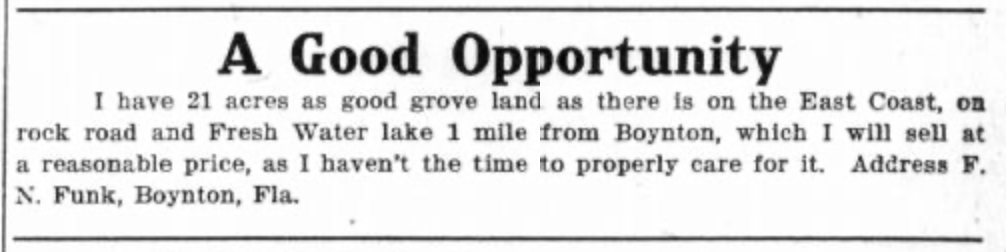
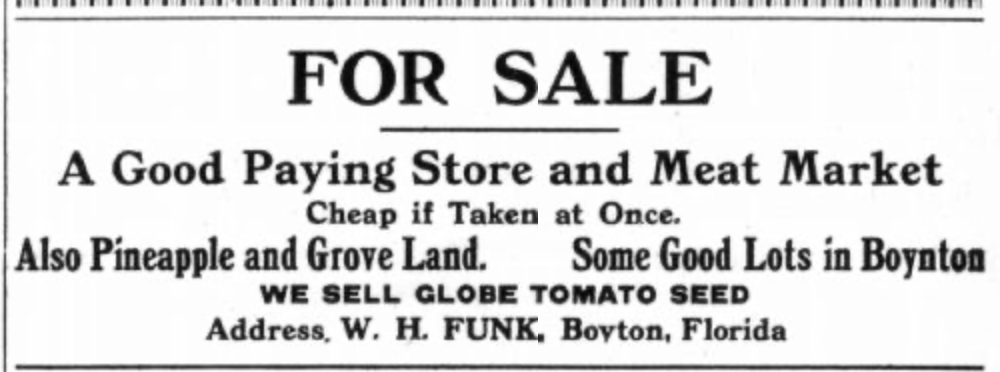
A look at Boynton’s business ads from 1914 shows a town grounded in farming and steadily growing into a permanent community.

Plenty of Cheap Land

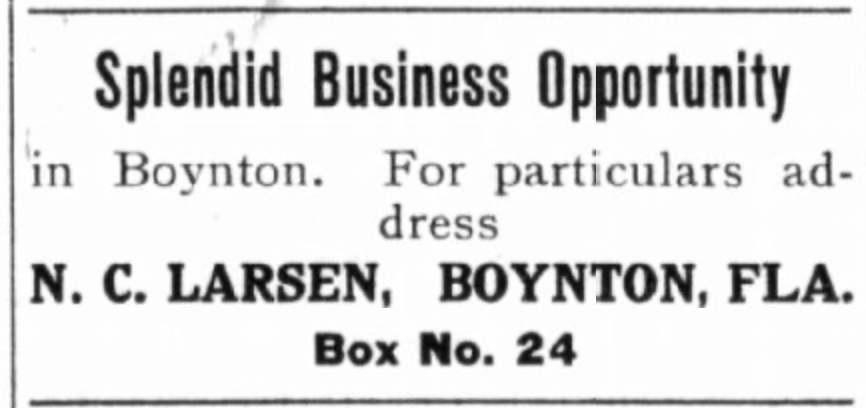
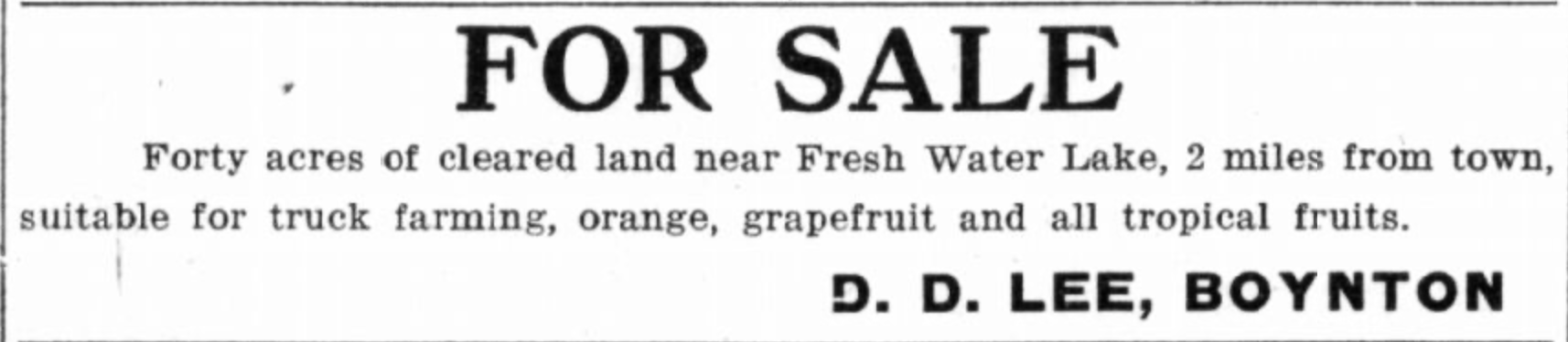
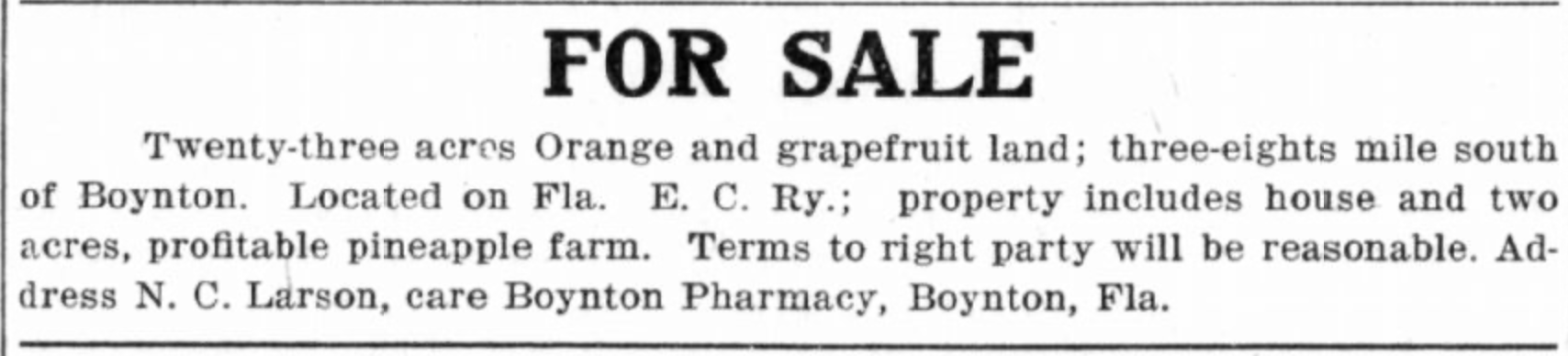
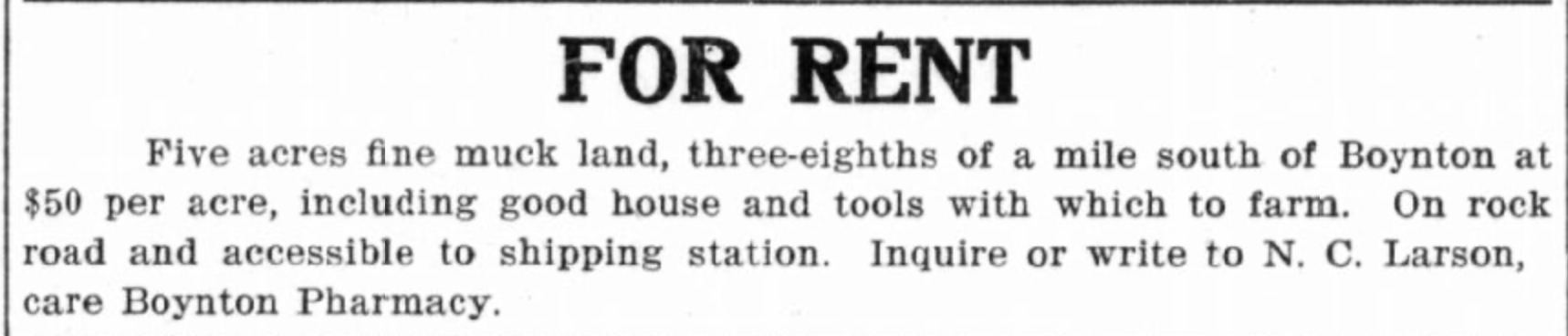
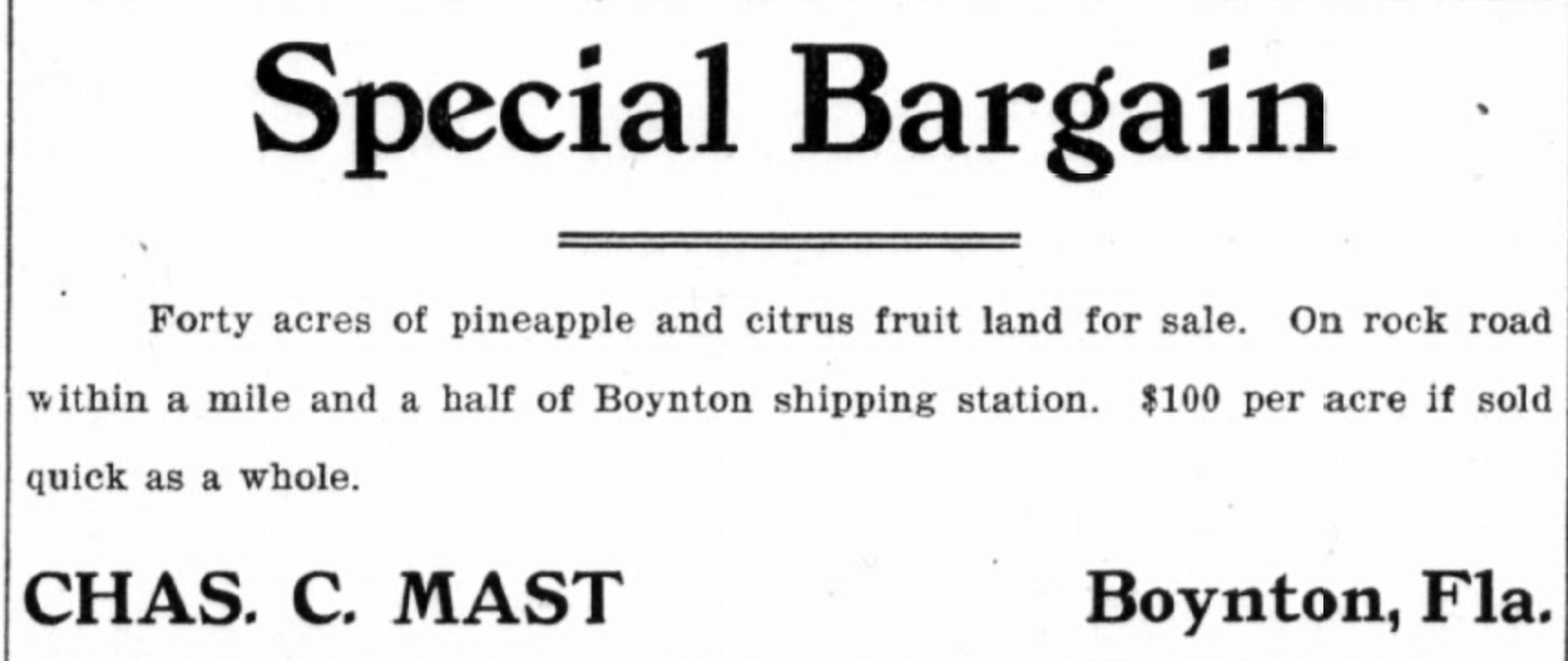
Land was actively being bought, sold, and rented. D. D. Lee offered 40 acres near Fresh Water Lake (Lake Boynton) suited for truck farming and citrus, while Chas. C. Mast promoted pineapple and citrus land close to the shipping station. N. C. Larsen handled grove property and muck land, reflecting the demand for productive acreage.

Clearing the Land

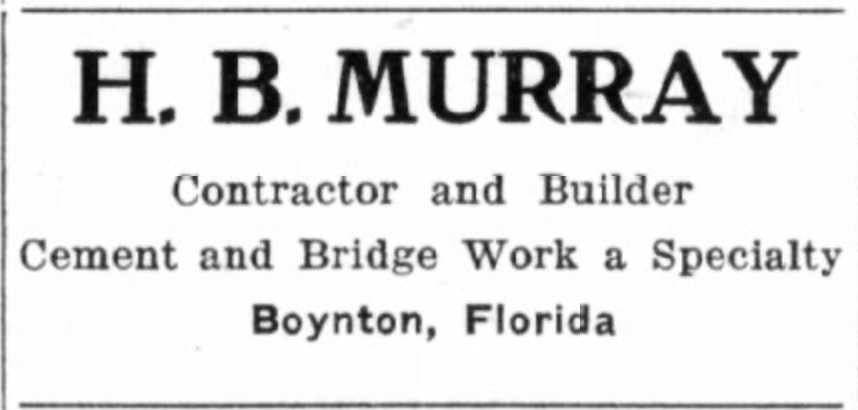
Supporting this farm economy were essential local services. A. L. Fuller provided heavy hauling, W. F. Riddle managed teaming and lighterage for muck and marl, and contractor H. B. Murray helped transform cleared land into working farms and homes by building homes and even bridges.

Shopkeepers

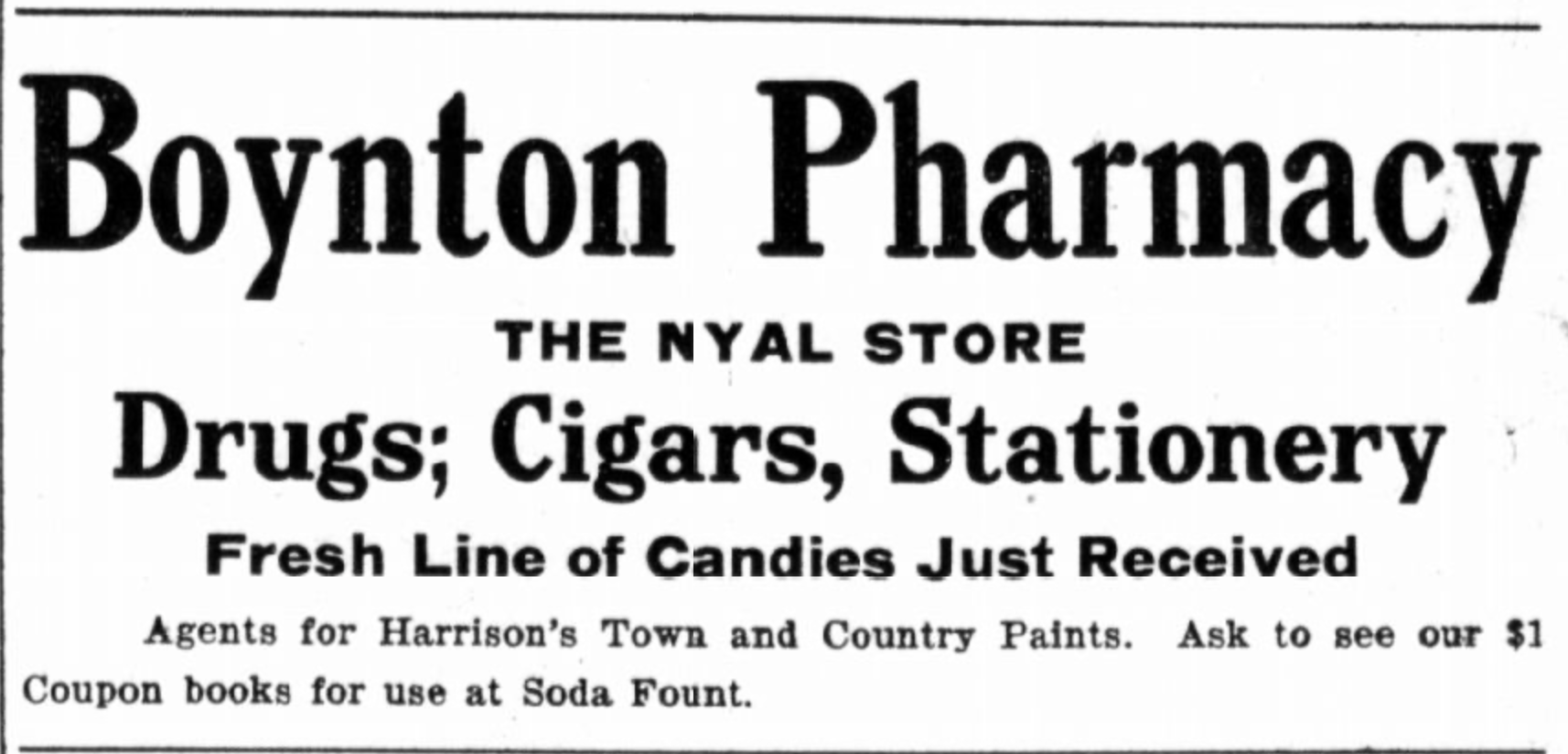
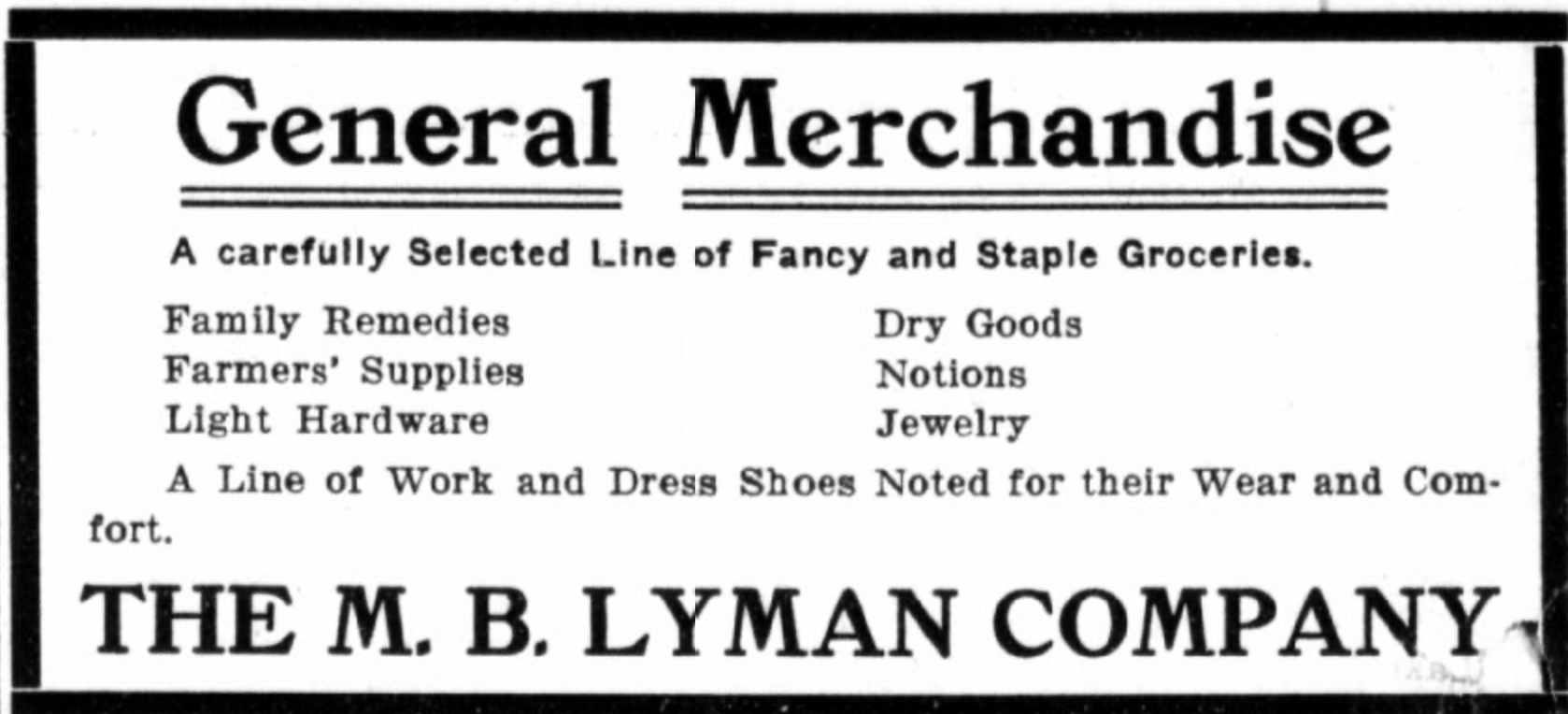
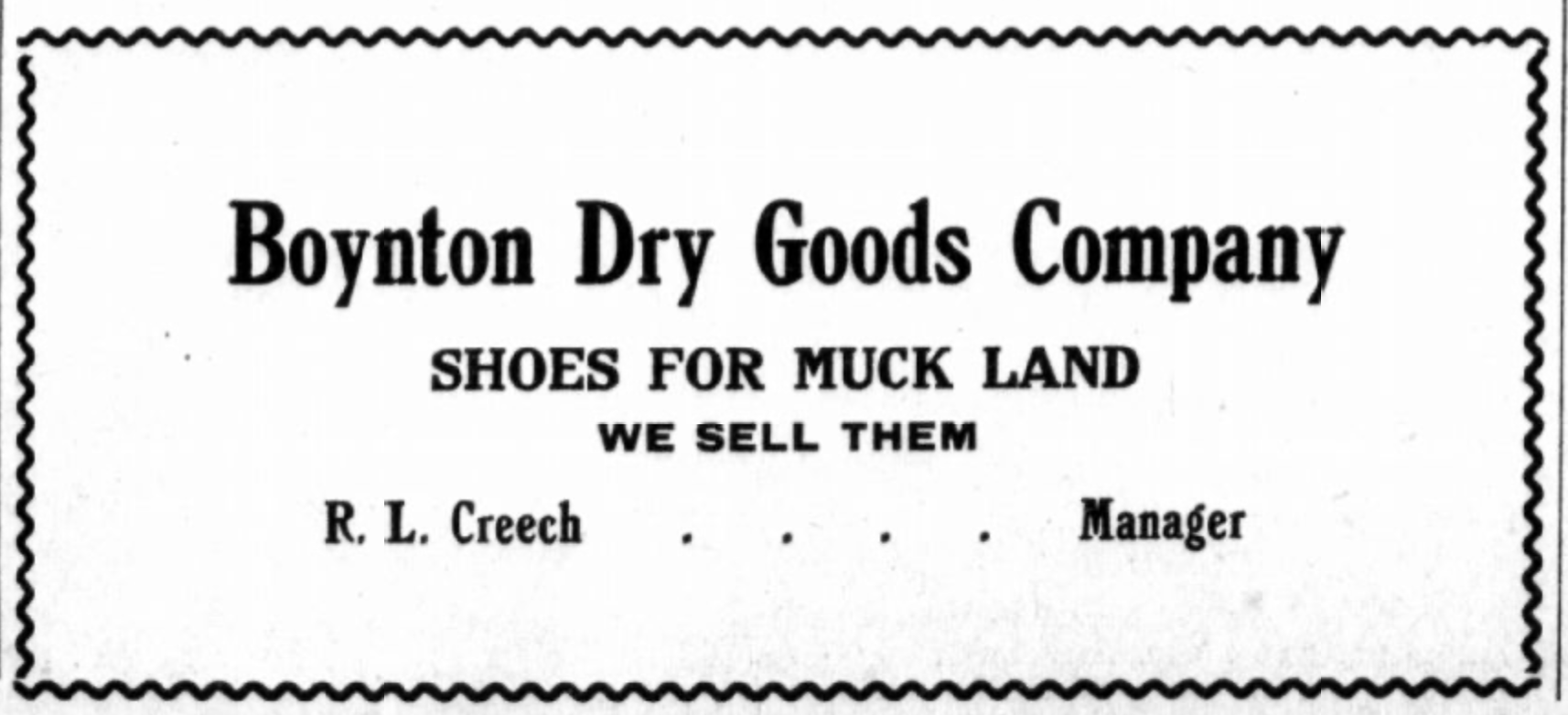
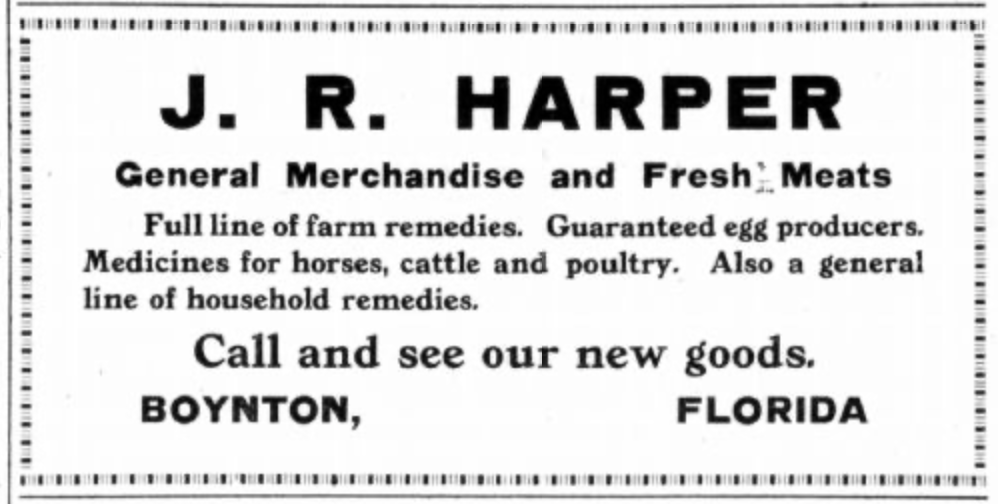
Merchants supplied both household and agricultural needs. J. R. Harper sold general merchandise, fresh meats, and livestock remedies, while the M. B. Lyman Company stocked groceries, dry goods, shoes, and hardware. The Boynton Pharmacy — the Nyal Store — carried medicines, paints, cigars, stationery, and candy.

Rooms for Rent

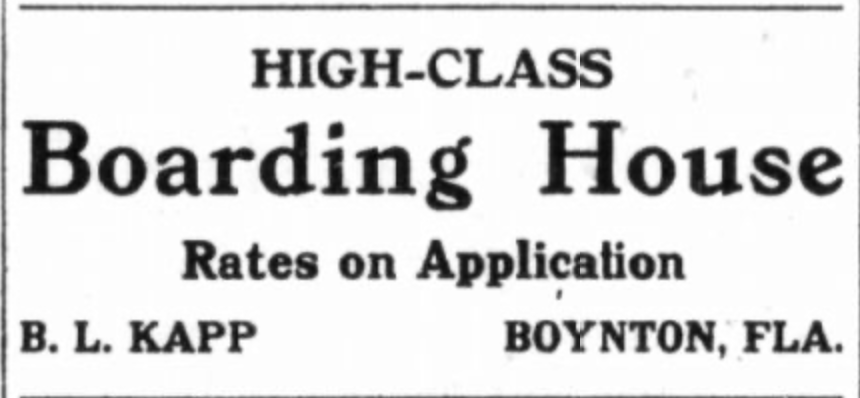
Hospitality and everyday life were also part of the picture. Hotel Vera, operated by J. F. Triplett and W. G. Keller, provided lodging and meals, while Holmes’ Amusement Parlor offered pool and billiards. Charlie A. Carter sold sprouted coconuts and even advertised a small bachelor home.

Early Developers

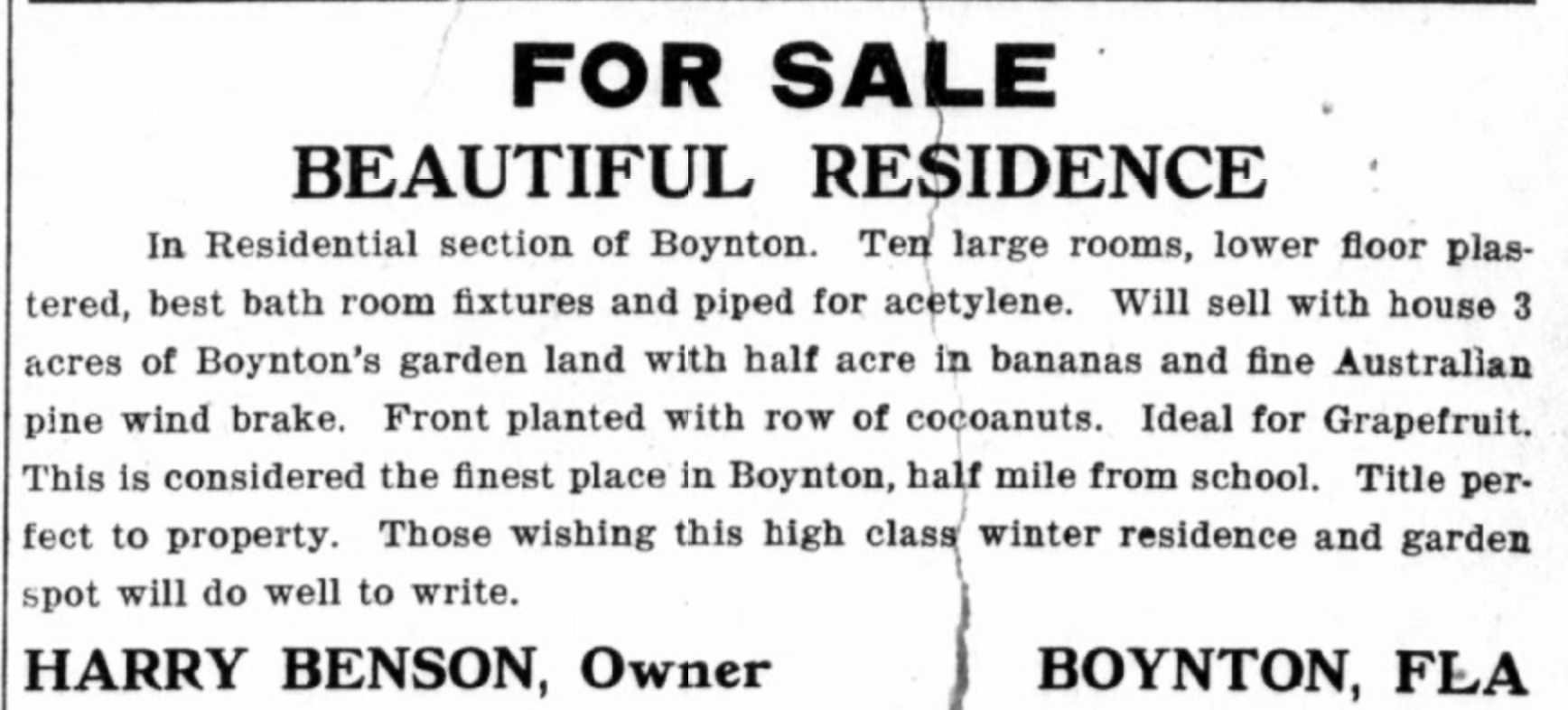
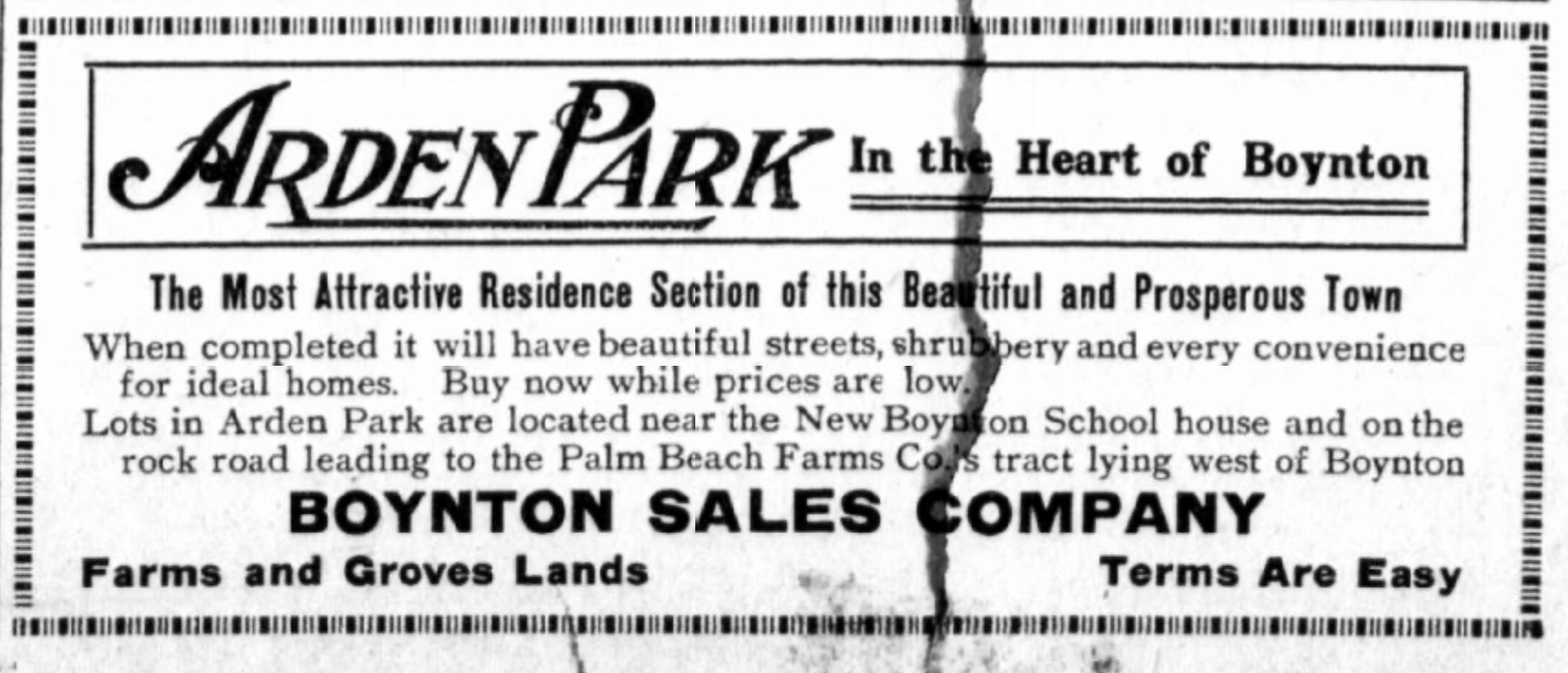
Developers were promoting Boynton’s future. Arden Park was marketed as a planned residential section near the school, and Harry Benson offered a winter residence on garden land.

These ads reflect a working agricultural town supported by tradesmen, merchants, builders, and land developers, a place where both business and community life were firmly taking hold.

Source: January 8, 1914 Lake Worth Herald


Pioneers of Boynton: Samuel B. Cade and Alonzo L. King

Did your ancestors farm in early Boynton? If you have old photos of early families like Cade, King, or others, please contact us. These stories should be documented, and shared with future generations.

Long before the formal establishment of the Town of Boynton, the area that would become Boynton Beach was a frontier landscape of palmetto scrub, tall grasses, and untamed farmland. Among its earliest settlers were two African-American families whose contributions helped lay the foundation for the community: the families of Samuel B. Cade and Alonzo L. “L.A.” King.
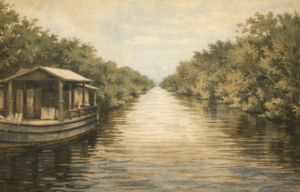
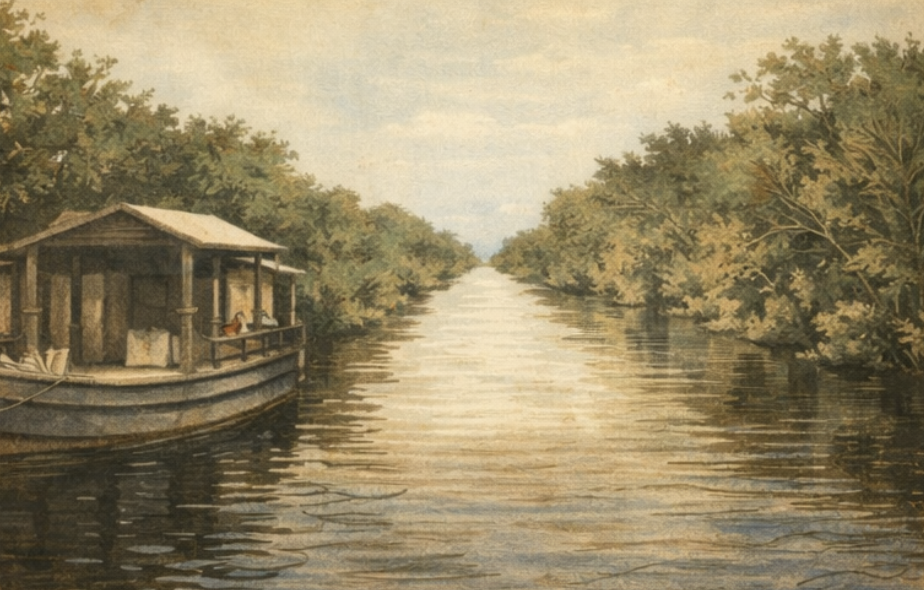
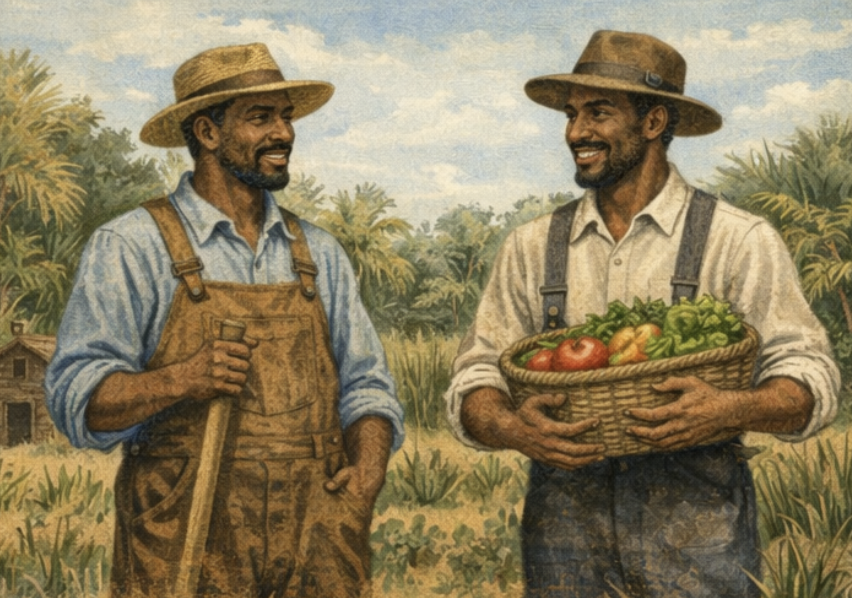
Boynton Canal, 1890s (AI Reimagined)

Farmers, Landowners, and Community Builders

Samuel B. Cade and Alonzo L. King were working farmers who transformed raw land into family farms. Through determination and labor, they established homesteads, raised families, and contributed to the region’s early economy. When new white settlers from Michigan arrived, Mr. Cade and Mr. King taught the newcomers best practices for farming in the unfamiliar sandy soil.
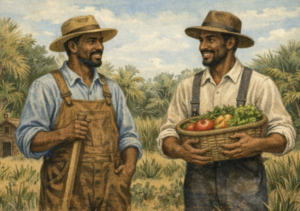
Early African American settlers (AI Reimagined)

Both men brought with them experiences shaped by the post–Civil War South. Samuel B. Cade, born in Georgia in 1852, came of age during Reconstruction. Alonzo L. King, born in 1862 in Virginia, later migrated southward to Florida as part of broader patterns of African-American movement in search of land and opportunity.

Alonzo drove the surrey for the Boynton Hotel owned by Nathan Boynton and Albert & Annie Parker. Samuel Cade lived and farmed nearby, building his household alongside other early settlers. Alonzo King’s son Willie worked as a bell boy in the hotel, and later became a cook.

Census records from 1910 list both men as heads of household in Boynton, identified as farmers and neighbors. Their families were part of a tight-knit agricultural community that contributed materially and socially to the area’s growth.

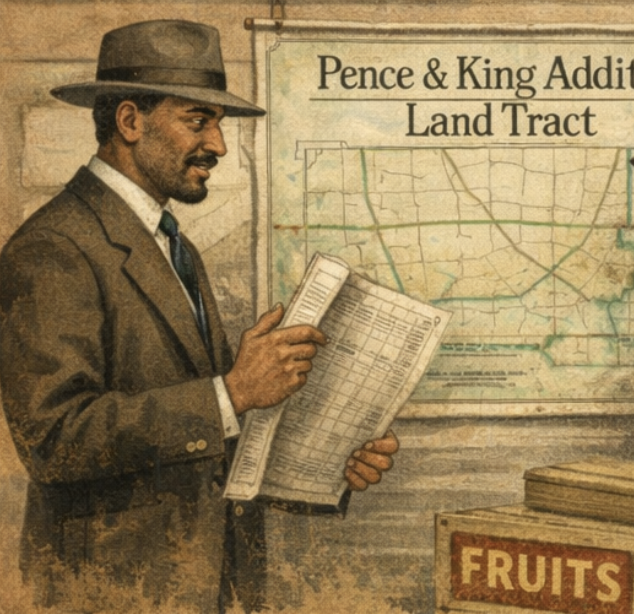
Alonzo King became a landowner of particular note. Historical records indicate his involvement in the development of the Pence/King Addition, a tract created for farming and settlement in partnership with local fruit shipper Cullen Pence. King’s name appears in county commission proceedings during the early twentieth century, reflecting a level of civic participation not always recognized in accounts of early Boynton history.
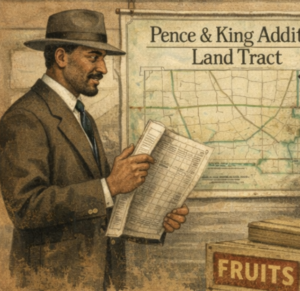
Pence & King addition (AI Reimagined)

Together, the Cade and King families formed part of a small but significant African-American farming community in the area.

Before the Town Was Platted

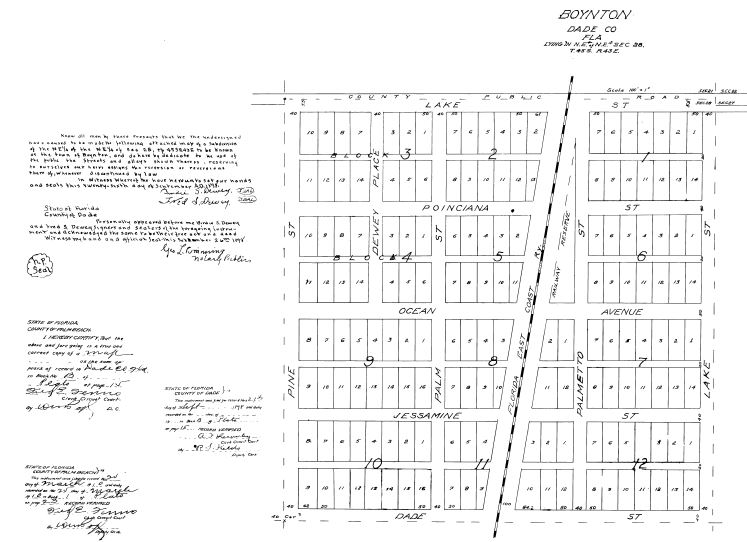
In 1898, Fred Dewey and Byrd Spilman Dewey officially platted the Town of Boynton. However, evidence suggests that Samuel Cade was already living and farming in the vicinity by the mid-1890s, and Alonzo King and his family were also established in the developing settlement.
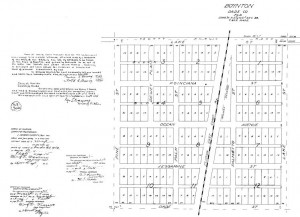
Plat for the Town of Boynton

The birth of King’s son William in what is now called Boynton in 1884 — prior to the town’s formal platting — underscores the presence of African-American settlers before the arrival of many later residents whose names are more commonly recorded. Their story broadens our understanding of who the true pioneers of Boynton were.

Later Years and Legacy

In the 1910s, Alonzo King relocated to Jacksonville, where he worked as a mason, carpenter, and laborer until his death in 1918. Samuel Cade remained in Palm Beach County, continuing to farm and raise his family until his death in 1924.

Today, as we reflect on Boynton’s origins, it is essential to recognize that African-American pioneers such as Samuel B. Cade and Alonzo L. King were not peripheral figures in the town’s development. They were foundational settlers — farmers, landowners, parents, and citizens — whose labor and resilience shaped the community long before it was formally incorporated.

Their legacy remains an integral part of Boynton’s shared history.

There are no known photographs of Samuel B. Cade or Alonzo L. “L.A.” King. The images included here are modern artistic renderings created with the assistance of ChatGPT. They are based on historical records, census data, and documented details about early Boynton’s landscape and agricultural life.

These illustrations are meant to help readers visualize what Boynton looked like in its earliest days — a sparsely settled frontier of palmetto scrub, waterways, dirt paths, and small homesteads carved out by hardworking families.

If you or your family have photographs of the Cade or King families — or of other early African-American settlers in the Boynton area — we would be honored to scan them. Preserving and sharing these images ensures that the full story of Boynton’s pioneers is remembered and passed on accurately for future generations.

Genealogy Timeline

1852 – Birth of Samuel B. Cade

  • Born in Georgia.
  • Grew up during Reconstruction, learning farming and resilience skills that would guide his family to Florida.

1862 – Birth of Alonzo L. King

  • Born in Prince William County, Virginia.
  • Would later migrate south to Florida, joining other African-American settlers in the developing region.

1883–1888 – Births of Alonzo King’s Children

  • 1883: Anna King born in South Carolina
  • 1884: William King born in Boynton, Florida — before the town was officially mapped
  • 1888: Pembrook King born in Kings Ferry, Nassau, Bahamas — showing the family’s regional mobility

1895 (Approx.) – Samuel Cade in Boynton

  • Evidence suggests Samuel Cade was living and farming in Boynton.
  • He was part of the small African-American farming community that predated the official town plat.

1898 – Boynton Town Plat

  • Fred and Byrd Spilman Dewey officially platted the town of Boynton.
  • Samuel Cade and Alonzo King were already living and farming nearby, showing African-American pioneers were foundational to the community.

1906–1907 – Alonzo King as Landowner

  • Newspaper records list Alonzo King as a landowner in Boynton.
  • Attended county commission meetings, demonstrating civic involvement.
  • Partnered with Cullen Pence, a major fruit shipper, to develop the Pence/King Addition, expanding settlement and agricultural plots.

1910 – Census Snapshot

  • Samuel Cade: Head of household, Black farmer, Boynton resident.
  • Alonzo King: Head of household, Black farmer/landowner, Boynton resident.
  • Both families were neighbors and part of a tight-knit early African-American farming community.

1915–1918 – Later Years

  • Alonzo King moved to Jacksonville, working as a mason/carpenter/laborer, dying in 1918.
  • Samuel Cade remained in Palm Beach County, farming and raising his family until his death in 1924.
Hoffman’s Chocolates: A Sweet Tradition

Hoffman’s Logo

Hoffman’s Chocolates has been a beloved part of Palm Beach County for over 45 years, offering delicious chocolates that have made sweet memories for locals and visitors alike. I first visited the Lake Worth store back in 1987, and I still remember the wonderful smell that filled the air—chocolate, sugar, and and other yummy sweets. It was a scent that stuck with me for years.

The original store in Lake Worth was small but full of charm. It quickly became a favorite spot in the community, known for its high-quality chocolates and its focus on using the best ingredients. I especially loved the chocolate-covered pretzels, which I often gave as gifts. They were the perfect mix of salty and sweet, and everyone I knew loved receiving them. During the holiday season, Hoffman’s really shined. The Christmas decorations, the Winter Wonderland displays, and the beautiful holiday lights made the store feel magical. It was a tradition for families, tour groups, and individuals to visit, and over 50,000 people would come by during the holiday season to see the massive facility and pick up some gourmet chocolates.

The company grew over the years but kept its personal touch. Founder Paul Hoffman’s handwritten recipes were still used to make each chocolate, keeping the quality and tradition alive. Paul originally bought a small chocolate shop in Lake Worth in 1974, borrowing $1,400 from a friend. His goal wasn’t to make a lot of money but to create a business where he and his family could work together, making delicious chocolate and living a fulfilling life. Over the years, Hoffman’s produced nearly 4 million pieces of chocolate each year, with more than 1,200 products, including over 150 types of truffles. The company used over 100,000 pounds of almonds and pecans each year, and during the busy winter season, production would reach thousands of pounds daily.

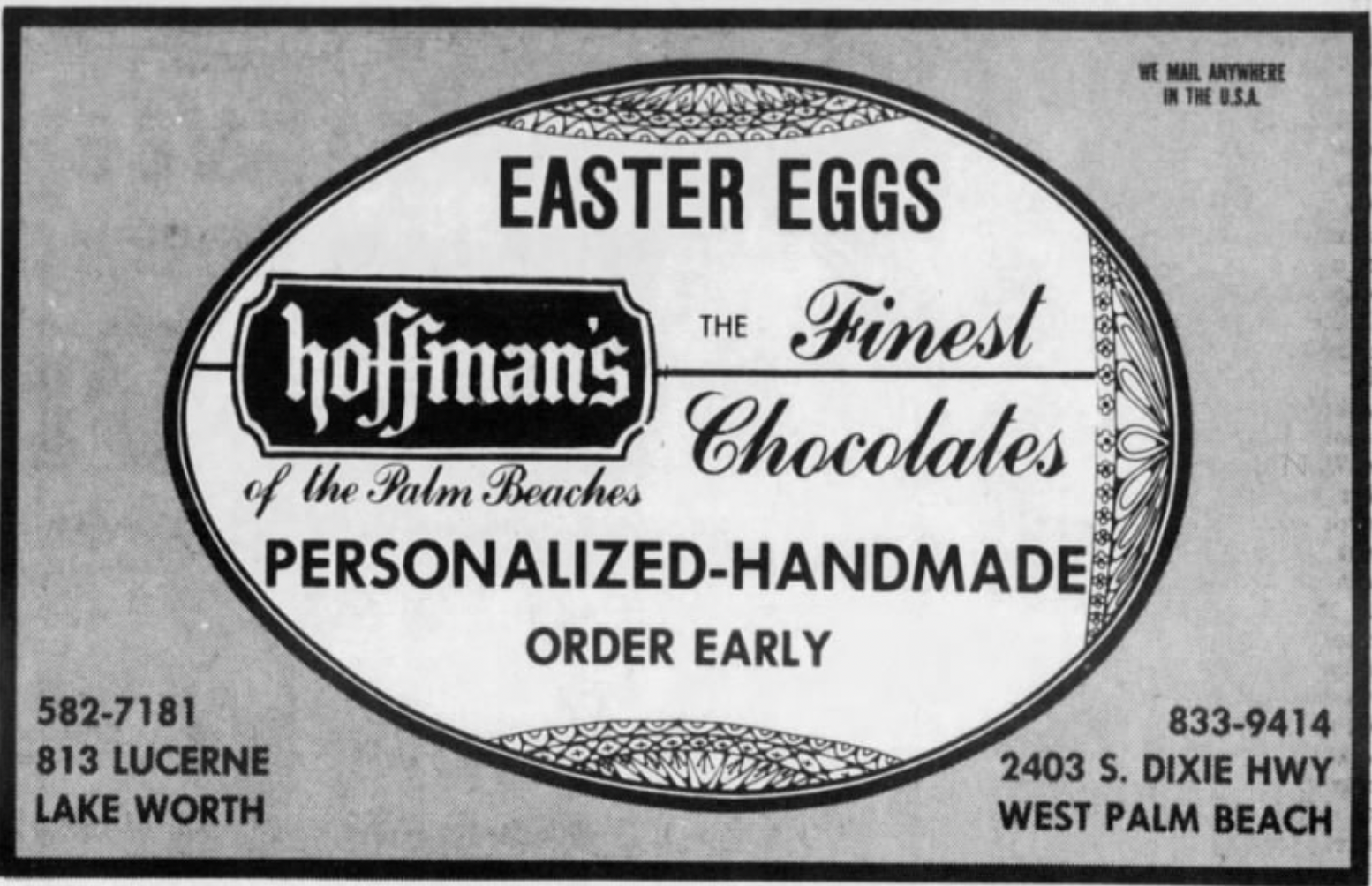
Hoffman’s was highly respected in the chocolate world. Bon Appetit called it “one of America’s finest chocolate shops,” and The Wall Street Journal named their Easter basket the best in the nation. Their commitment to quality was clear, and it seemed like Hoffman’s Chocolates would always be a part of Palm Beach County.

Hoffman’s 1979 Palm Beach Post ad

But in 2013, theHoffman family sold the business to BBX Corp., and things started to feel different. BBX had big plans for the company, focused on expansion, but in doing so, much of the charm and personal touch that made Hoffman’s special seemed to disappear. The small, cozy storefronts were replaced by a more corporate approach, with new locations opening, production moved to Orlando, and the focus shifting away from quality and customer service.

One of the hardest parts for many locals was the loss of the Christmas Holiday Lights. For years, the lights and festive decorations were a major attraction, but after the sale, that tradition faded. The magical experience of visiting Hoffman’s during the holiday season was no longer the same. The business felt less personal, and the community connection seemed to weaken.

With BBX focusing on growth, it’s hard to say what the future holds for the Lake Worth location. It’s possible we could see condos or another type of development in its place soon. The changes to Palm Beach County are clear, and it’s sad to think that the place that once smelled so sweet might soon be gone.

For now, we’ll hold on to the memories of those sweet smells, the festive lights, and the chocolates that were once a part of the community’s heart. Whether or not Hoffman’s Chocolates can return to its roots and bring back the charm that made it special is unclear, but the memories will always remain—a time when chocolate-covered pretzels, holiday decorations, and a local favorite made life a little sweeter.

Boynton Woman’s Club Founder & Civic Organizer: Cora Stickney Harper

Boynton Woman’s Club Founder & Civic Organizer: Cora Stickney Harper

Cora Stickney, 1880, Wellesley College Archives.

Meet Cora Stickney Harper, founder of the Boynton Woman’s Club.

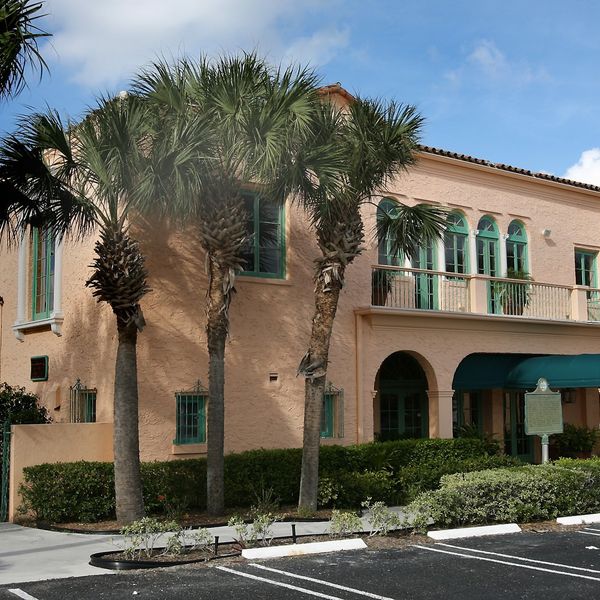
Boynton Woman’s Club 2nd Clubhouse, 1010 Federal Highway.

While relatively unknown today, this extraordinary, selfless woman left an indelible mark on the fledgling Boynton settlement. Her unique upbringing, progressive actions, generous spirit, and charitable endeavors make her story both noteworthy and significant to Boynton history.

Cora Harper, Wellesley College, 1879

Cora Stickney Harper was an influential early resident of Boynton Beach whose generosity and spirit have left a legacy that endures to this day. Born into a well-to-do family, Cora graduated from Wellesley College in 1888. Wellesley’s archives describe her as possessing a great joy for living, wit, and a fun-loving nature.

Cora Stickney, 1879, Wellesley College Archives.

However, her life was marked by tragedy. In 1897, her father, a cashier at the Great Falls National Bank for 35 years, was murdered during a bank robbery. Despite this loss, Cora was left financially secure. She wintered in Florida to convalesce from the tragedy. At a sanatorium near Merritt Island, she spent months reading, painting outdoors (en plein air), and bathing in the healing mineral springs. There she met Charles Thomas Harper, who was the local mail carrier.

Charles Thomas Harper, ca. 1905

In 1901, Cora and Charles married in Savannah, Georgia. Afterward, the couple moved to Boynton where Charles was an agent for the F.E.C. Railway and Southern Express Companies in Boynton, with a sprawling family of sisters, nieces, and nephews. Intriguingly, Cora understated her age on their marriage certificate, claiming to be 25 years old when she was, in fact, 42.

Cora quickly immersed herself in community life. She became one of the founders of the Boynton Woman’s Club in 1909, alongside her husband, who helped facilitate the purchase of land at the southeast corner of E. Ocean Avenue and SE 4th Street for the club. The Harpers offered the club a low-interest mortgage, demonstrating their commitment to its success.

In addition to her contributions to the Woman’s Club, Cora took steps to improve educational opportunities for local youth. In 1911, she arranged for Boynton’s young people to attend high school in West Palm Beach, as Boynton lacked its own high school at the time.

Ella Harper (left) and Cora Stickney Harper (right) after Ella’s 1913 graduation from Palm Beach High School

Cora’s civic engagement extended beyond Boynton. She became a charter member of the Daughters of the American Revolution (DAR) Evergreen Chapter in Miami in 1909. On the 1910 U.S. Census, she listed her age as 42, again understating her actual age of 51. In 1913, Cora and her husband moved to Fort Pierce, where she founded the Aiseehatchee Chapter of the DAR in early 1914.


Tragically, Cora passed away on November 1, 1914, at St. Andrew’s Episcopal Church. In recognition of her contributions, the DAR chapter in Fort Pierce was renamed the Cora Stickney Harper Chapter, National Society Daughters of the American Revolution.

Cora’s legacy extended through her last will and testament, which reflected her lifelong dedication to education and family. She left monetary gifts to her sisters-in-law and nieces, contingent upon their completion of their education, and donated $2,000 to the Wellesley College Students’ Aid Society.

Her husband, Charles T. Harper, remarried in 1916 and relocated to Homestead, where he served as the town’s mayor. Sadly, Charles and his daughter were killed in a car accident involving a speeding ambulance.

Cora Stickney Harper’s life was one of resilience, leadership, and generosity. Her contributions to Boynton and beyond—from founding the Boynton Woman’s Club to her work with the DAR and her support for education—have cemented her place in history as a remarkable woman whose spirit continues to inspire.

Cora Stickney Harper DAR Chapter members 2014

The History of Boynton Beach DVD

The History of Boynton Beach – This 1976 film, made for the nation’s Bicentennial celebration, has been digitally restored. As a tribute to Harvey Oyer, Jr., this film captures a Boynton Beach of the 1970s and includes many vintage images from Boynton’s past. With an introduction by Harvey Oyer III, this film is a priceless treasure of Boynton history.

The DVD is SOLD OUT but you can view the film on YouTube.