How I-95 Changed Downtown Boynton Beach

Ever wonder why Boynton Beach never developed a downtown like Delray’s Atlantic Avenue? The answer may lie in two highways built decades ago.

When Interstate 95 cut through Palm Beach County in the late 1960s and early 1970s, it promised faster travel and modern transportation. But for towns along its route, the new highway also came with tradeoffs. Boynton Beach was one of them.

A March 1969 Boynton Beach News Journal article described the planned route of I-95 through the city. The interstate would pass through Boynton with just two exits: NE 2nd Avenue (today’s Boynton Beach Boulevard) and SW 15th Avenue (now Woolbright Road). Between those two points, the highway would cut directly through neighborhoods and businesses.
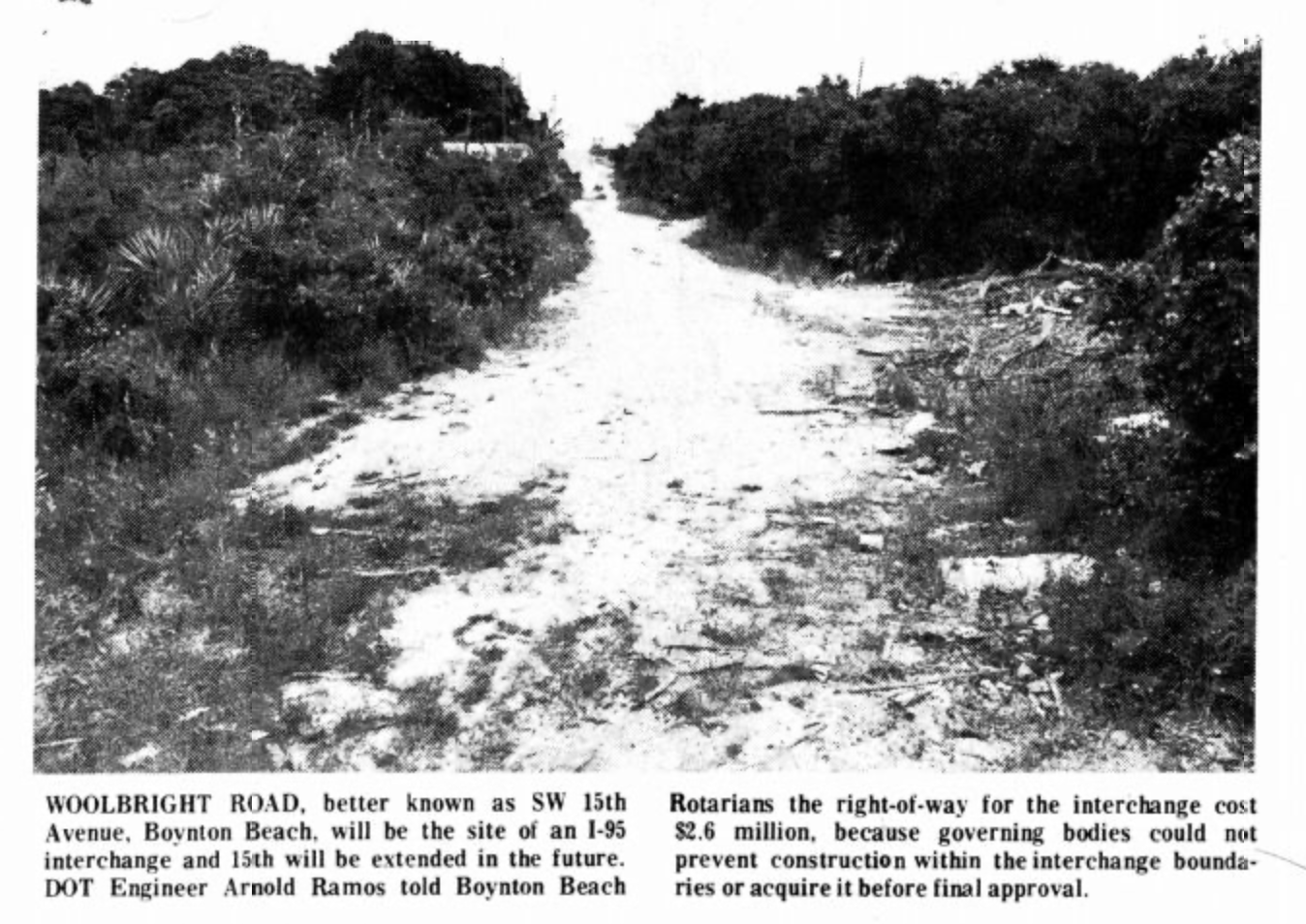

The project required taking land along the route. The article noted that three houses on SW 8th Street just south of SW 2nd Avenue would be removed to make way for the interstate. Businesses were affected as well. Rinker Materials would have to relocate because the new highway would pass directly through its property.

Residents and businesses along Ocean Avenue raised concerns during planning, asking how the interstate would affect access across town. Their concerns were justified.
State Road Department officials explained that Ocean Avenue would not cross the interstate. Because the highway would be elevated at the nearby interchange, building a crossing over both I-95 and the railroad tracks was considered too expensive. The plan simply eliminated it.

That decision had long-lasting consequences.
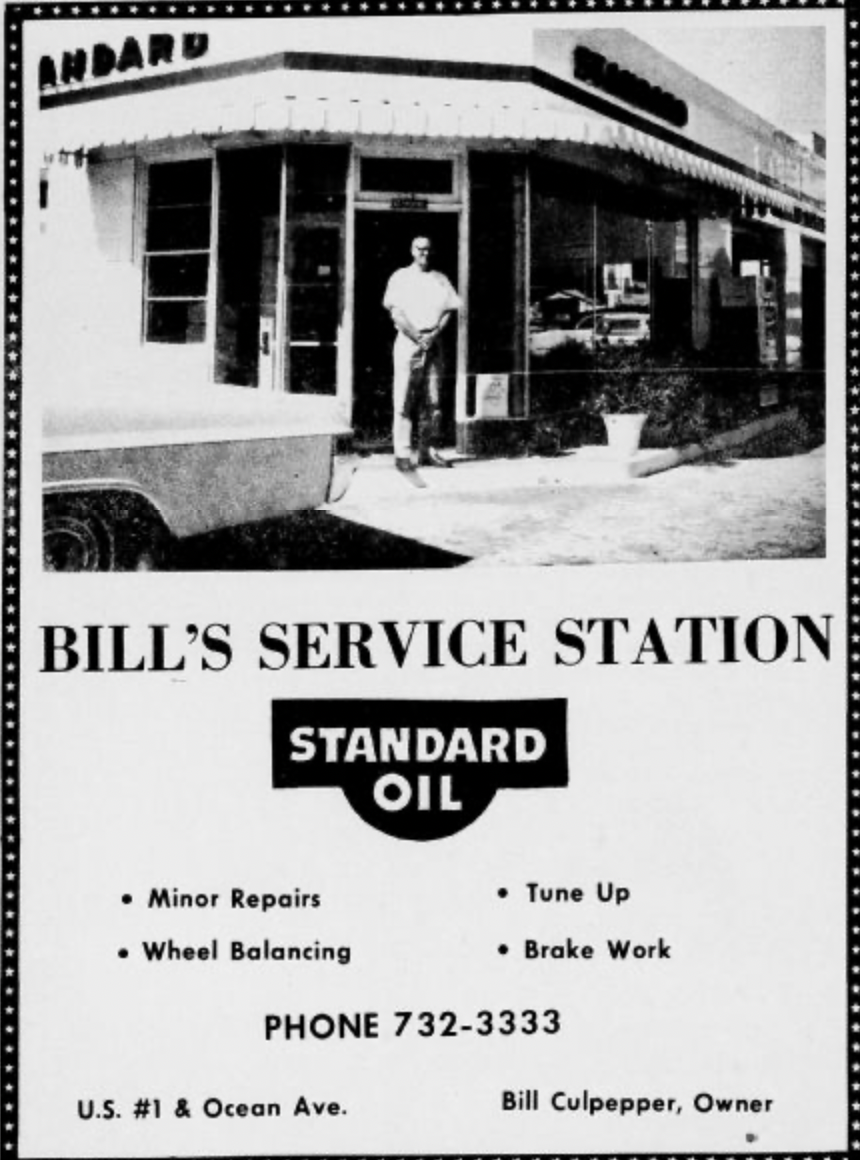
 

Ocean Avenue had long been the main route into downtown Boynton Beach, the historic business district near the Intracoastal Waterway.

Before the interstate era, motorists traveling north and south along U.S. 1 and Dixie Highwaynaturally passed through downtown, providing steady traffic for local shops and restaurants.

The shift in travel patterns had actually begun earlier. When the Florida Turnpike—then called the Sunshine State Parkway—opened in 1957, long-distance drivers were already being funneled onto a faster route west of the coastal towns instead of traveling through them.

The arrival of I-95 completed the bypass.


With exits only at Boynton Beach Boulevard and Woolbright Road, drivers on the interstate had no direct route into downtown via Ocean Avenue. Thousands of cars passed the city every day, but most never entered the historic business district.
Over time, traffic that once flowed naturally toward the waterfront disappeared, and businesses that depended on pass-through customers struggled. As development followed the interstate westward, downtown Boynton Beach was gradually left off the main travel route.

By the time the Boynton Beach Mall opened in 1985, much of Boynton’s retail and restaurants had closed, or moved west.

Looking back, the story helps explain why the once-busy downtown district faded. The highway that connected South Florida also redirected the traffic that had once kept Boynton’s historic center alive.


Boynton Woman’s Club Founder & Civic Organizer: Cora Stickney Harper

Boynton Woman’s Club Founder & Civic Organizer: Cora Stickney Harper

Cora Stickney, 1880, Wellesley College Archives.

Meet Cora Stickney Harper, founder of the Boynton Woman’s Club.

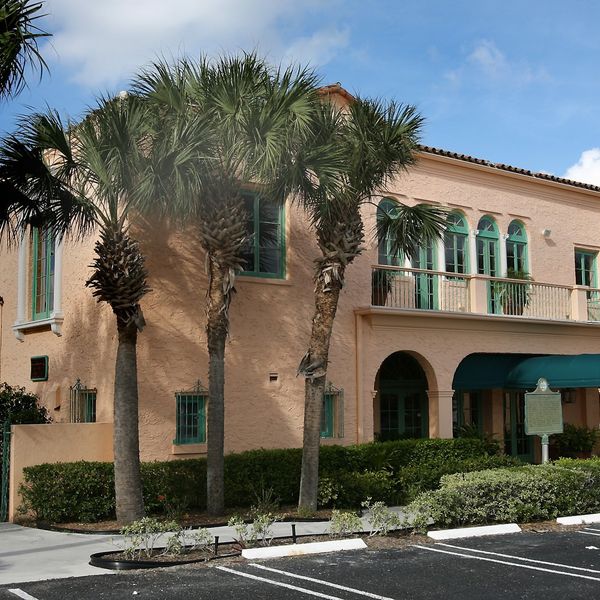
Boynton Woman’s Club 2nd Clubhouse, 1010 Federal Highway.

While relatively unknown today, this extraordinary, selfless woman left an indelible mark on the fledgling Boynton settlement. Her unique upbringing, progressive actions, generous spirit, and charitable endeavors make her story both noteworthy and significant to Boynton history.

Cora Harper, Wellesley College, 1879

Cora Stickney Harper was an influential early resident of Boynton Beach whose generosity and spirit have left a legacy that endures to this day. Born into a well-to-do family, Cora graduated from Wellesley College in 1888. Wellesley’s archives describe her as possessing a great joy for living, wit, and a fun-loving nature.

Cora Stickney, 1879, Wellesley College Archives.

However, her life was marked by tragedy. In 1897, her father, a cashier at the Great Falls National Bank for 35 years, was murdered during a bank robbery. Despite this loss, Cora was left financially secure. She wintered in Florida to convalesce from the tragedy. At a sanatorium near Merritt Island, she spent months reading, painting outdoors (en plein air), and bathing in the healing mineral springs. There she met Charles Thomas Harper, who was the local mail carrier.

Charles Thomas Harper, ca. 1905

In 1901, Cora and Charles married in Savannah, Georgia. Afterward, the couple moved to Boynton where Charles was an agent for the F.E.C. Railway and Southern Express Companies in Boynton, with a sprawling family of sisters, nieces, and nephews. Intriguingly, Cora understated her age on their marriage certificate, claiming to be 25 years old when she was, in fact, 42.

Cora quickly immersed herself in community life. She became one of the founders of the Boynton Woman’s Club in 1909, alongside her husband, who helped facilitate the purchase of land at the southeast corner of E. Ocean Avenue and SE 4th Street for the club. The Harpers offered the club a low-interest mortgage, demonstrating their commitment to its success.

In addition to her contributions to the Woman’s Club, Cora took steps to improve educational opportunities for local youth. In 1911, she arranged for Boynton’s young people to attend high school in West Palm Beach, as Boynton lacked its own high school at the time.

Ella Harper (left) and Cora Stickney Harper (right) after Ella’s 1913 graduation from Palm Beach High School

Cora’s civic engagement extended beyond Boynton. She became a charter member of the Daughters of the American Revolution (DAR) Evergreen Chapter in Miami in 1909. On the 1910 U.S. Census, she listed her age as 42, again understating her actual age of 51. In 1913, Cora and her husband moved to Fort Pierce, where she founded the Aiseehatchee Chapter of the DAR in early 1914.


Tragically, Cora passed away on November 1, 1914, at St. Andrew’s Episcopal Church. In recognition of her contributions, the DAR chapter in Fort Pierce was renamed the Cora Stickney Harper Chapter, National Society Daughters of the American Revolution.

Cora’s legacy extended through her last will and testament, which reflected her lifelong dedication to education and family. She left monetary gifts to her sisters-in-law and nieces, contingent upon their completion of their education, and donated $2,000 to the Wellesley College Students’ Aid Society.

Her husband, Charles T. Harper, remarried in 1916 and relocated to Homestead, where he served as the town’s mayor. Sadly, Charles and his daughter were killed in a car accident involving a speeding ambulance.

Cora Stickney Harper’s life was one of resilience, leadership, and generosity. Her contributions to Boynton and beyond—from founding the Boynton Woman’s Club to her work with the DAR and her support for education—have cemented her place in history as a remarkable woman whose spirit continues to inspire.

Cora Stickney Harper DAR Chapter members 2014

Knollwood Groves: A Treasure of Memories

The story of Knollwood Groves begins in the early 1930s when the land was owned by Frederick Foster Carey and called Papaya Groves, Tranquility Farm. In 1933, the property was sold to Kenneth G. Smith, a Chicago businessman and president of the Pepsodent toothpaste company. Initially, Smith named the property the Amos and Andy Farm to align with Pepsodent’s sponsorship of the popular Amos and Andy radio show.

However, when the sponsorship ended, Smith renamed the property Knollwood Groves. Under its new name, Knollwood Groves flourished as a citrus grove and tourist destination, attracting visitors with its citrus tours, train rides, alligator wrestling shows, and a recreated Seminole Indian village. It was also known for its iconic apple pies, fresh-squeezed orange juice, and the unmistakable scent of orange blossoms that filled the air along Lawrence Road.

Knollwood Groves remained a beloved Boynton Beach landmark until 2005, when it closed due to increasing development pressures and the challenges of maintaining agricultural land in a growing urban area. The property was eventually sold and redeveloped into the Knollwood residential community.

Despite its closure, the legacy of Knollwood Groves endures in the fond memories of those who visited, worked, and grew up in Boynton Beach, offering a nostalgic glimpse into Florida’s agricultural past.

The following memories were compiled from posts made at the Boynton History Facebook page: 

Knollwood Groves was more than just an attraction on Lawrence Road—it was a beloved part of Boynton Beach’s history, filled with sights, scents, and experiences that left an indelible mark on generations.

“Knolly,” Knollwood Groves’ mascot painted on the side of the tram that transported visitors through the farm and old Florida hammock

The sweet, heady fragrance of orange blossoms greeted visitors, evoking a sense of joy and nostalgia. For many, it was a favorite destination for school field trips. First graders would marvel at the vibrant groves, with the tractor tour guide’s voice echoing phrases like “sweet carambola” during the tram rides. The trips were an annual tradition, offering wholesome fun and hands-on learning about citrus farming.

Knollwood’s famous apple pies were a highlight for many, their taste cherished long after the grove closed. Some still wish they had the recipe. Families visited regularly to pick up fresh fruit, homemade fudge, and even discounted “day olds” for juicing at home. Driving down Lawrence Road, the air filled with the aroma of oranges, was an experience in itself.

For locals, Knollwood Groves was also a workplace. In the 1960s, fruit packers, including one visitor’s mother, carefully prepared citrus for shipping. Others, like a sibling duo, assembled shipping boxes after school. In the 1970s, kids worked there, sneaking fresh oranges on occasion and feeling a deep connection to the land.


Memories of Martin Two Feathers, who performed alligator demonstrations and drove the tram, add a lively human touch to the grove’s story. It wasn’t just a place to buy fruit; it was a gathering spot where families bonded over fresh produce, apple pies, and the sights and sounds of a simpler time.


Knollwood Groves is missed by those who grew up in Boynton Beach, its legacy carried in fond recollections of orange-scented roads, school trips, and moments shared with loved ones.

The South Lake Worth (Boynton) Inlet History

SOUTH LAKE WORTH INLET (BOYNTON INLET) 

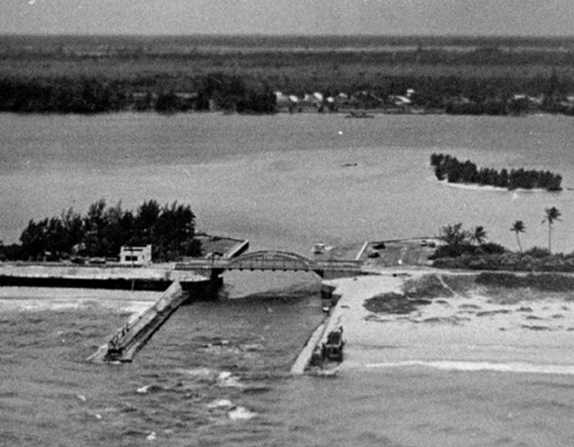
The Boynton Inlet, or what is officially known as the South Lake Worth Inlet, was a project that took many years to happen. Originally, Lake Worth was a fresh water lake. When the Palm Beach Inlet was opened in the 1800s, it changed to a salt water lagoon. At the far end

The Boynton Inlet

The Boynton Inlet

of the lake, the water was more brackish. Several cities used the lake to dump raw sewage. It was felt that making an additional opening to the sea would help “flush” the lake and to provide access for anglers and sport fishing.

The inlet was opened in 1927, and is a popular recreational spot for picnics and fishing.

The original article from March 17, 1927, announcing the inlet opening, from the Palm Beach Post.

CONNECTING CUT IS MADE AFTER YEARS OF ENGINEERING WORK

Scores Watch Ceremonial Labor at 11 o’clock Wednesday Night

At 11:18 o’clock last night the South Lake Worth Inlet at Boynton became a reality.

For at this hour waters from the Atlantic ocean glided in through the tiny cut, shoveled in the sand, and mingled with the waters of Lake Worth, for the first time at this point, filling the channel cut by a huge clam shell dredge. Dozens of spectators leaned from the bridge, which tops the project, and watched the operations by the glare of large search lights, while others tramped through the sand below to stand on the point to observe the laborers as they shoveled the opening wedge through which the ocean flowed.

Although about two weeks work yet remains for dredging the sand and cutting through part of the rock in the channel, last night’s task marked the official opening of the South Lake Worth inlet and the real termination of the project extending over a period of many years.

The South Lake Worth inlet, connecting the Atlantic ocean and Lake Worth, at a point just north of Boynton and the head of the lake, when completed will be available for pleasure craft, as well as being a vehicle for drainage. A depth of five feet at low tide will be increased to seven at high tide with a space of 154 feet between the two front jetties, and a 32 foot overhead clearance under the bridge.

Conceived in 1923, the project was almost one year in assuming definitive shape at the end of which time plans had been drawn, estimates made, the inlet district created and the project financed. The district extends from Southern Boulevard in West Palm Beach to a point one mile south of Boynton.

Riddle Brothers, engineers, were engaged to have charge of the entire projects, and last night both Karl and Kenyon Riddle of the firm, stood on the sands and watched the culmination of the $225,000 project, together with many of the town officials.

The concrete bridge, which has no draw, was completed August 1, 1924. Work started on the inlet proper in September, 1923, first on the solid concrete jetties, both of which withstood both hurricanes last summer without damage. The jetties, according to the engineering are of a peculiar construction, unique along the coast.

A suction dredge has been at work on the channel for some time and on Tuesday of this week the clam shell dredge began operations in a 21 hour-a-day schedule. It is expected that with the opening wedge cut, much of the sand will wash out to sea during high tides.

Lost Tourist Attractions

The Boynton Beach area was home to many well-known tourist attractions of the past. Sadly, these roadside stops no longer exist in today’s Boynton Beach.

James Melton’s Autorama – Located on US 1 in Hypoluxo, famous tenor James Melton displayed his extensive automobile collection to the public. Muralist Bernard Thomas painted a western themed mural in one of the museum halls. Mr. Melton’s untimely death in 1962 led to the closing of the museum. The property was sold and became a development.

Bianca’s Birds – This attraction on US 1 featured performing birds and a mock Seminole Indian village. Guests could dock boats or park on the premises. Later the property became a trailer park, then a residential development.

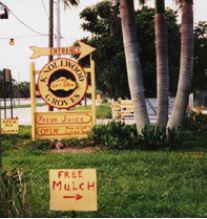
Knollwood Groves – Open from 1933 until 2005, this Lawrence Road attraction

Knollwood Groves

Knollwood Groves

featured citrus shipping, famous apple pies, a train ride through the groves and alligator wrestling and a hammock area with a recreated Seminole Indian village. It is now the Knollwood residential development.

Madison’s Jungle Garden – Located on Military Trail north of Gateway Boulevard, this tiny attraction was a rest stop for travelers. Several animals were on display in a small zoo. The Madisons made items to sell to the tourists such as orange blossom perfume, palmetto hats and pepper hot sauce.

Palm Beach Groves – Operated for decades by the Shelton Family, this attraction featured a tour of the groves, sausage trees and an extensive store for Florida produce and souvenirs. Its peacock flock survives in the nearby Fox Hollow neighborhood.

Rainbow Tropical Gardens – This beautiful garden on US 1 featured beautiful landscaping and lagoons with small fancy buildings throughout the property. The main building is today’s Benvenuto Restaurant, while the back of the property is a residential development. A few of the small garden structures survive on private property.

Waite’s Bird Farm – Located on US 1 north of Boynton Beach, this attraction was originally the Lewis Bird Farm.  Howard and Angela Waite owned and operated the zoo and pet shop. It featured trained birds, alligators, monkeys and other animals, and birds were raised and sold as pets. The building still stands with a different occupant.