Cappy, The Boynton Beach Fire Department’s Amorous Dalmatian

For this blog we are pleased to have a guest blogger, Michael Landress of the Boynton Beach Fire Department. His tale of Cappy is sure to bring a chuckle – BBHS Editors

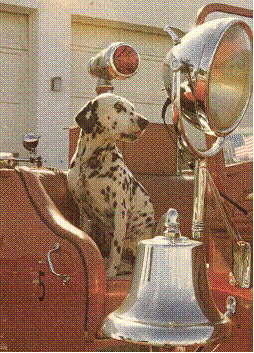
In 1969, the Boynton Beach Fire Department adopted a five-week old Dalmatian puppy. The firemen decided to hold a contest for the local children around town to name the frisky pup. The winning submission, “Cappy,” was submitted by six-year old Michele Jones.  Tiny Miss Jones was awarded a $25 savings bond for her effort and the rest is history.
Cappy seemingly responded well to his new name and enjoyed his accommodations at the fire house. He always loved riding on the gasoline-powered fire engines, but shied away
Cappy the Dog

Cappy the Dog

from the fire trucks that burned diesel. Cappy could be gruff at times and loathed bath water, but for the most part he was fun to have around.  Early in his career he would ride beside the firemen on the fire engine. Upon arrival at the fire scene, he would stand guard over the truck — posing like a tail-wagging, spotted gladiator.
There are many accounts of Cappy’s shenanigans, including the time he wolfed-down 50 radishes during one sitting and his well-documented disdain for veterinarians. However, none of those dog-tales can quite compare to when he began noticing the female of the species.
With his instincts and hormones in high gear, he would peruse the warm night air like a kind of canine Romeo searching for romance and tomfoolery.  One evening, while lurking in the shadows, Cappy unlawfully entered a screened enclosure and proceeded to mate with a Westminster Kennel Club quality German Sheppard named Loki.
The owners of the show pooch were not too pleased with Cappy or the fire department. Loki’s owner was quoted in the Boynton newspaper as saying; “Cappy . . . he’s some fireman . . . he runs around starting his own fires!”  The city was forced to pay the veterinarian costs for Cappy’s late night rendezvous.  Cappy did eventually father a whelp named Daisy. Soon after, his roaming ways and Boynton days ended.
Cappy retired from the Boynton Beach Fire Department in 1976 to live on a farm in north Florida. It is unknown if Cappy ever found true love, but this writer is confident he lived out his dog days in style
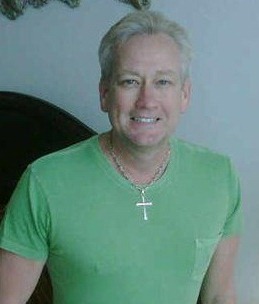
 

Michael Landress

Michael Landress

Michael Landress is a native Floridian and novice historian. He has spent the previous 15 years as a professional firefighter/paramedic for the City of Boynton Beach Fire Rescue Department. He holds a BA from St. Thomas University in Miami, Florida and his hobbies include; spending time with his two teenage sons, writing, photography, supporting the Miami Dolphins and saltwater fishing.
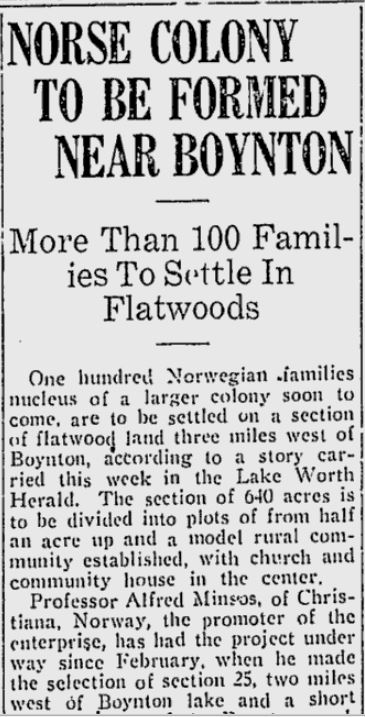
Boynton could have become “Little Norway”

You just never know what you will come across when you search through the old newspapers online. One of strangest Boynton tales was a scheme to bring over 100 Norwegian families to farm lands along Military Trail. In 1923, Professor Alfred Minsos of Christiana, Norway was scouting out Florida lands where the Norwegians could live. He

February 1923 Palm Beach Post Article

February 1923 Palm Beach Post Article

contacted the Model Land Company, which was Henry Flagler’s land development company. Frank Pepper, one of Model Land Company agents, knew of some land in Boynton that the owner, D.P. Council, wished to sell because he no longer could afford the taxes. The land was located on the southeast corner of Woolbright Road and Military Trail, and later was Herb Keatt’s dairy and today is the Indian Spring development. Mr. Council was even willing to give 40 acres of the land if the Model Land Company would extend the road to the colony, probably following today’s Woolbright Road path.

In a February 1923 letter to Prof. Minsos, T. T. Reese of West Palm Beach wrote “I want to say a word regarding our summer climate – they will find it delightful in every way. We, at times, have insects, but I have never found them a menace to happiness or comfort.” I can say with certainty that they would not have found the summer climate delightful.

But the Norwegians never came to Boynton. No documentation was found if they went to somewhere else in Florida, and I didn’t find any other information on Professor Minsos. Lutefisk , a strange fish dish where the fish is preserved in lye and smells real bad, could have become a local delicacy. Maybe it’s a good thing they didn’t come.

Boynton’s Earliest Churches

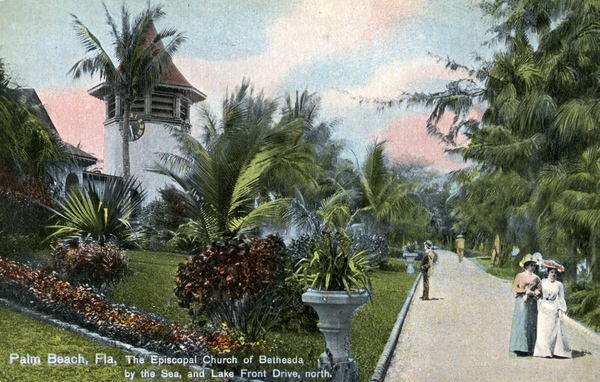
Before Palm Beach County existed, most of southeast Florida was Dade County. Before the pioneers founded religious institutions, the community relied on the occasional traveling missionary for church services. Congregants gathered in homes and in shady

Bethesda-By-The-Sea Church - Palm Beach (Courtesy Florida Memory)

Bethesda-By-The-Sea Church – Palm Beach (Courtesy Florida Memory)

arbors, reading the Bible and singing hymns. As more settlers arrived, the families raised money, gathered materials, and built small local churches. Weather and fire destroyed most of the early church buildings, though one pioneer church built in 1894, the second Bethesda-By-The-Sea Episcopal church, still stands in Palm Beach.

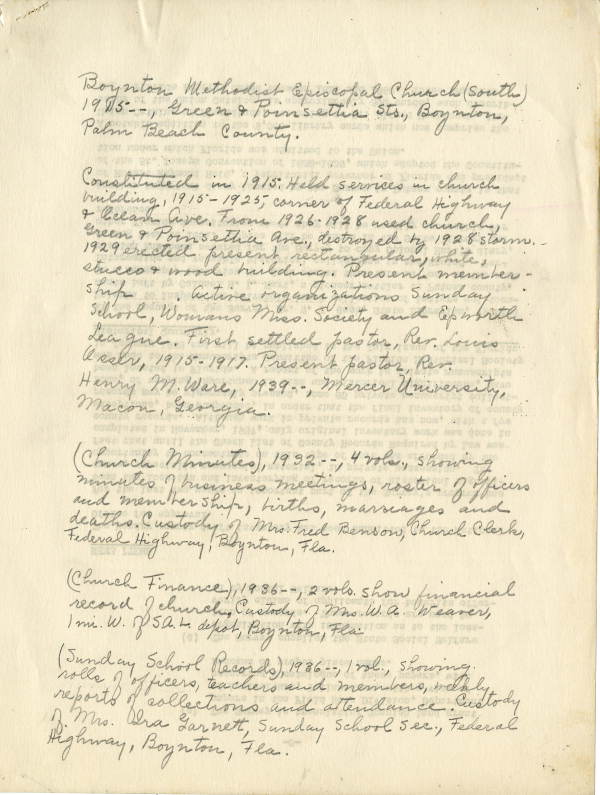
In 1930-1940, the WPA (Works Progress Administration) surveyed churches throughout the state to chronicle the history and inventory the church archives. The WPA reported the Town of Boynton had seven organized congregations with church buildings, though few buildings were the original structures.

According to WPA records, Saint Paul’s African Methodist Episcopal Church (1900) is the oldest. The records designate Saint John Baptist (1909) as the second oldest, yet a comprehensive history of the Boynton Methodist Episcopal Church, South published in 2006 (First United Methodist Church of Boynton Beach, Florida: A Centennial Celebration: A History of the First 100 Years 1905-2005) is contrary to the WPA date of 1915 and supports the claim the Boynton Methodist formed in 1905.

Original WPA Notes scanned into Florida Memory

Original WPA Notes scanned into Florida Memory

Other early Boynton churches

Saint John Baptist Church 1909

Saint Cuthbert’s Episcopal Church 1923

Community Church 1926

Church of God 1936

New Mount Zion Church 1939

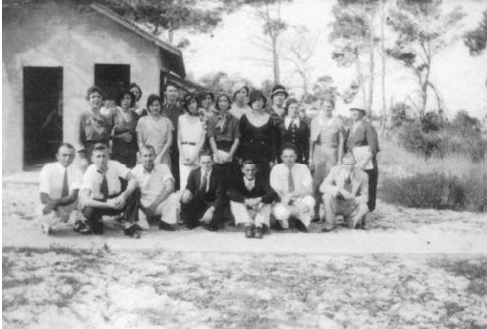
Methodist Church, 1930s

Methodist Church, 1930s

In the 1976 film, The History of Boynton Beach, one of the scenes shows scores of men, women and children exiting a church. As the church-bell chimes, people scurry across Seacrest Boulevard and gather in small groups to chat. The women wear lovely skirts and wear heels, with their heads covered by colorful hats. Nearly every gentleman wears a tie, and most are carrying a suit coat or sport jacket over his arm. Though today many church-goers don’t dress up as much, this idyllic scene is still repeated across Boynton Beach on Sunday mornings.

Today Boynton Beach and nearby unincorporated areas of Palm Beach County are home to nearly 600 religious institutions. The Boynton Beach Historical Society would like to add to its knowledge base and archive with information including primary documents and photographs of each church. To contribute to the history, please email us at boyntonhistory@gmail.com.

No hurly-burly in Boynton!

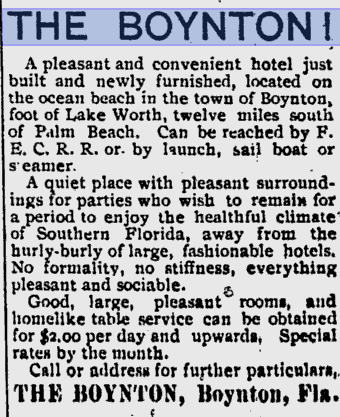
As I was watching television this morning, a reporter was describing the village of Bucklebury, where the royal baby is, as being away from the “hurly-burly” of London. To my mind immediately came an old advertisement for the Boynton Hotel, which said that the Boynton Hotel was “away from the hurly-burly of large, fashionable hotels.”

Boynton Hotel ad from 1899

Boynton Hotel ad from 1899

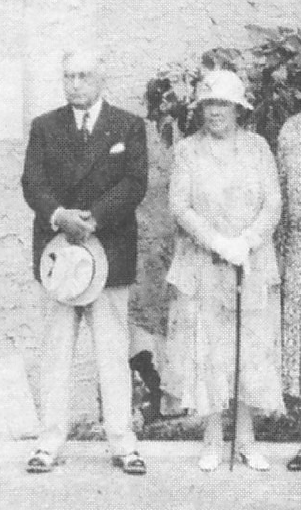
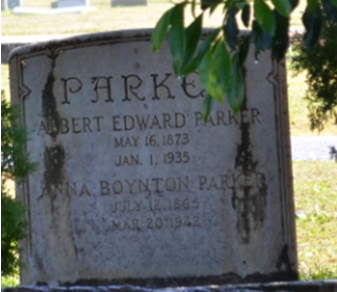
So who could have written the ad with the somewhat British expression? It very well could have been Albert Edward Parker, who managed the hotel for many years. He was Major Nathan S. Boynton’s son-in-law, married to his daughter Anna. The only known picture of them was taken at the Boynton Woman’s Club dedication in 1932. Parker was a native of England, born in 1873 who emigrated to America in 1886.

A.E. Parker also has a special spot in Palm Beach County’s history as the first naturalized citizen, sworn in on the day that Palm Beach County became official, July 1, 1909. Parker managed the hotel until the early 1920s, and also had the first dairy in Boynton, the Bertana farm, which was a combination of his first name and Anna’s. He went by the name “Bert” among his friends.

Albert and Anna Parker, 1932

Albert and Anna Parker, 1932

He went on to become West Palm Beach’s city manager, and eventually sold real estate in Palm Beach. He built a beautiful Mediterranean-revival house on Flagler Drive (recently renovated). Albert passed away in 1935; he and Anna are interred at Woodlawn Cemetery in West Palm Beach.

Parker Gravesite

Parker Gravesite

Boynton’s Egg Circle

You can purchase farm fresh eggs in western Boynton Beach. Heritage Hen Farms (hidden behind the Publix Supermarket on Haverhill Road, west of Military Trail and south of Le Chalet Blvd) offers freshly laid chicken eggs, honey and goat milk.

Heritage Hen Farm

Heritage Hen Farm

During the 1920s, 30s and 40s, the farm was the site of Oscar Winchester’s “Flatwoods” pineapple plantation. Mr. Winchester was widely known as the “Pineapple King.”

http://www.heritagehen.com

If you have enough money, you can buy a mini-hen farm from the 2012 Neiman Marcus Fantasy Christmas Catalog for “just a drop in the bucket” – $100,000.

Neiman Marcus 2012 Fantasy Christmas Catalog Mini-Hen Farm

Neiman Marcus 2012 Fantasy Christmas Catalog Mini-Hen Farm

There’s one catch; cultivation of chickens and other farm animals are prohibited within the Boynton Beach city limits.

Not to ruffle any feathers, but that wasn’t always the case. Boynton once boasted a very successful Egg Circle.

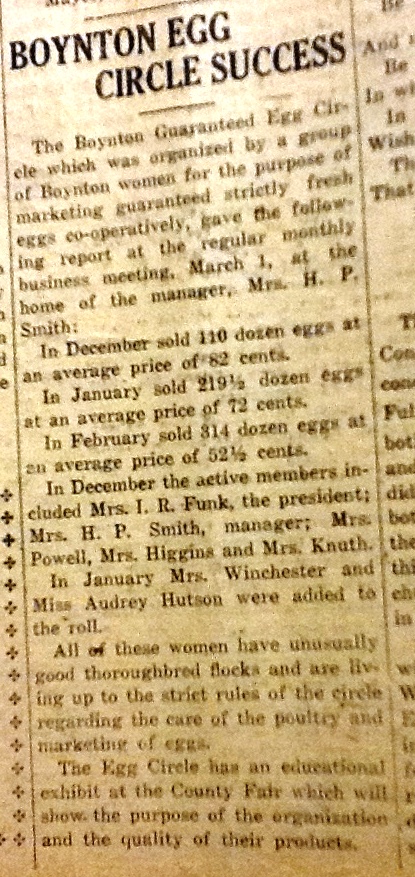
In 1921, shortly after the town’s incorporation, a flock of Boynton Women organized a co-op for cultivating and marketing home-grown eggs.

Lake Worth Herald, Dec. 1 1921

Lake Worth Herald, Dec. 1 1921

Led by president Mrs. I.R. Funk, and Manager, Mrs. H.P. Smith, seven Boynton entrepreneurs went into business.

The Egg Circle presented an educational exhibit and promoted their egg circle production at the annual Palm Beach County Fair. (Note: George Graham Currie founded the Palm Beach County Fair in 1912)

Nearly 650 dozen eggs sold during the winter season. Because they didn’t put all their eggs in one basket, the women were able to sock away a nice little nest egg.