Rainbow Tropical Gardens: A Roadside Paradise in Boynton Beach

Rainbow Tropical Gardens: A Roadside Paradise in Boynton Beach

In the first half of the twentieth century, the coastal region of South Florida experienced rapid transformation. Railroads, highways, and the land boom of the 1920s brought new towns and tourism to areas like Boynton Beach. Along U.S. Highway 1, travelers encountered a landscape filled with nurseries, citrus groves, and small attractions that promoted Florida’s image as a lush, tropical destination. Among these, one of the most memorable was Rainbow Tropical Gardens, created and maintained by Clyde O’Brien Miller, a gifted horticulturist whose imagination and craftsmanship shaped the site into one of Boynton Beach’s earliest and most beloved landmarks.
Clyde O’Brien Miller and His Vision

Clyde O’Brien Miller was born in 1885 and developed an early interest in tropical plants and landscape design. He was part of a generation of horticulturists who viewed Florida not only as fertile ground for agriculture but also as a living canvas for artful gardens. Before establishing his own property, Miller worked on the gardens of Addison Mizner’s Cloister Inn in Boca Raton, where he absorbed Mizner’s use of Mediterranean Revival architecture and romantic garden design. This experience strongly influenced his later work.

By the late 1920s, Miller had settled in Boynton Beach and purchased land along U.S. 1 just north of downtown. He opened Rainbow’s End Nursery, which sold tropical plants and decorative landscape materials. Miller’s passion for creating beautiful spaces soon transformed the nursery into something larger. He began developing the grounds into Rainbow Tropical Gardens, a series of landscaped pathways, water features, and floral displays that showcased the variety and vibrancy of Florida’s tropical vegetation. Miller’s vision combined horticulture and art in a way that appealed to both tourists and local residents.
Design and Features

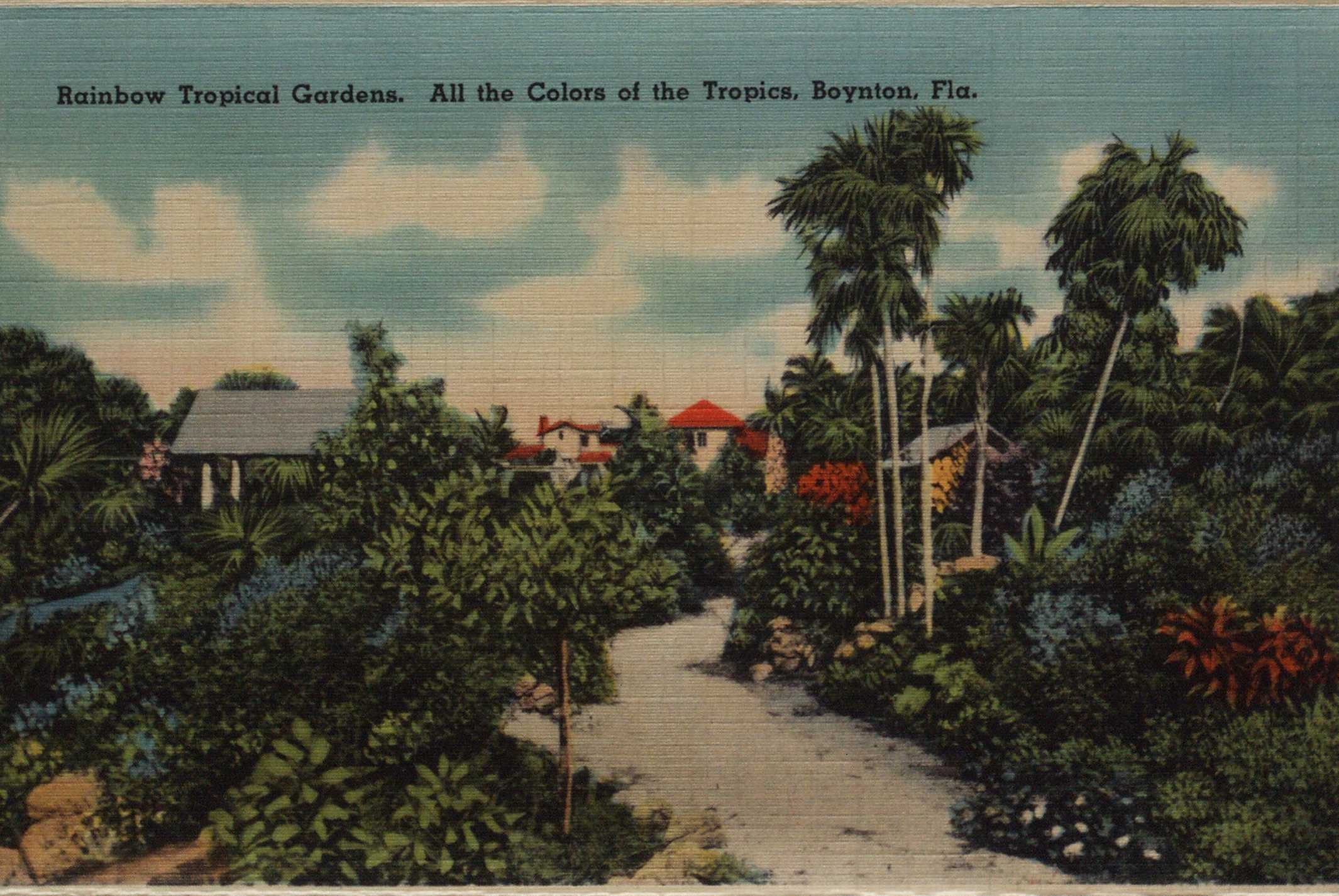
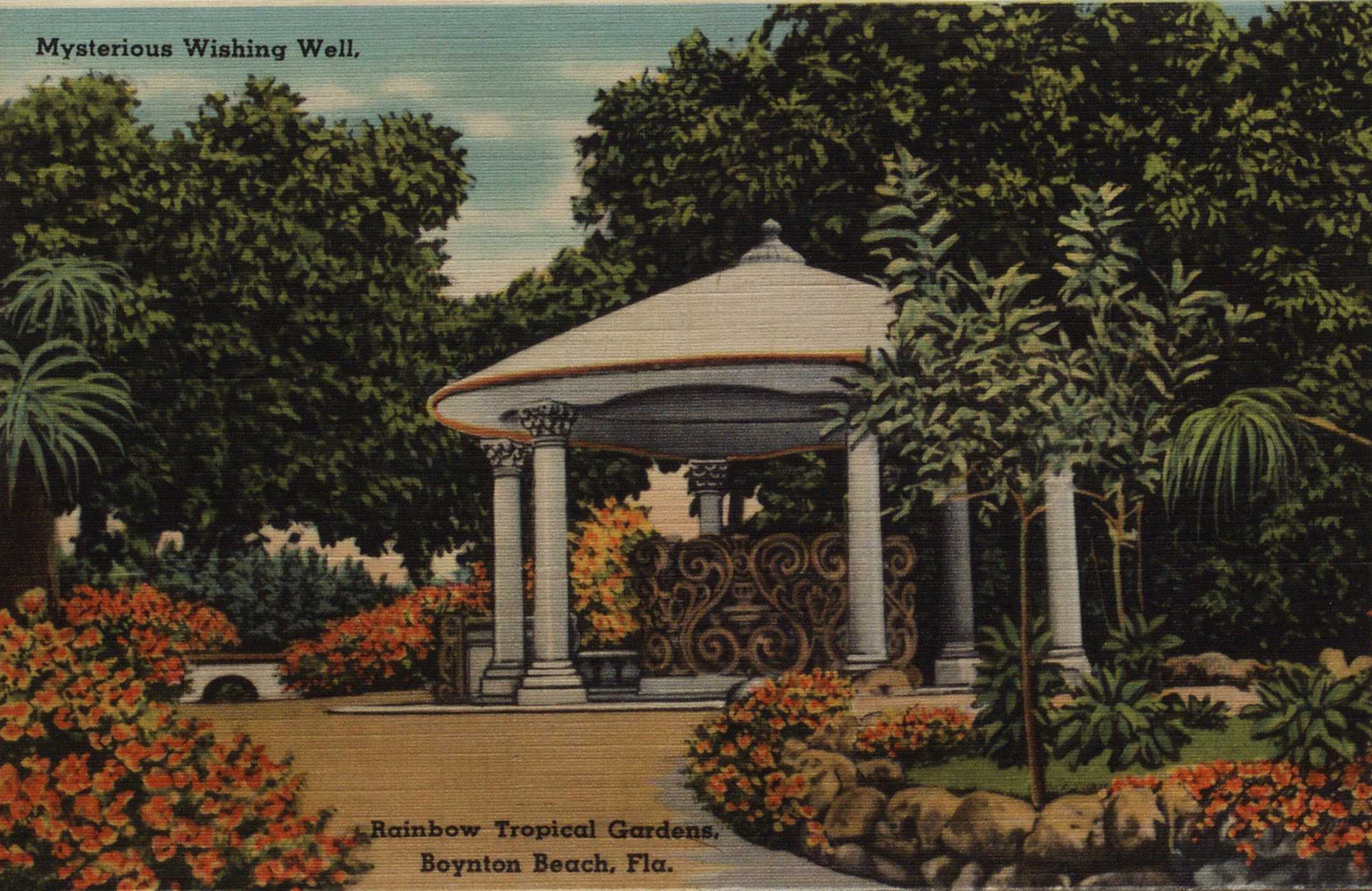
The gardens reflected Miller’s mastery of planting design and his appreciation for the visual power of color and form. He arranged winding footpaths that led through beds of hibiscus, crotons, bougainvillea, and palms. Visitors followed these trails past lagoons, fountains, and bridges, each carefully placed to frame the surrounding landscape. Stone gazebos, archways, and pergolas offered shade and a sense of discovery, while reflecting pools mirrored the vibrant foliage overhead.

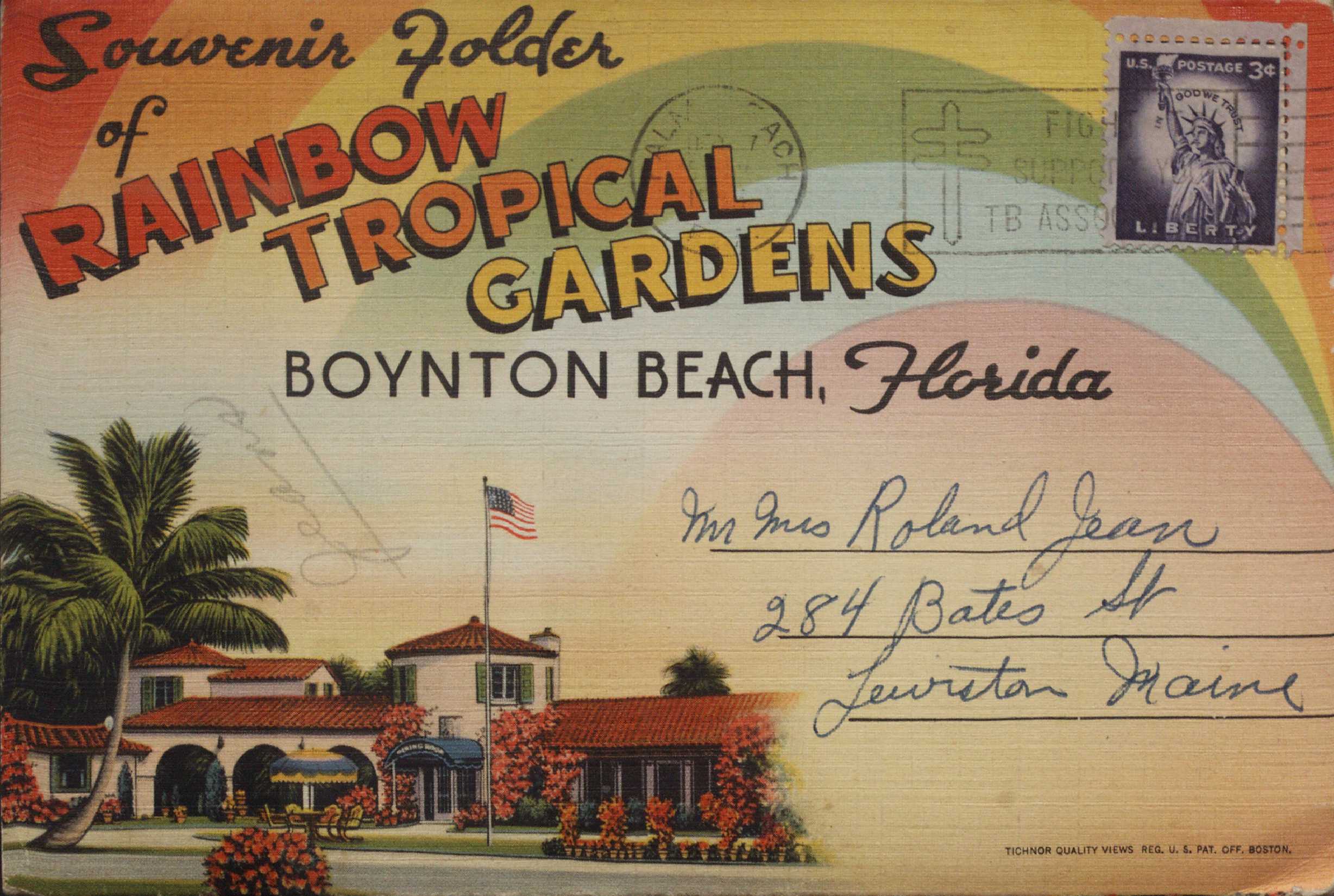
At the front of the property stood Mediterranean Revival–style buildings that served as the gift shop and café. Local tradition and historical recollections suggest that Addison Mizner, who had already established himself as Palm Beach County’s most famous architect, either designed or inspired these structures. The combination of stucco walls, barrel tile roofs, and arched openings harmonized perfectly with the surrounding plantings.

Miller himself was responsible for much of the stonework and ornamental detailing throughout the grounds. His craftsmanship gave the gardens a handmade quality that distinguished them from purely commercial roadside attractions. Everything about the property reflected careful planning and artistic intent.
The Tourist Attraction Years

During the 1930s and 1940s, Rainbow Tropical Gardens became a celebrated stop for travelers driving the Dixie Highway and later U.S. 1. Visitors walked through the gardens, took photographs, and purchased tropical plants to ship north. The site appeared on linen postcards distributed across the country, often labeled with its motto, “All the Colors of the Tropics.” These colorful images helped spread Boynton Beach’s reputation as a place of natural beauty.

By the postwar years, Miller expanded the attraction to meet the expectations of modern tourists. The property included bird shows, alligators, and a Seminole Indian Village, reflecting the entertainment trends of the 1950s. Despite these additions, the heart of the gardens remained Miller’s landscapes and his commitment to horticultural display.

Rainbow Tropical Gardens also functioned as a community landmark. Local families held gatherings on the grounds, and the gardens served as a backdrop for countless photographs and wedding portraits. It represented the idealized Florida landscape that residents and visitors alike associated with sunshine, color, and abundance.
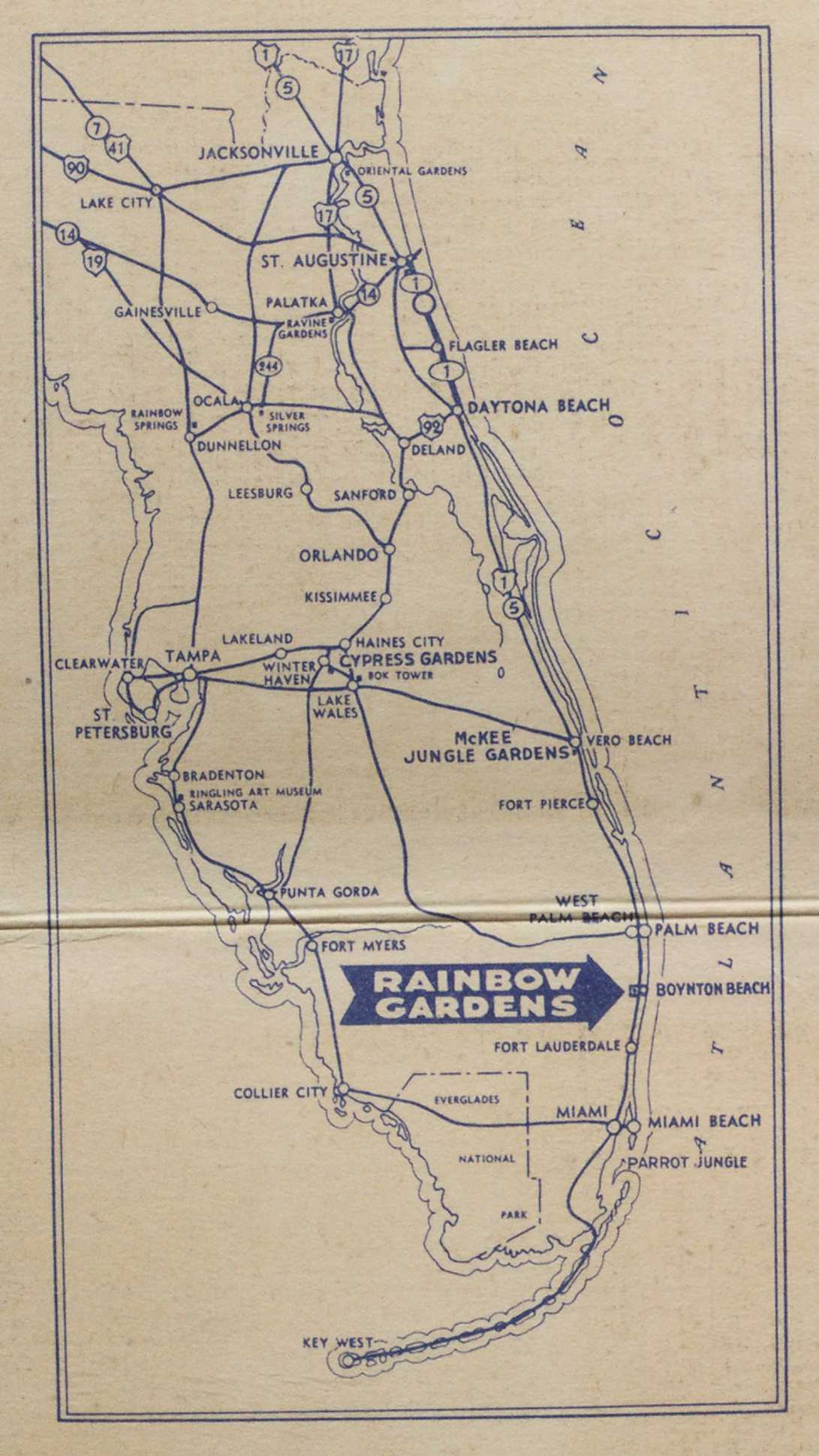
Florida map showing Rainbow Tropical Gardens

Decline and Transformation

By the late 1950s, the tourist economy of coastal Florida began to shift. The construction of the interstate highway system diverted travelers away from U.S. 1, reducing the steady stream of visitors who once stopped in Boynton Beach. Larger and more heavily advertised attractions, such as Cypress Gardens near Winter Haven, began to dominate the market. Like many independent roadside sites, Rainbow Tropical Gardens could not compete.

The property gradually closed, and much of the land was redeveloped. However, the main building, which had served as the garden’s entrance and café, survived. It was adapted for new use and today operates as Benvenuto’s Catering and Restaurant, a well-known Boynton Beach landmark. The restaurant retains many original architectural elements, including stucco walls, Spanish tile roofing, and arched porticos that date back to the garden’s early years.

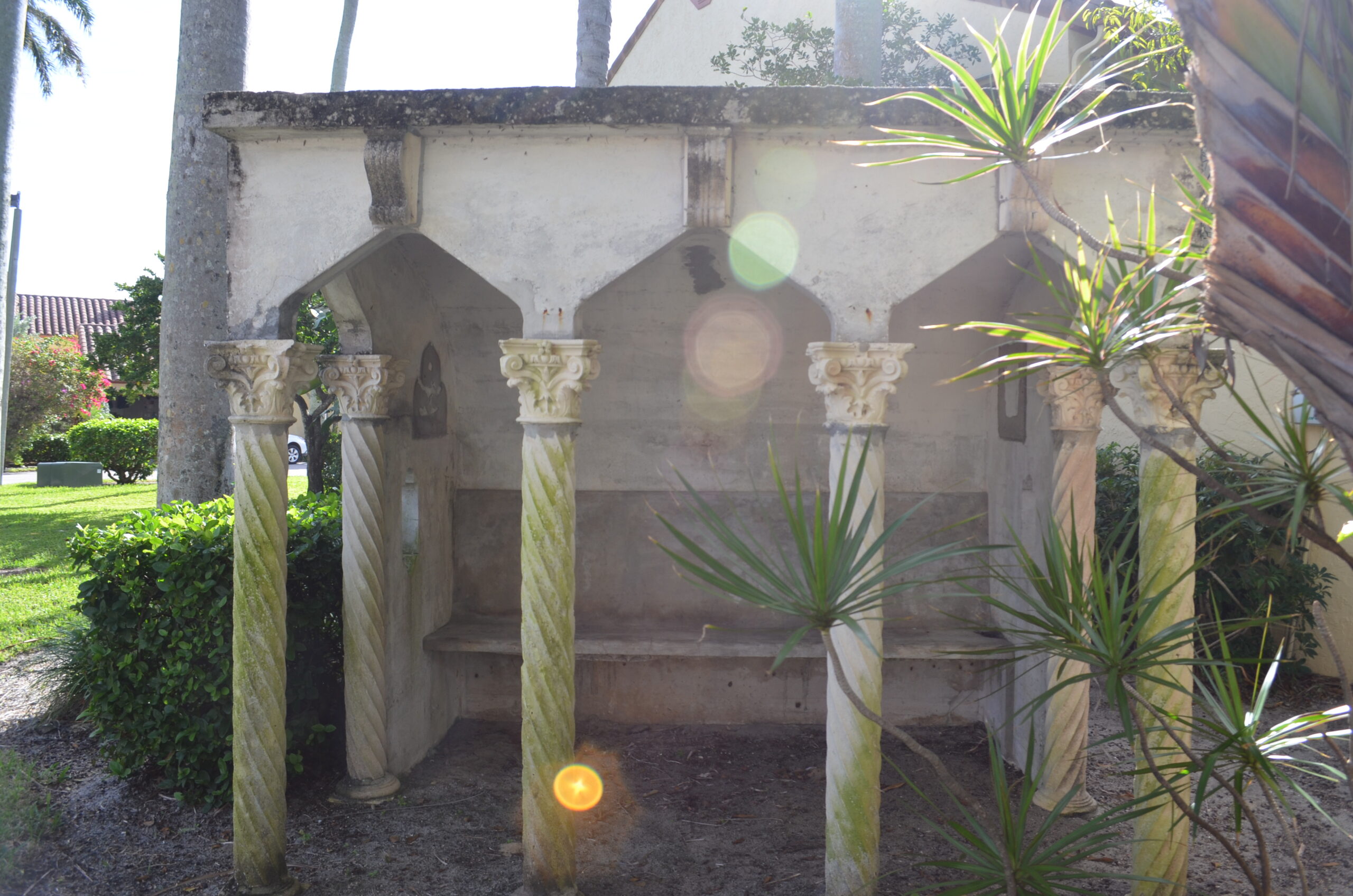
The surrounding area became part of the Dos Lagos residential community, which occupies what was once the broader landscape of the gardens. Within that neighborhood, a few of the original garden structures still exist. Stone gazebos, walls, and fragments of pathways can still be found amid newer development, quietly preserving traces of Miller’s original design.
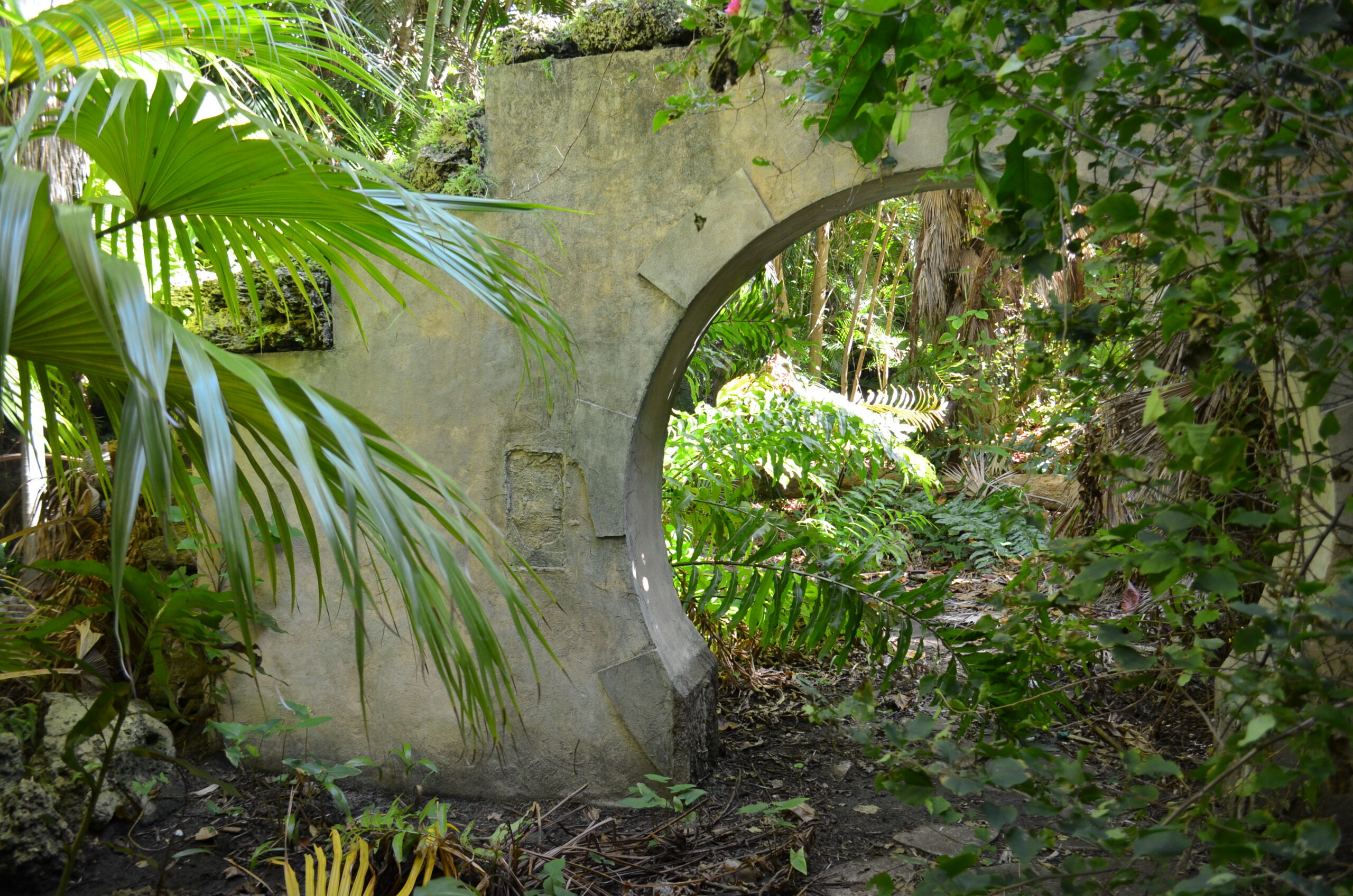
Remnant arch from Rainbow Tropical Gardens

Clyde Miller’s Legacy

Clyde O’Brien Miller’s work at Rainbow Tropical Gardens reflected his belief that horticulture was an art form capable of transforming the everyday environment. His skill as a gardener and builder made him one of Boynton Beach’s early creative figures. Although Miller was not trained as an architect, his collaboration with the Mizner aesthetic and his ability to blend structure and vegetation placed him within the larger tradition of Florida’s garden designers.

Miller’s influence extended beyond the physical site. His approach to tropical landscaping anticipated later trends in South Florida design, where color, texture, and native flora became central features of residential and public gardens. Even after the gardens closed, his example inspired other nurserymen and landscapers in the region.
Enduring Significance

Rainbow Tropical Gardens stood for three decades as a symbol of South Florida’s beauty and enterprise. It showcased the possibilities of tropical horticulture at a time when the region was defining its identity as a tourist paradise. The site’s history connects Boynton Beach to the broader story of Florida’s roadside culture and the individuals who shaped it through imagination and labor.

Although much of the original garden has vanished, the survival of Benvenuto’s Restaurant and several of Miller’s stone structures ensures that the spirit of Rainbow Tropical Gardens has not completely disappeared. For residents of the Dos Lagos community, the memory of the gardens remains embedded in the landscape itself.

Knollwood Groves: A Treasure of Memories

The story of Knollwood Groves begins in the early 1930s when the land was owned by Frederick Foster Carey and called Papaya Groves, Tranquility Farm. In 1933, the property was sold to Kenneth G. Smith, a Chicago businessman and president of the Pepsodent toothpaste company. Initially, Smith named the property the Amos and Andy Farm to align with Pepsodent’s sponsorship of the popular Amos and Andy radio show.

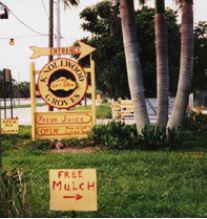
However, when the sponsorship ended, Smith renamed the property Knollwood Groves. Under its new name, Knollwood Groves flourished as a citrus grove and tourist destination, attracting visitors with its citrus tours, train rides, alligator wrestling shows, and a recreated Seminole Indian village. It was also known for its iconic apple pies, fresh-squeezed orange juice, and the unmistakable scent of orange blossoms that filled the air along Lawrence Road.

Knollwood Groves remained a beloved Boynton Beach landmark until 2005, when it closed due to increasing development pressures and the challenges of maintaining agricultural land in a growing urban area. The property was eventually sold and redeveloped into the Knollwood residential community.

Despite its closure, the legacy of Knollwood Groves endures in the fond memories of those who visited, worked, and grew up in Boynton Beach, offering a nostalgic glimpse into Florida’s agricultural past.

The following memories were compiled from posts made at the Boynton History Facebook page: 

Knollwood Groves was more than just an attraction on Lawrence Road—it was a beloved part of Boynton Beach’s history, filled with sights, scents, and experiences that left an indelible mark on generations.

“Knolly,” Knollwood Groves’ mascot painted on the side of the tram that transported visitors through the farm and old Florida hammock

The sweet, heady fragrance of orange blossoms greeted visitors, evoking a sense of joy and nostalgia. For many, it was a favorite destination for school field trips. First graders would marvel at the vibrant groves, with the tractor tour guide’s voice echoing phrases like “sweet carambola” during the tram rides. The trips were an annual tradition, offering wholesome fun and hands-on learning about citrus farming.

Knollwood’s famous apple pies were a highlight for many, their taste cherished long after the grove closed. Some still wish they had the recipe. Families visited regularly to pick up fresh fruit, homemade fudge, and even discounted “day olds” for juicing at home. Driving down Lawrence Road, the air filled with the aroma of oranges, was an experience in itself.

For locals, Knollwood Groves was also a workplace. In the 1960s, fruit packers, including one visitor’s mother, carefully prepared citrus for shipping. Others, like a sibling duo, assembled shipping boxes after school. In the 1970s, kids worked there, sneaking fresh oranges on occasion and feeling a deep connection to the land.


Memories of Martin Two Feathers, who performed alligator demonstrations and drove the tram, add a lively human touch to the grove’s story. It wasn’t just a place to buy fruit; it was a gathering spot where families bonded over fresh produce, apple pies, and the sights and sounds of a simpler time.


Knollwood Groves is missed by those who grew up in Boynton Beach, its legacy carried in fond recollections of orange-scented roads, school trips, and moments shared with loved ones.

The South Lake Worth (Boynton) Inlet History

SOUTH LAKE WORTH INLET (BOYNTON INLET) 

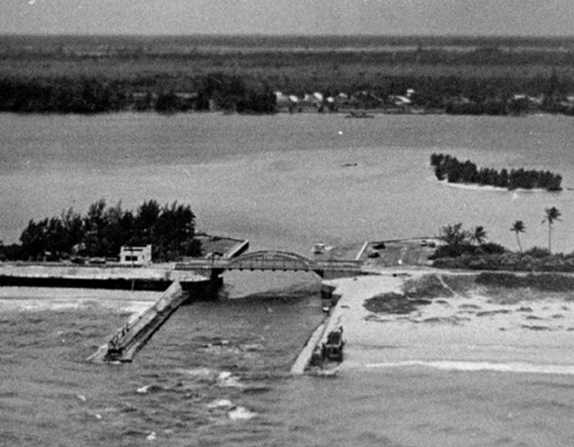
The Boynton Inlet, or what is officially known as the South Lake Worth Inlet, was a project that took many years to happen. Originally, Lake Worth was a fresh water lake. When the Palm Beach Inlet was opened in the 1800s, it changed to a salt water lagoon. At the far end

The Boynton Inlet

The Boynton Inlet

of the lake, the water was more brackish. Several cities used the lake to dump raw sewage. It was felt that making an additional opening to the sea would help “flush” the lake and to provide access for anglers and sport fishing.

The inlet was opened in 1927, and is a popular recreational spot for picnics and fishing.

The original article from March 17, 1927, announcing the inlet opening, from the Palm Beach Post.

CONNECTING CUT IS MADE AFTER YEARS OF ENGINEERING WORK

Scores Watch Ceremonial Labor at 11 o’clock Wednesday Night

At 11:18 o’clock last night the South Lake Worth Inlet at Boynton became a reality.

For at this hour waters from the Atlantic ocean glided in through the tiny cut, shoveled in the sand, and mingled with the waters of Lake Worth, for the first time at this point, filling the channel cut by a huge clam shell dredge. Dozens of spectators leaned from the bridge, which tops the project, and watched the operations by the glare of large search lights, while others tramped through the sand below to stand on the point to observe the laborers as they shoveled the opening wedge through which the ocean flowed.

Although about two weeks work yet remains for dredging the sand and cutting through part of the rock in the channel, last night’s task marked the official opening of the South Lake Worth inlet and the real termination of the project extending over a period of many years.

The South Lake Worth inlet, connecting the Atlantic ocean and Lake Worth, at a point just north of Boynton and the head of the lake, when completed will be available for pleasure craft, as well as being a vehicle for drainage. A depth of five feet at low tide will be increased to seven at high tide with a space of 154 feet between the two front jetties, and a 32 foot overhead clearance under the bridge.

Conceived in 1923, the project was almost one year in assuming definitive shape at the end of which time plans had been drawn, estimates made, the inlet district created and the project financed. The district extends from Southern Boulevard in West Palm Beach to a point one mile south of Boynton.

Riddle Brothers, engineers, were engaged to have charge of the entire projects, and last night both Karl and Kenyon Riddle of the firm, stood on the sands and watched the culmination of the $225,000 project, together with many of the town officials.

The concrete bridge, which has no draw, was completed August 1, 1924. Work started on the inlet proper in September, 1923, first on the solid concrete jetties, both of which withstood both hurricanes last summer without damage. The jetties, according to the engineering are of a peculiar construction, unique along the coast.

A suction dredge has been at work on the channel for some time and on Tuesday of this week the clam shell dredge began operations in a 21 hour-a-day schedule. It is expected that with the opening wedge cut, much of the sand will wash out to sea during high tides.

Lost Tourist Attractions

The Boynton Beach area was home to many well-known tourist attractions of the past. Sadly, these roadside stops no longer exist in today’s Boynton Beach.

James Melton’s Autorama – Located on US 1 in Hypoluxo, famous tenor James Melton displayed his extensive automobile collection to the public. Muralist Bernard Thomas painted a western themed mural in one of the museum halls. Mr. Melton’s untimely death in 1962 led to the closing of the museum. The property was sold and became a development.

Bianca’s Birds – This attraction on US 1 featured performing birds and a mock Seminole Indian village. Guests could dock boats or park on the premises. Later the property became a trailer park, then a residential development.

Knollwood Groves – Open from 1933 until 2005, this Lawrence Road attraction

Knollwood Groves

Knollwood Groves

featured citrus shipping, famous apple pies, a train ride through the groves and alligator wrestling and a hammock area with a recreated Seminole Indian village. It is now the Knollwood residential development.

Madison’s Jungle Garden – Located on Military Trail north of Gateway Boulevard, this tiny attraction was a rest stop for travelers. Several animals were on display in a small zoo. The Madisons made items to sell to the tourists such as orange blossom perfume, palmetto hats and pepper hot sauce.

Palm Beach Groves – Operated for decades by the Shelton Family, this attraction featured a tour of the groves, sausage trees and an extensive store for Florida produce and souvenirs. Its peacock flock survives in the nearby Fox Hollow neighborhood.

Rainbow Tropical Gardens – This beautiful garden on US 1 featured beautiful landscaping and lagoons with small fancy buildings throughout the property. The main building is today’s Benvenuto Restaurant, while the back of the property is a residential development. A few of the small garden structures survive on private property.

Waite’s Bird Farm – Located on US 1 north of Boynton Beach, this attraction was originally the Lewis Bird Farm.  Howard and Angela Waite owned and operated the zoo and pet shop. It featured trained birds, alligators, monkeys and other animals, and birds were raised and sold as pets. The building still stands with a different occupant.

The Coquimbo Shipwreck: A Tale of Adventure, Rescue, and Legacy

THE COQUIMBO SHIPWRECK: A TALE OF ADVENTURE, RESCUE, AND LEGACY

by Janet DeVries Naughton

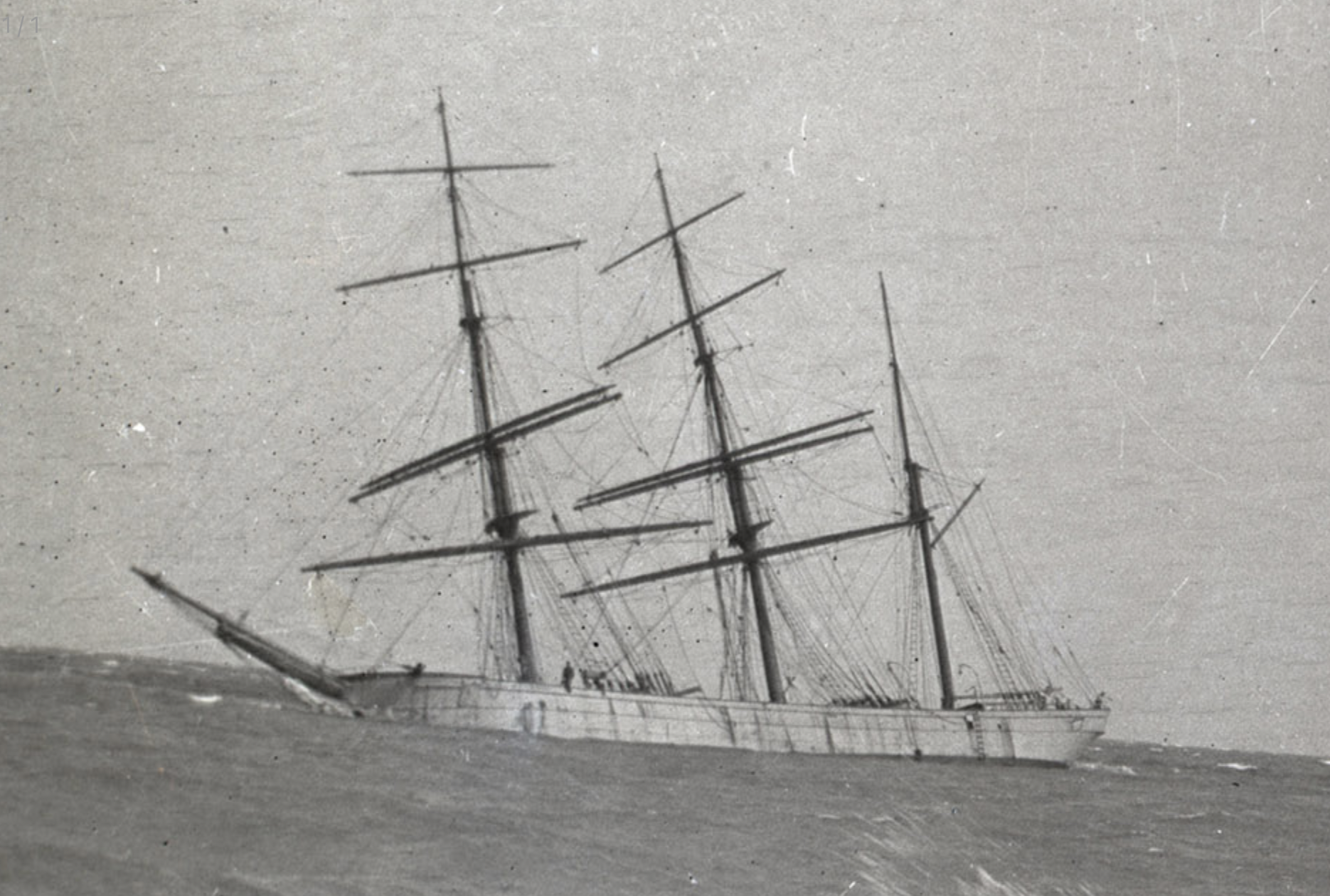
The Coquimbo loaded with lumber, ashore 1/2 mile below the Boynton Hotel (Photo credit: Martin County Digital)

THE SHIP

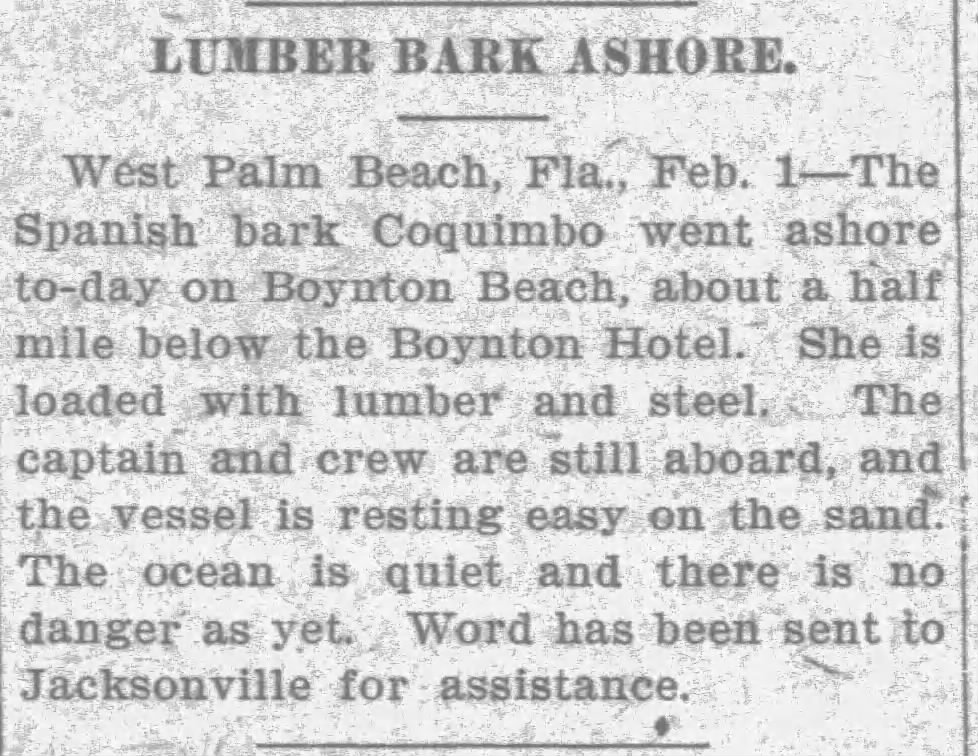
In the early morning hours of a brisk January morning in 1909, the residents of Boynton awoke to a surprising sight. Just beyond the breakers, a large sailing ship loomed in the shadows, its masts towering above the water. The ship, a Norwegian barkentine named Coquimbo, had run aground on the offshore reef.

Lumber Bark Ashore (2 Feb 1909 Gulfport Record)


Built in Glasgow in 1876, the Coquimbo was a classic example of a lumber ship, designed to carry vast quantities of timber across the oceans. With two square-rigged masts forward and a schooner-rigged mast aft, the Coquimbo was a formidable vessel, one that had seen its share of rough seas and long voyages.

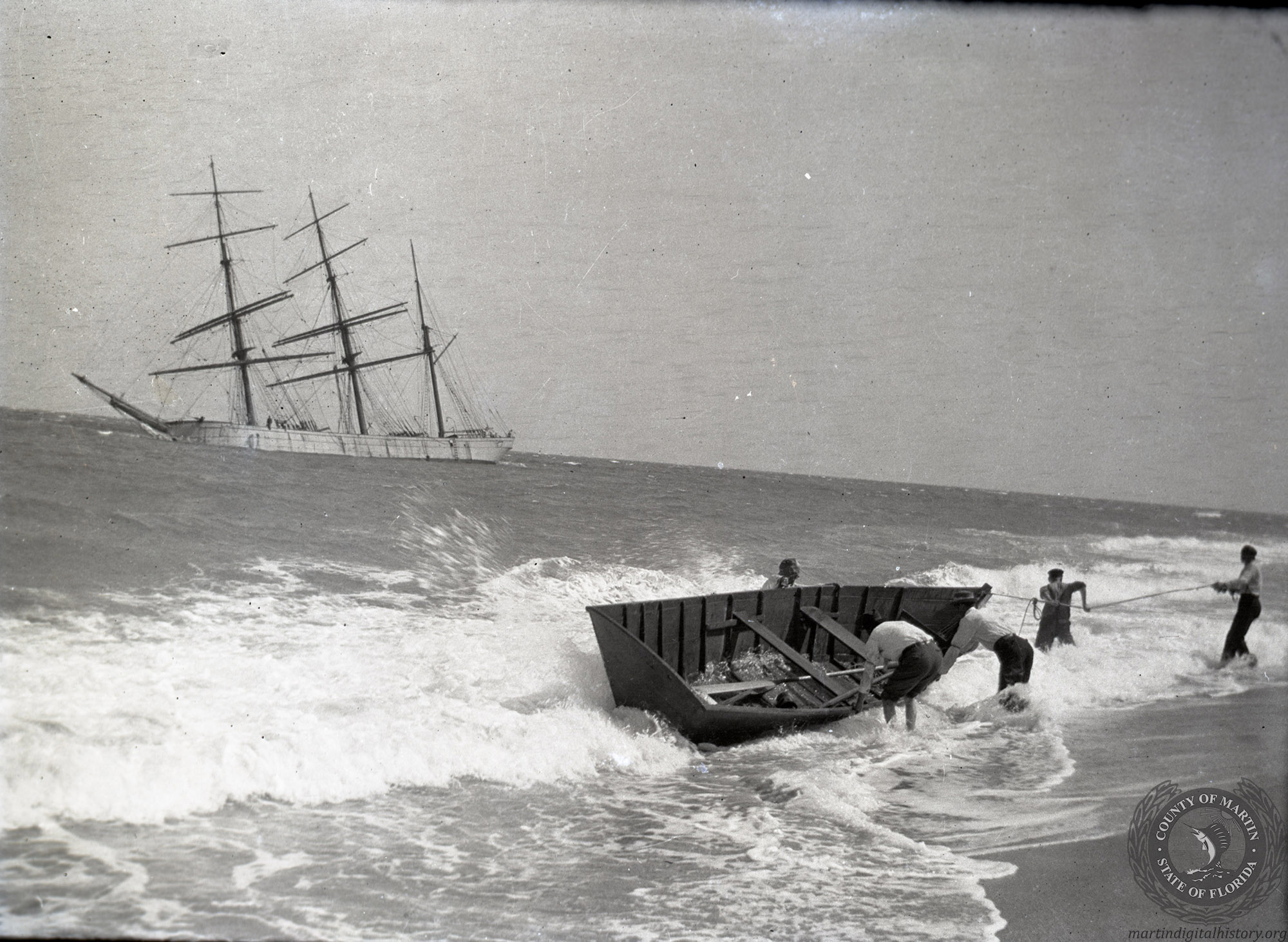
A small boat and several men readying to go out to the stranded Coquimbo (Photo credit: Martin County Digital)

The Coquimbo, destined for Buenos Aires, carried longleaf pine lumber grown in Gulfport, Mississippi. But as she sailed down the coast of Florida, disaster struck. Whether due to navigational error or the treacherous nature of the reef, the ship found herself hopelessly stranded. Aboard were fifteen men: three Swedes, one Dane, one Finn, and ten Norwegians, led by their captain, I. Clausen. They were now at the mercy of the sea and the elements, their ship a helpless giant stuck fast on the coral.

THE RESCUE

Word of the stranded ship spread quickly among Boynton residents. By midmorning, settlers rushed to the scene, eager to assist in the rescue. They crossed the canal, now known as the Intracoastal Waterway, on a hand-pulled skiff, determined to help the crew. According to oral history accounts, a breeches buoy transported the fifteen men to the beach.

Cargo little value to wreckers (4 Feb 1909, Miami Morning News-Record)

For the next two months, the crew of the Coquimbo made their home on the beach, camping under makeshift tents fashioned from the ship’s sails. The weather was often chilly, and blustery, but the men endured, waiting for a steam tug to arrive from Key West to free their ship. The tug finally arrived, but despite days of effort, the Coquimbo remained stubbornly grounded. By May, the relentless pounding of the waves began to break up her hull, sealing her fate as a permanent fixture on the reef.

THE LUMBER

With the ship beyond saving, attention turned to her cargo: the precious lumber. According to pioneer Bertha Williams Chadwell, within days, a bonanza of long-leaf pine began washing ashore, scattered along a one-mile stretch of Boynton Beach. The settlers wasted no time in salvaging the timber. Families scrambled to pull the logs from the surf, stacking them in huge piles.

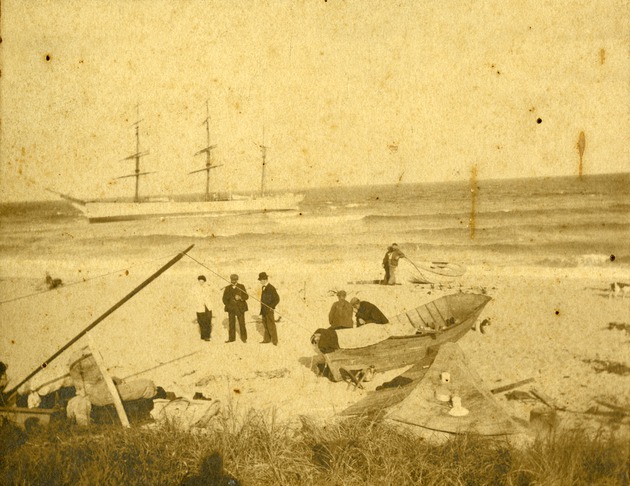
Men standing on the beach with dories laden with goods from the Coquimbo (shown in background) Photo courtesy of the Boynton Beach Historical Society

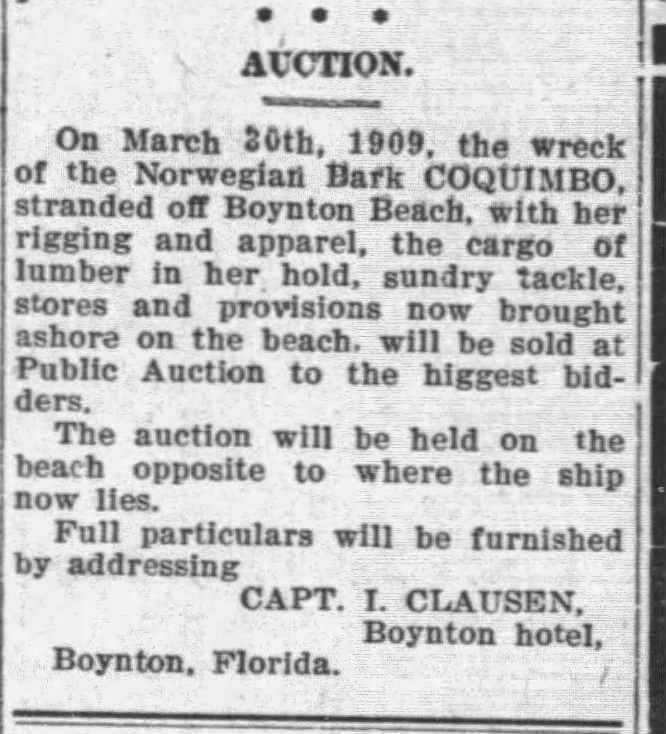
Capt. Clausen stayed at the Boynton Hotel and places ads in newspapers advising that the Coquimbo rigging, tackle, lumber and provisions were to be sold at Public Auction (24 Mar 1909)


A U.S. Marshall eventually arrived and declared that all the wood would have to be auctioned. However, he permitted the Boynton men to mark their piles, allowing them to purchase the lumber at low bids.


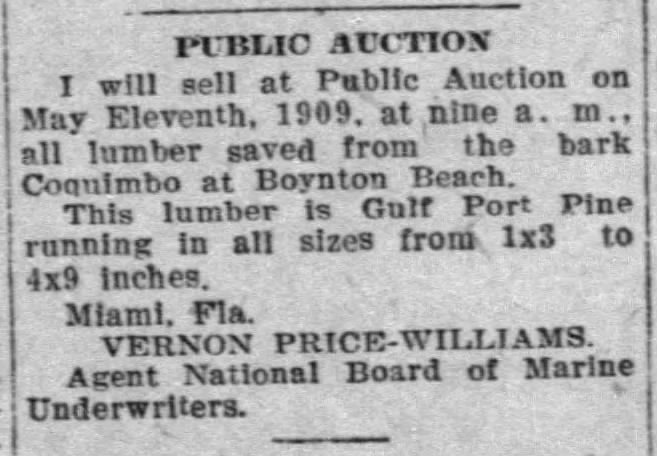
Marine underwriters Vernon Price-Williams selling Coquimbo lumber at auction (7 May 1909)


The remaining lumber was bought by a salvager from Key West, who had been informed of the wreck by the unsuccessful tugboat captain. This salvager constructed a miniature railroad that ran from the beach to the Intracoastal Waterway, using six oxen to pull a small car loaded with timber to a waiting barge. The lumber was then transported to Key West, where it was used to construct homes in what was, at the time, the wealthiest city in Florida.


THE LEGACY

The Coquimbo’s lumber played a significant role in the development of Boynton Beach and the surrounding area. Many of the early homes and businesses in Boynton were built with the salvaged wood, including the original Boynton Beach Woman’s Club, which once stood on Ocean Avenue.

The Boynton Woman’s Club building on Ocean Avenue was built from lumber salvaged from the Coquimbo. The building lasted nearly a century and was demolished for the 500 Ocean apartment complex (Photograph: Richard Katz)

The ship’s salvaged bell continued to ring at First United Methodist Church for a couple decades, and today hangs outside St. Cuthbert’s Episcopal Church. The wood, auctioned to the settlers, became an integral part of the town’s architectural history.

Horace B. Murray house, constructed with longleaf pine from the Coquimbo cargo

SKELETAL REMAINS

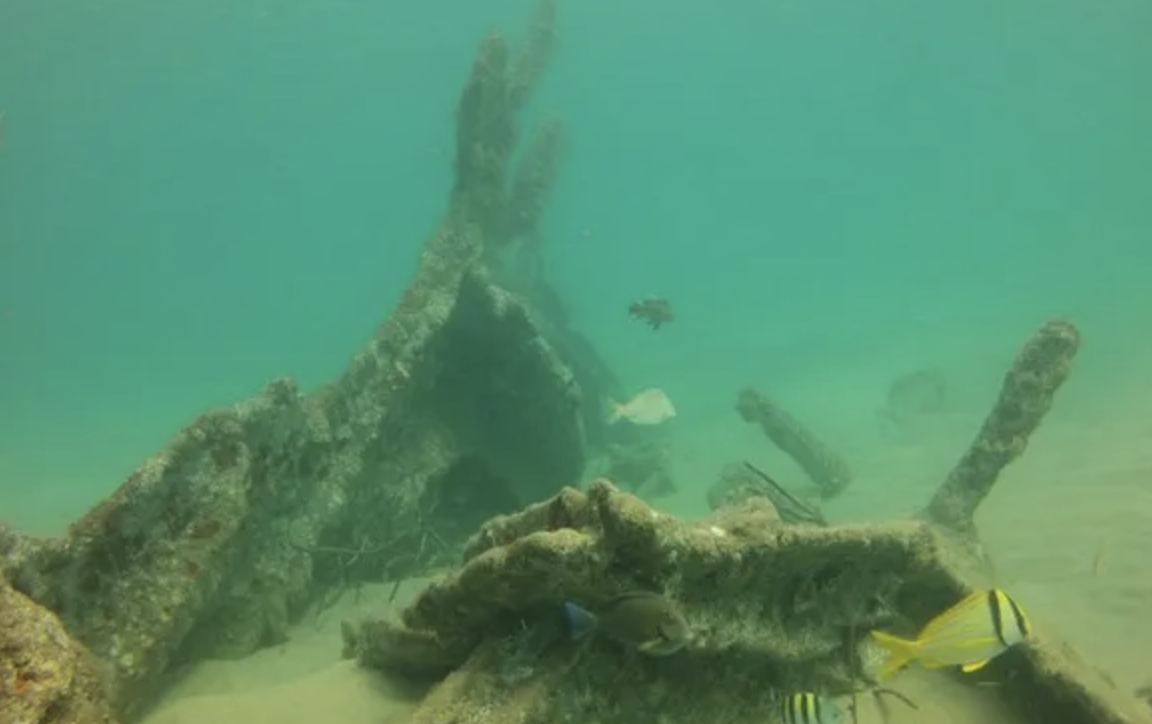
The Coquimbo herself, though, did not disappear entirely. In 1997, a magnetometer survey off the coast of Briny Breezes revealed remnants of a sailing ship. The survey team, led by local historian Steve Singer, concluded that the wreckage belonged to the Coquimbo. The ship’s bow, two masts, and other wreckage were now exposed, lying about 350 yards offshore in 15 to 17 feet of water.

An underwater photo of what Steven Dennison says is the 1909 wreck of the Coquimbo (2013, Steven Dennison photographer)

The wreckage was soon reburied under the shifting sands, only to be uncovered again in 2013 by Hurricane Sandy. It was during this time that Steven Dennison, a local resident, stumbled upon the shipwreck while snorkeling. Dennison had been exploring the waters off Ocean Ridge when he noticed something unusual on the ocean floor. As he swam closer, he realized he had discovered the long-lost Coquimbo. He found that the ship’s structure was remarkably well-preserved, with the bow, masts, and steering mechanism still intact. He shared his discovery with Joe Masterson, founder of the Marine Archaeological Research and Conservation group, who confirmed that the wreck was indeed the Coquimbo. By April 2013, the shifting sands had once again buried the ship, leaving no trace of her on the ocean floor.

LOCAL HERITAGE

The story of the Coquimbo is more than just a tale of a shipwreck; it is a story of resilience, community, and the enduring legacy of the past. The ship’s lumber helped build a town, and her wreckage continues to intrigue and inspire those who learn of her fate. The Coquimbo may be hidden beneath the sand, but her story lives on in the memories of those who cherish the history of Boynton Beach.

SOURCES

Blackerby, Cheryl. 2013. History Revealed: Sandy Uncovers Final Resting Spot of Norwegian Freighter The Coquimbo. The Coastal Star https://thecoastalstar.com/profiles/blogs/history-revealed-sandy-uncovers-final-resting-spot-of-norwegian-f

Castello, David. Wreck of the Coquimbo. https://www.boyntonbeach.com/history-of-boynton-beach/coquimbo/

Naughton, Janet DeVries. 2015. Discovery of Unusual Postcard of the 1909 Shipwreck Coquimbo and the Tale of Two Clydes. Boynton Beach Historical Society

Nichols, James H. 1980. The Wreck of the Coquimbo, Palm Beach Daily News

Singer, Steve. Norwegian Bark Coquimbo. https://www.anchorexplorations.com/bark-coquimbo-shipwreck?fbclid=IwY2xjawEyEA1leHRuA2FlbQIxMAABHVV-FT-WwwaH1fJmkGniYXtICj7sd6NnxfKUu6rnm-DNRrBCvIawlP8AHQ_aem_-qb8i1c6iBzglJoER1HWQQ

Willoughby, Hugh de Laussat II, 1885-1956, “Launching a boat, Winter 1912,” Martin Digital History, accessed August 20, 2024, http://www.martindigitalhistory.org/items/show/5992.

ORAL HISTORIES

Chadwell, Bertha Daugharty Williams, 1979, Boynton Beach City Library

Murray, Glenn L. 1978, Boynton Beach City Library

NEWSPAPERS

Daily Press, Newport News, VA

The Evening Mail, Halifax, Nova Scotia

Gulfport Record, Gulfport. Mississipi

The Macon Telegraph, Macon, Georgia

Miami Morning News-Record, Miami

The Miami News, Miami

The Ocala Evening Star, Ocala

The Palm Beach Post, West Palm Beach

South Florida Sun Sentinel, Fort Lauderdale

The Philadelphia Inquirer, Philadelphia

The Roanoke Times, Roanoke Virginia

South Florida Sun Sentinel, Fort Lauderdale

Virginian-Pilot, Norfolk, Virginia