Jean Rider Pipes: From 1930s “Sister Act” to Boynton Civic Leader

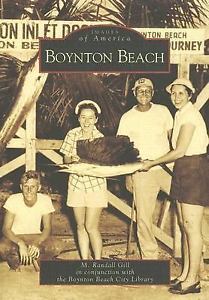
I first saw her infectious smile in 2005. Randall Gill and I, who were working together on a book “Images of America: Boynton Beach,” did not know her name. We did however recognize that the small, brown haired woman in the checkered shirt laughing as she posed holding up the sailfish epitomized the flavor of Boynton Beach in the 1950s. Our editors agreed, and out of several hundred photos considered, this ended up as the book’s cover. It helped that rugged and tan Capt. Homer Adams, well-known in the Boynton community and from a pioneer family also graced the cover. The backdrop of the fish board framed by waving palms added to the joyful scene.

Jean Rider Pipes, center (Photo courtesy Shirley Adams).

At our first book signing, appropriately held at the Boynton Beach City Library, where the book was “born,” someone excitedly announced “That’s Mrs. Pipes! She was married to Mayor Pipes.” We had a last name, but not a first. In the 1950s, many women were still referred to as Mrs. So-and-so, and only their family and friends knew their first names. In 2005, few newspaper collections were available in digital format, so learning more about the pretty lady took time, and involved good old crowd-sourcing.

At another book event, someone remembered that Mrs. Pipes taught swimming lessons. Another person revealed that Mrs. Pipes had a large in-ground swimming pool and invited neighborhood children over to swim. One of the boat captains eyed the book cover and declared “Jean Pipes, she was a wonderful lady angler and won many fishing tournaments.

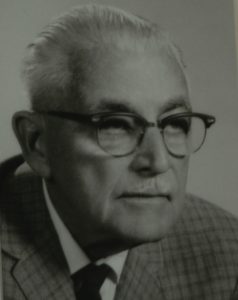
A display of photographs of past mayors hanging in the Boynton Beach Commission Chambers indicated that J. Willard Pipes was Boynton mayor in 1962. An Internet search revealed that Pipes, of Chicago, retired as vice-president of Pepsi-Cola and moved to Boynton about 1948.

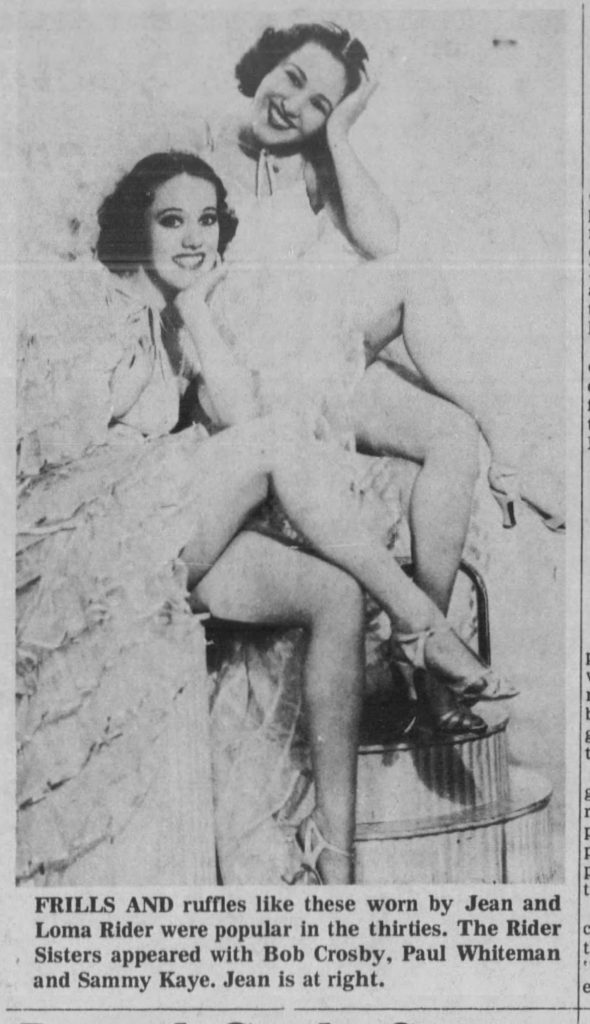
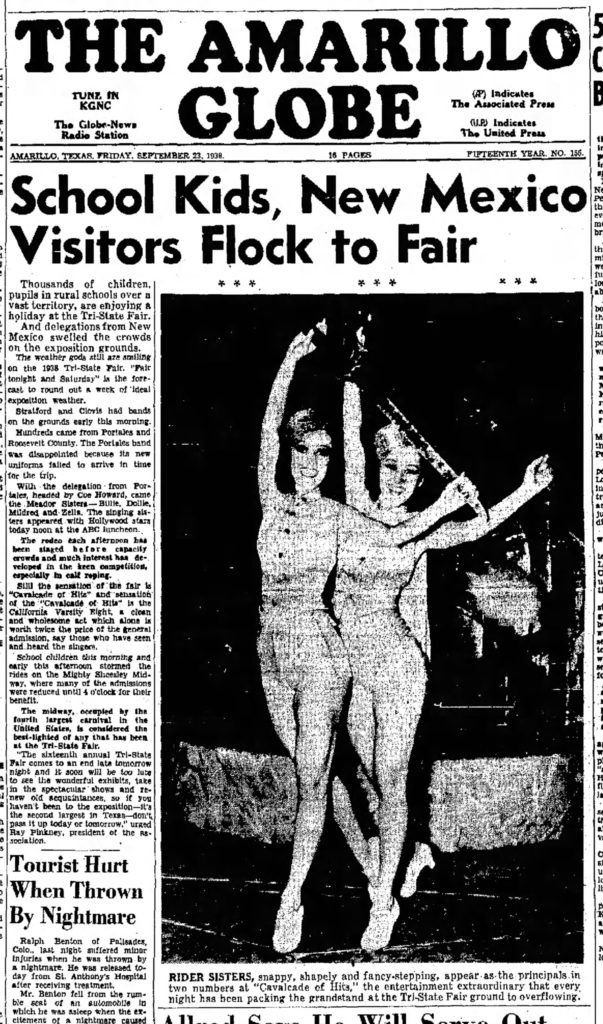
Mrs. Pipes, or Jean as we now knew her, previously led the the dazzling life of a vaudeville-like entertainer – dancing and singing with her sister Loma as a sister act. Jean and Loma performed as The Rider Sisters and tap-danced and sang their way around Illinois, Wisconsin, Michigan, Indiana and Ohio. The duo had gigs in theaters, night clubs and county fairs. They were famous.

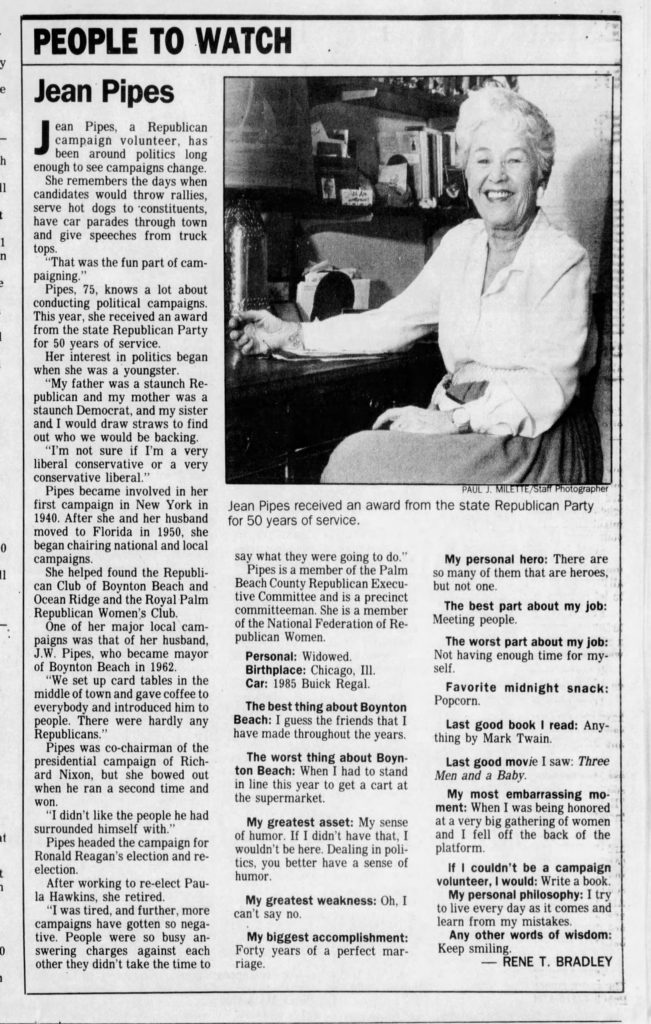
Once in Boynton Beach, Jean didn’t totally hang up her dancing shoes, but she channeled some of her energy and vivaciousness into transforming the sleepy bedroom community. She quickly got to work championing for a hospital (Bethesda) and organizing the Royal Palm Republican Club Federated. She helped found the Boynton Lantana Business and Professional Women’s Club and served on the board for the Palm Beach County Libraries and numerous other affiliations.

She enjoyed the outdoors, and the thrill of landing “the big one.” She opened her swimming pool to the neighborhood children. She positioned her husband Willard to become mayor of Boynton. It’s somewhat surprising that she didn’t run for mayor herself.

Rider Road and Willard Way east of Federal are named after Jean Rider and Willard Pipes. Jean Rider Pipes lived in Boynton until her 1999 death, and newspapers from the previous fifty years in Boynton are peppered with her contagious smile. News clips from the 1930s portray the “double pleasure” entertainment of the Rider Sisters. Jean’s obituary claimed that her motto was “Invest in People.” She lived her life well, and left an indelible mark and a little bit of her sparkle upon Boynton Beach.

Palm Beach County’s First Automobiles

1905 – Florida requires automobile registration

Florida Memory - Early Auto Registrations, 1905-1917

Florida Memory – Early Auto Registrations, 1905-1917

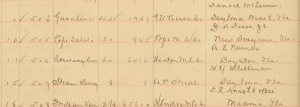
In 2015, the State Archives of Florida digitized the first two volumes of motor vehicle registrations recorded by the Florida Department of State. These ledger pages, found online at Florida Memory, Found Here contain detailed information recorded between 1905 and 1917 about our earliest vehicles, including the registered owner, city, county, make, model and horsepower of each automobile and motorcycle.

George Potter

George W. Potter was the first person in this part of the state (Palm Beach County) to legally register his automobile with the state.

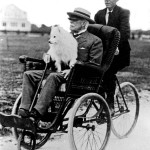
George Potter, courtesy Potter Collection, Historical Society of Palm Beach County

George Potter, courtesy Potter Collection, Historical Society of Palm Beach County

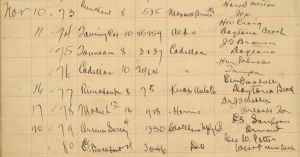
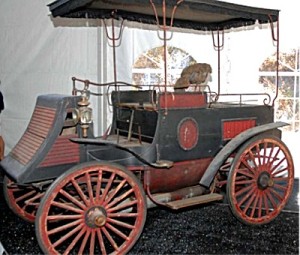
Other horseless carriages were dotting the sandy roads, but Potter’s registration of a lightweight, four-horsepower Orient Buckboard, recorded November 20, 1905, was the 80th registered vehicle in the entire state of Florida. Before moving to Florida, Potter studied art and engineering in Cincinnati. His great grandson, David Willson, cartoonist for the Palm Beach Daily News, recounts how you could tell Potter had a fascination with all things mechanical as his sketches were filled with bridges and steam boats.

Record #80 Geo. W. Potter Nov. 20, 1905 vehicle registration

Record #80
Geo. W. Potter Nov. 20, 1905 vehicle registration

Waltham Manufacturing Company was a manufacturer of automobiles in Waltham, Massachusetts, including the Orient Buckboard, between 1902 and 1908

Henry M. Flagler

Henry M. Flagler, courtesy Library of Congress

Henry M. Flagler, courtesy Library of Congress

Henry Morrison Flagler registered his vehicle on December 6, 1905, a few weeks after Potter. Local history sources contend that Flagler did not allow motorized vehicles on his luxury island resort at Palm Beach, instead preferring guests to traverse through the gardens and jungle trials via wicker rickshaw bicycles, powered by Negro guides.
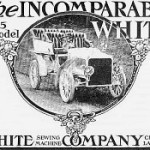
White Auto Co. 1905

White Auto Co. 1905


Flagler’s vehicle, listed as a Touring Car manufactured by White Sew’g Mch. Co. (White Sewing Machine Co./White Motor Co.) operated on steam, hence the vehicle was not a noisy as other autos of the time. Presidents William Taft and Theodore Roosevelt also owned White Motor Company automobiles during this time period.

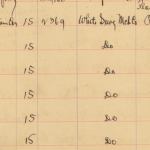
Florida East Coast Hotel Automobile Registrations

Florida East Coast Hotel Automobile Registrations


Florida East Coast Hotel System

The vehicle must have served Flagler well, for in the next few months his Florida East Coast Hotel system purchased and registered five additional identical touring cars.

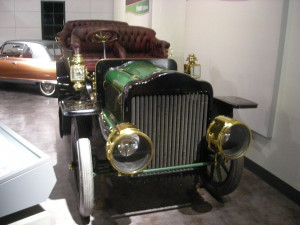
1907 White Touring Steam Car, courtesy Henry Ford Museum

1907 White Touring Steam Car, courtesy Henry Ford Museum

Boynton Hotel Company President A.E. Parker

A. E. Parker Touring Car Record

A. E. Parker Touring Car Record

In January 1908, Albert Edward Parker, manager of the Boynton oceanfront hotel and son-in-law of hotel owner Maj. Nathan Smith Boynton, registered his 30-horsepower Winton M.C. Co. Touring Car. Parker conducted business in both West Palm Beach and Miami, and likely used the old, bumpy sand trail to traverse the county for business purposes and to take hotel guests on sight-seeing tours.
Winton Motor Carriage Car

Winton Motor Carriage Car


1908 – 500 registered vehicles in Florida

By 1908, 500 vehicles were registered in the state of Florida.


2016 – Over 20,000,000 registered vehicles in Florida

Currently, there are over twenty million vehicles registered in Florida, with 1.2 million in Palm Beach County.

Vehicles registered in the State of Florida as of February 5, 2016

DRIVE SAFE!

Boynton’s Strange Connection with two of America’s most Popular Songs

Jonathan_Edwards_Spilman.tif

J.E. Spilman

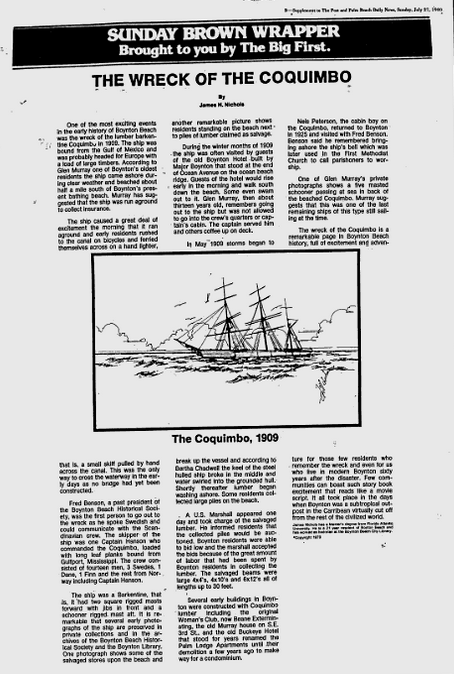
The hamlet of Boynton, as it stood at the turn of the twentieth century, has direct connections with two of the most popular songs in American history. One of the most popular songs of the nineteenth century was Flow Gently, Sweet Afton, with music written by Jonathan E. Spilman, set to the poem by Robert Burns. Written in 1838, the sheet music was found in all the major song books of the time and remains a popular tune. A search of YouTube finds dozens of renditions; one of the most popular recent versions is by Nickel Creek: https://www.youtube.com/watch?v=oNrSMLQ8P7c

The connection to Boynton? The composer, J.E. Spilman, was Byrd Spilman Dewey’s father! Spilman had written the song while a law student at Transylvania Law School. Spilman wrote other melodies which can be heard by clicking here.

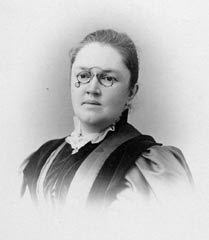
If that were not enough, then there is America the Beautiful; many think that this song should be our national anthem. The song’s lyrics are the work of Katherine Lee Bates, who graduated from Wellesley in 1880; music by Samuel A. Ward. Cora Stickney Harper was one of Katherine’s best friends at Wellesley, and they remained lifelong friends.

Katherine Lee Bates

Katherine Lee Bates

Cora founded the Boynton Women’s Club in 1909. This rendition of the song is quite beautiful – https://www.youtube.com/watch?v=EmP9LvHgcaA. The song with lyrics was first published in 1910, so Cora would have heard it while living in Boynton.

Maybe it is just that “six degrees of separation” thing, but the connections are noteworthy.

The “Other” Boynton Beach

In my days working as archivist for the Boynton Beach City Library, every once in a while I’d get a phone call from an enthusiastic caller who thought they discovered a rare image of Boynton Beach. I adore finding new (old) images of Boynton Beach, so you can imagine my excitement as I anticipated this revealing, deeper glimpse into the faded history of our fair city.

A group of young people enjoying the time at the shore.

A group of young people enjoying the time at the shore.

Envision my disappointment, and theirs, when I scrutinized the photograph and determined it was not Boynton Beach, Florida.

How did I know the images were not Boynton Beach? Well, the trees weren’t right (we had pines and palms). The big Ferris Wheel and merry-go-round, while resplendent for their time, weren’t representative of our Boynton Beach.

Beach-goers flocked to the New Jersey shore in the summer-time.

Beach-goers flocked to the New Jersey shore in the summer-time.

The other Boynton Beach, in this case, was a New Jersey waterfront resort established by another Boynton, Cassimer Whitman Boynton, a native of Maine. It was located in Woodbridge Township near Perth Amboy.


There are many similarities and even more differences in Boynton Beach, New Jersey and Boynton Beach, Florida.


One of the amenities in Boynton Beach, New Jersey

One of the amenities in Boynton Beach, New Jersey

Similarities between Boynton Beach, New Jersey (also known as Sewaren) and the Boynton Beach Hotel in Florida.


  • Both places called Boynton Beach
  • Both established as resorts for wealthy northerners
  • Both on the waterfront
  • Both offered postcards as souvenirs to guests
  • Both had wooden hotels for guests to stay
  • Visitors arrived to both resorts via train or boat
  • Both had a bathing beach with a bathhouse
  • Both had a shooting range
  • Both offered fishing and boating excursions
  • Both began in the late 1800s
  • Both the resort in New Jersey and the Hotel Boynton in Florida closed by 1925


Pleasure boating.

Pleasure boating.

Differences between Boynton Beach, New Jersey (also known as Sewaren) and the Boynton Beach Hotel in Florida (established by Major Nathan Smith Boynton of Port Huron, Michigan).


This undivided back postcard shows the bathing beach and bathhouses.

This undivided back postcard shows the bathing beach and bath houses.

  • Started by different Boynton families (they were both descendants of Sir Matthew Boynton)
  • The Boynton Beach in New Jersey attracted visitors in the summer months
  • The Boynton Beach in Florida attracted visitors in the winter months
  • The Boynton Beach in New Jersey offered amusement rides, a Nickelodeon, photographic booths and pony rides.
  • The Boynton Beach in New Jersey had a hot dog stand and an ice cream stand
  • The Boynton Beach in Florida offered dining in the Boynton Beach Hotel dining room. Meals were included for $2.00 a day in 1898.
  • The Boynton Beach in New Jersey had a dance pavilion with live orchestra’s every Saturday in night in the summer.
  • The Boynton Beach in New Jersey had a pier.
The Ferris Wheel. Boynton Beach, New Jersey

The Ferris Wheel. Boynton Beach, New Jersey


Both of the resorts closed by 1925. The New Jersey property was sold to the Shell Oil Company. The Florida Boynton property was managed by A.E. Parker, Major Boynton’s son-in-law until 1925. The area is now known as Ocean Ridge.


The Dancing Pavillion. Boynton Beach, New Jersey

The Dancing Pavillion. Boynton Beach, New Jersey


The faded picture postcards of both Boynton Beach resorts are the remnants of this idyllic time in history.

Pre- 1907 postcard of Boynton Beach New Jersey.

Pre- 1907 postcard of Boynton Beach New Jersey.

More information about Boynton Beach in New Jersey may be found at the following websites:


Hatala, Greg. The Star Ledger. (2013)

http://www.nj.com/middlesex/index.ssf/2013/07/glimpse_of_history_cabanas_at_boynton_beach.html

History of Sewaren. http://mhswebtvprinting.tripod.com/wrcsewarenhistory.html.

ThatNJVideoGuy. Historical Boynton Beach. https://www.youtube.com/watch?v=VpnS1jlVxG0.

http://www.nj.com/middlesex/index.ssf/2013/07/glimpse_of_history_cabanas_at_boynton_beach.html

Trueger, V. Sewaren’s History. (2011) Garden State Legacy. Issue 11. http://gardenstatelegacy.com/files/Sewarens_Heyday_Troeger_GSL11_PRINT.pdf.