A STORIED PAST
Some people might claim the old Boynton restaurant held some type of curse. We know that its proprietors and managers met unnatural deaths. Within eight years, four people perished in three separate incidents on and around the Stone Lodge.
THE STONE LODGE RESTAURANT
The roadside eatery, known as the Stone Lodge, operated from 1924 to 1940 1 1/2 miles south of Boynton’s Ocean Avenue along U.S. 1. The property intersects with the road known today as SE 23rd Avenue. Further west that roadway turns into Golf Road as it continues on to Military Trail past the Village of Golf, Delray Dunes and Country Club Stables.
The lodge occupied the land west of U.S. 1, where the Marathon gas station is today. When the 1920 Federal census enumerators came through Boynton, they counted about 550 people living here, and its residents were primarily laborers, tradesmen and farming and fishing families.
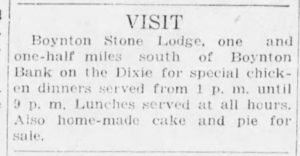
Stone Lodge ad (20 Feb. 1925, The Palm Beach Post)
Initially, the lodge only operated as a seasonal lunch stand type restaurant, typically open from November through April. Austin Abbot Stone and wife Louisa Jane Turner opened the establishment in 1924. The Stones owned and operated a bakery and rooming house in Massachusetts. They began wintering in Boynton about 1923/24, as did Louisa’s two younger sisters, Grace and Mabel.
MOUTH WATERING HOME COOKING
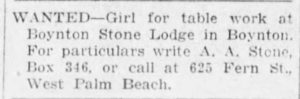
Help Wanted at Boynton Stone Lodge ad (20 Jun 1925, The Palm Beach Post).
The Stones served hearty home cooked lunches like ham and alligator pear sandwiches on thick slices of bread that they baked daily. Their chickens supplied plentiful eggs and fresh chicken to be roasted or fried and served to hungry guests. Razor-back hogs, wild turkeys and deer provided other protein. Boynton’s bounty of fish and oysters supplemented the green beans, sweet potatoes, tomatoes and other vegetables from their garden. Freshly squeezed seasonal orange and grapefruit juice and milk from the cows kept on the property washed down delicious desserts like cocoanut cake and huckleberry pie.
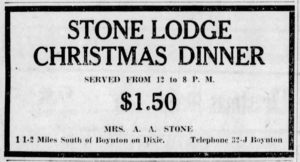
Stone Lodge ad (23 Dec. 1927, The Palm Beach Post)
By 1925 the Stones took out Help Wanted ads in the Palm Beach Post seeking kitchen help and tea room attendants. They began advertising their “Chicken and Waffle Dinners” with large ads in The Post, The Lake Worth Herald and Miami News show similar advertisements, and society news columns tell about the lively luncheons, meetings and dinner parties at the Lodge.
HURRICANES
According to news accounts, an unnamed 1926 hurricane shuttered the restaurant for a season Since the Stones only wintered in Boynton, they were not in town during the hurricane season. In 1928, two more hurricanes hit Florida’s east coast, including the devastating “Okeechobee” killer ‘cane.
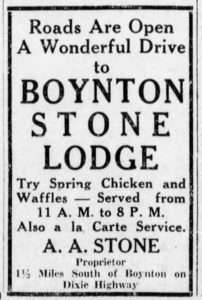
Ad for Boynton Stone Lodge (16 Apr. 1927, The Palm Beach Post).
An advertisement for the Stone Lodge Restaurant indicated that the restaurant closed due to road washout and obstruction caused by the hurricanes. Since the rural nature of Boynton at the time considered the isolated place as “in the boonies,” the roadways between Boynton and Delray were likely not a priority for improving.
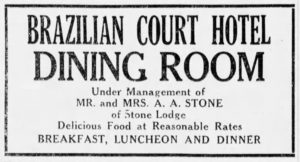
Mr. and Mrs. Stone operating the Brazilian Court Hotel Dining Room (17 Nov. 1928, The Palm Beach Post).
It is unclear if the restaurant itself sustained damage. It’s probably that the enterprising Stones had another couple to manage the Stone Lodge, since in November, 1929 Austin and Louisa Stone were managing The Brazilian Court Dining Room at the swanky boom-time Brazilian Court Apartments in Palm Beach.
The renovated eatery opened in 1929 adding “Fried Chicken and Fish Dinners,” and boasted that it attracted an élite clientele. In other words, it was pricy, and it is likely that more snowbirds and club women dined at the eatery than Boynton locals. There was not much along U.S. 1 in those early years. The 1930 Federal Census shows that Mr. and Mrs. Roland Owens who operated the Lee Manor Inn next to the Boynton Woman’s Club were enumerated as their nearest neighbors to the north.
By the 1930s, one can see that the Depression has set in, and the Stone’s featured “summer specials,” including breakfast, lunch, dinner, homemade cake and pie. The aging, hardworking couple had hired help that probably boarded with them. The establishment’s size is not disclosed in news accounts, however, since the Stones had “boarders” living with them in Massachusetts, the lodge probably served as a temporary home to northern visitors.
DEATH BY ELECTROCUTION
Austin Stone, the Stone Lodge’s namesake, met his demise in the inn’s wash-house in 1932. According to The Post, a family member (probably his wife Louisa) found the unresponsive 74-year-old proprietor on the laundry room floor in a puddle of water, with both hands severely burned.
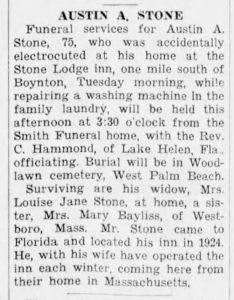
Death notice for Austin A. Stone, electrocuted at home repairing a washing machine (11 Feb. 1932, The Palm Beach Post).
Mr. Stone had attempted to fix a washing machine while standing in a puddle. Dr. Nat Weems and medics dispatched from Smith Funeral Home in Lake Worth administered mouth-to-mouth resuscitation to the restaurant owner for over an hour with no avail. Dr. Weems listed primary cause of death as electrocution (accidental), and recorded senility as secondary cause.
STOIC MRS. STONE WORKS TO KEEP THE RESTAURANT
During the Great Depression, the widow Stone rented out rooms with board and continued to run the Stone Lodge Restaurant. On the 1935 Florida census, her sister Mabel and brother-in-law Jay Herbert Gould are listed as family members; their occupations are both bakers. Discounted lunches and dinners are once again advertised in The Post. It was what Little Orphan Annie called a “hard-knock life.” Few people had the money to dine out, and those that did, were not spending their time or discretionary income in Boynton.
FOR SALE
After her sister Mabel’s husband died in 1937, Louisa attempted to sell the Lodge, including the house, restaurant and surrounding property. A Palm Beach Post advertisement illustrates that the complex included fully stocked acreage of over three acres, chicken coop and other outbuildings, house, established restaurant with a favorable reputation.
PLEA FOR HELP
As the 1939 season began, Louise again advertised her property, this time with a $5K price tag. On October 30th, the Palm Beach Post ran a wanted ad in which Louise sought a couple to manage the property. It stipulated that the Stone Lodge had an established clientele and had continuously operated for over 14 seasons with the same owner.
PREPARING FOR THANKSGIVING
On November 12, 1939, Louisa Turner Stone awoke early, as usual, and headed out to the Stone Lodge’s chicken coop. Running a restaurant was hard work, and even on a weekend morning, much work had to be done. Thanksgiving and Christmas were approaching, and business at the restaurant was picking up. Earlier in the year, a wild grass fire started at J.J. Williams Fernery had threatened the Stone and Woolbright properties, and severely damaged the Boynton Nurseries. Louisa had recently hired a couple to help her operate the restaurant for the season, and placed prominent advertisements for holiday dinners (this year the fare included roast duck) in The Post. She was probably feeling optimistic, perhaps even excited on that Sunday morning.
TRAGEDY RATTLES BOYNTON
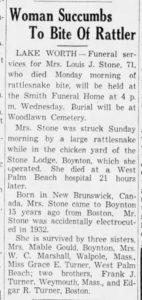
Death notice for Louise J. Turner Stone fatally bit by a rattlesnake (14 Nov. 1939, The Palm Beach Post).
While Louisa was in a chicken yard, a large rattlesnake bit the 71-year-old. Her certificate of death signed by Dr. William Ernest Van Landingham indicates that she died from the rattlesnake bite at 7:00 a.m. the next day at Good Samaritan Hospital in West Palm Beach. Good Samaritan, was the the closest hospital to Boynton in those days. Someone, either the new restaurant manager, or Louisa’s sister Mabel, who served as informant on the death record, drove the victim 17 miles up U.S. 1 to no avail.
BITING BACK
Two days later, Joe Harless and Paul Mercer were motoring down U.S. 1 on their way to the opening of the Delray Beach Country Club. The duo saw a large rattler in the road outside the Stone Lodge. The newspaper article reported that the men stopped the car, and Mercer stepped out and used his golf club to whack the snake and completely sever its head. Whether the rattler was the same one that fatally struck Louisa Stone, we will never know, but on that day one less rattlesnake lived in Boynton. 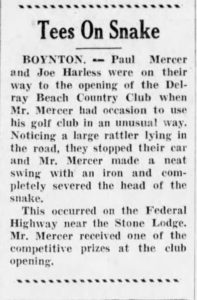
Smith Funeral Home held services for Mrs. Stone. She was laid to rest in Woodlawn Cemetery next to her husband Austin. Their tombstones are in the old section, and one can stay that I have walked amid the Stones many times on our Historic Moonlight Cemetery Tours. Their story, and that of the old Stone Lodge Restaurant will live on through this blog and on the historic tours.
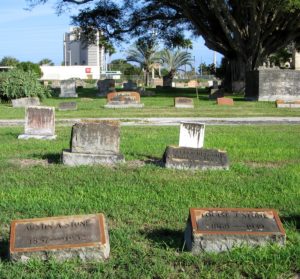
Woodlawn Cemetery, West Palm Beach looking east. Pillow headstones for Austin and Louisa Stone are in the forefront.
DOUBLE SUICIDE
One would think that those two horrendous events at the Stone Lodge proved tragic enough. Unfortunately, there is more to the story. It appears that the restaurant operated through the holidays and the rest of the season, probably under the management of Mabel and the newly hired couple. Then, on April 1st the following year, two bodies were found dead in a car outside the lodge. A garden hose was taped to the car’s exhaust and run inside the window. Justice of the Peace W.F. Ridel determined it a double suicide.
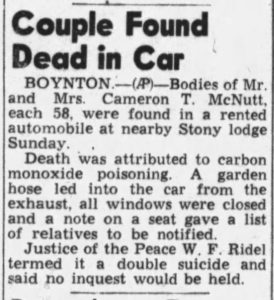
Former Ringling Brothers performers commit double suicide in car outside Boynton eatery (1 April 1940, Tampa Bay Times)
The
Palm Beach Post reported former vaudeville and Ringling Brother’s Circus performers Joseph and Laura Cameron McNutt who had managed the Stone Lodge committed a double suicide. The married couple left two notes in the car, one indicating that they should be cremated, and another saying that the car was rented.
In July, 1941 The Post published an ad offering the Stone complex and property for $5K. Augustus Robinson from Hartford, Connecticut purchased the property, Robinson also bought adjacent properties and filed a plat for his subdivision in 1951.
If you have any memories, tales or photos of the old Stone Lodge, we’d love to see/hear more about the establishment.