The Notorious Ashley Gang and Its Surprising Boynton Connections

INTRODUCTION

This research chronicles Florida’s notorious Ashley Gang and their connections to Boynton Beach. Readers will learn about John Ashley and his infamous bank-robbing posse that kept a secret hideout in western Boynton, held-up trains and  interacted with unsuspecting Boynton residents.  

In addition, we share the surprising revelation of a prominent  Boynton pioneer family whose 16-year-old daughter married into the outlaw Mobley-Ashley family and some speculation of how Boynton locals supplied the gang with groceries and sundries—and one famous son who even lent Ashley his pistol!

1888

John Ashley is born near Fort Myers, Florida.

1896 – December

Horace Bentley Murray and his wife Mary Elizabeth Smith moved to Boynton from Michigan. Murray was a tomato farmer and crew leader/carpenter for Major Nathan S. Boynton’s oceanfront hotel.
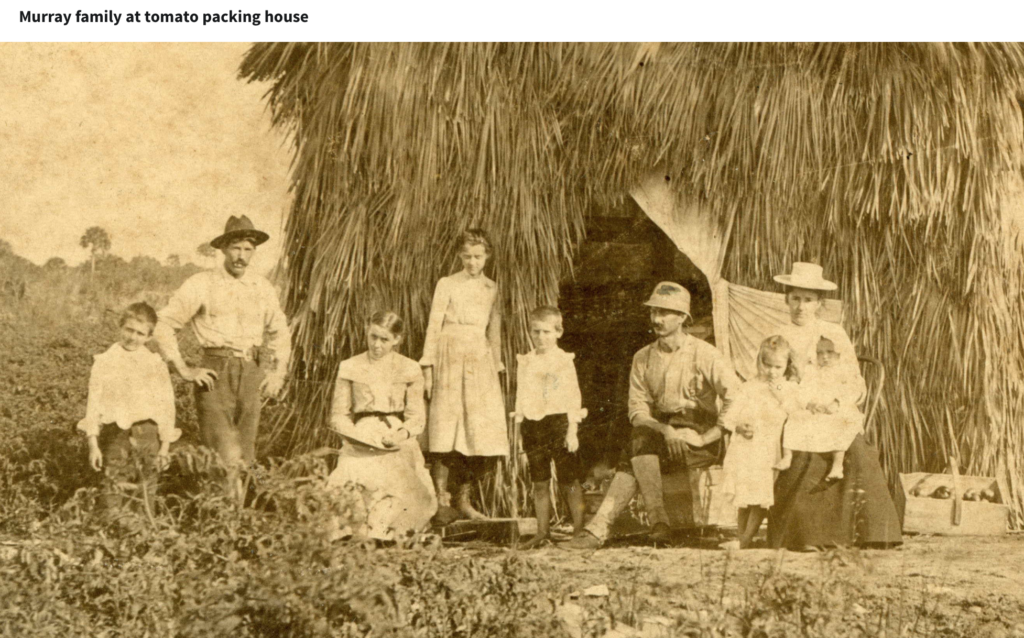
Horace Murray & wife Mary Smith Murray (far right), with William Henry “Uncle Billy” Smith to the left, along with Murray children and an unnamed Boynton schoolteacher (Boynton Beach Historical Society)

1898

Mary Smith Murray’s younger brother William Henry “Billy” Smith and his wife moved to Boynton and lived near the Murray family. Local historical accounts don’t mention much of Smith, but he is identified in a Murray family photo as “Uncle Billy.”

It was that photo that instigated the research which led to the Ashley Gang connection. In the photo, Billy appears rugged and self-confident, wearing a wide-brimmed hat and long-sleeved shirt while standing in front of the Murray’s palmetto frond packing shed. While you don’t see any visible guns in the photo, it’s likely that Smith was packing a pistol, as in the wilds of tropical Florida wildlife outnumbered humans, and gun ownership (revolvers and rifles) was very important. Billy Smith farmed and became Palm Beach County Supervisor of Roads. Mary Smith’s sister, Lillie, lived in Boynton her entire life, and married carpenter Charles Davies.

Billy Smith and wife Florence had four daughters; it was teenaged Dorothy Louise (born in 1913) who married into the Mobley-Ashley family at age 15— Louise’s daughter, Mary Lou Mobley, child of the notorious Lubby Mobley was born two months later. John Robert “Lubby” Mobley was born to gang members George Westley “West” Mobley and Mary Alice Ashley (John Ashley’s sister). Lubby lived a crime-riddled gangster life both before and after his 1928 marriage to Dorothy Smith. 

1911 – December

JOHN ASHLEY ACCUSED OF MURDERING FELLOW TRAPPER DESOTO TIGER
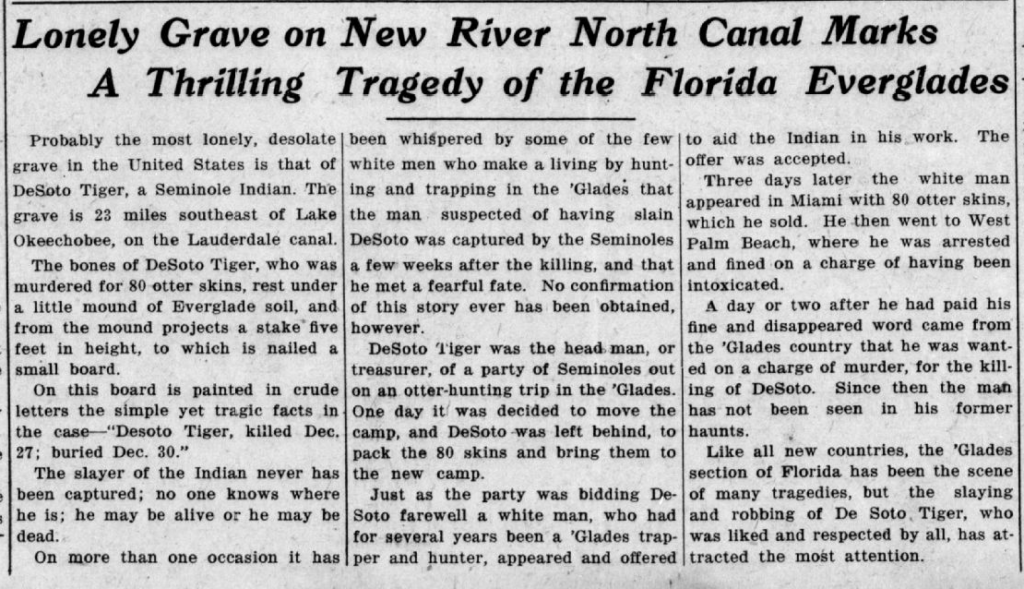
DeSoto Tiger’s Gravesite (9 Oct 1913, Lake Worth Herald)

The Boynton story begins shortly after 19-year-old trapper John Ashley was wanted  for the December 1911 murder of DeSoto Tiger, son of Cow Creek chief Tommy Tiger. Ashley was the last person seen in a canoe with DeSoto and was spotted selling a load of valuable otter skins. Later, in 1915, Ashley would testify on his own behalf and claim self-defense in Tiger’s killing.
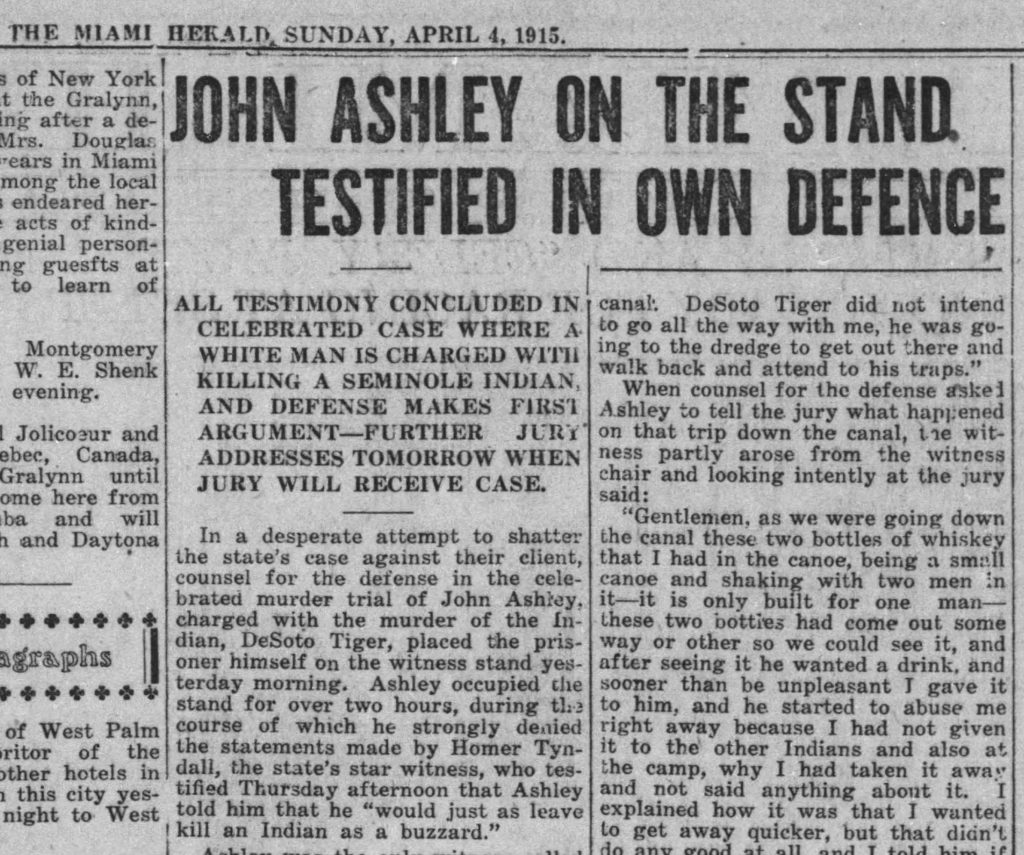
A charming John Ashley testifies on his own defense saying that the DeSoto Tiger shooting was self-defense (4 April 1915, The Miami Herald)

1910-1912


JOHN ASHLEY CAMP DISCOVERED  IN WESTERN BOYNTON

According to Marvin Pope “Ham” Anthony in a Historical Society of Palm Beach County oral history interview with Harvey E. Oyer III, Joe Ashley (John Ashley’s father) and one of John’s brothers both worked at the Anthony’s Store in the men’s wear department around this time. Anthony’s father was friends with both the Ashley and Mobley families and claimed that they were good, outstanding people. John Ashley was really the only bad one. The Mobleys lived on Tanglewood Court in West Palm Beach.

Anthony related a surprising story about Boynton’s Chuck Pierce [Charles W. Pierce, Jr.] who worked in the sporting goods department at Anthony’s, who was given a pistol for Christmas. Pierce and a friend were “out back of Boynton where their home was.” Pierce told Anthony that while out in the woods the two boys met a nice-looking man who inquired what they were doing. When they said they were just turkey hunting, the man offered to do it for them and asked for the gun. After a long time, they finally heard a shot, and the fellow gave them a turkey and the gun back. The Ashley Gang robbed the Bank of Boynton a few weeks later. As the story goes, one of the boys went up to see what the handcuffed thugs looked like “…and this nice-looking man looked over and winked at him and said ‘Son, how was that turkey?’” Apparently Chuck Pierce had loaned his new pistol to the bandit John Ashley.
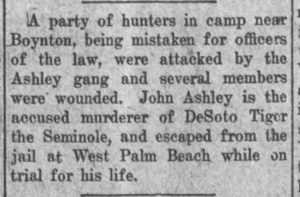
Boynton hunting party attacked by Ashley Gang 19 Feb 1915, Orlando Evening Star)

1915 February

John Ashley and his band of thugs terrorized and machine-gunned a hunting party camped out west of Boynton near the Rangeline (State Road 441).
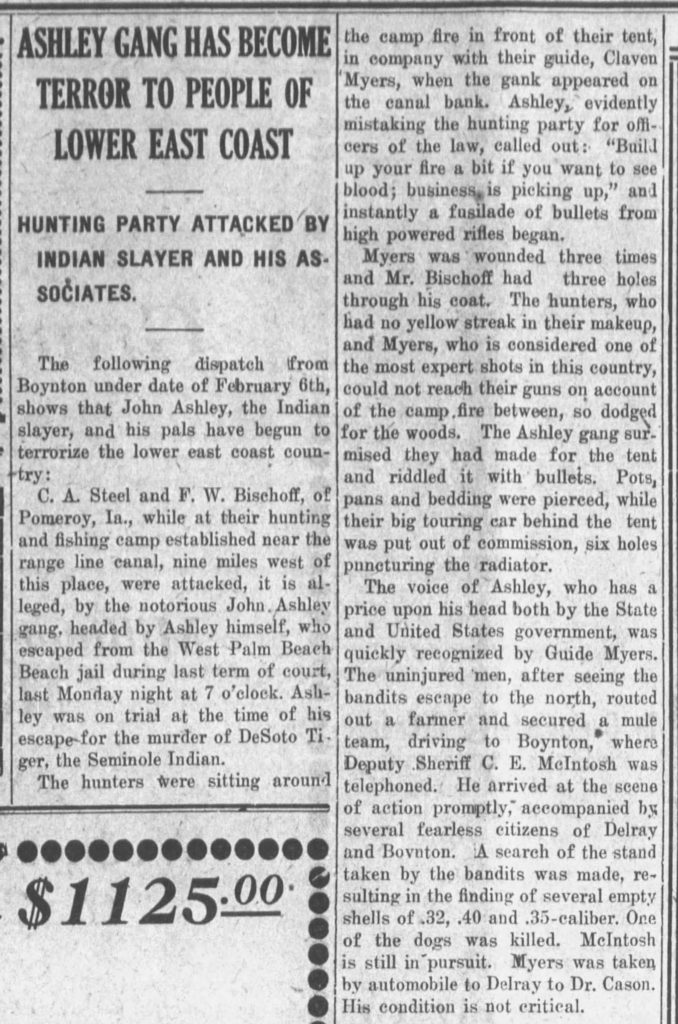


(19 Feb 1915, Orlando Evening Star)

1914 November

JAIL BREAK

John Ashley breaks out of jail.

1915 – February

BLUNDERING BANDITS

The Ashley Gang robs the Stuart Bank. John Ashley loses his right eye when his accomplice accidentally shoots him. Since Ashley’s wound demanded medical attention, the fugitive was apprehended.
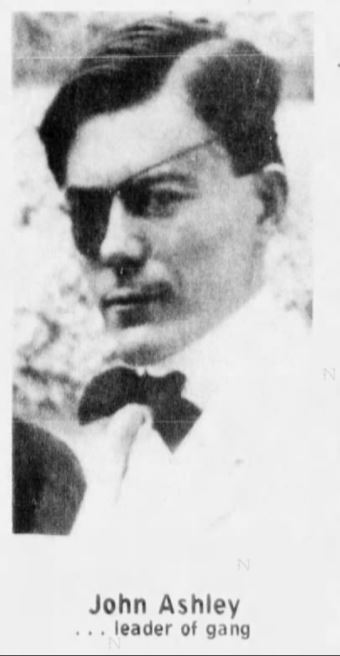
John Ashley, leader of gang

1915 – February

30 local men form a posse to hunt down the “organized crime family” that had no respect for the law. Sheriff Baker wanted them “dead or alive.”

1915 March

Ashley is captured and imprisoned in the Miami jail.

1915 June

Bob Ashley (John’s brother) ambushes and kills Miami Police Department Deputy Sheriff Wilber W. Hendrickson in an attempt to release John Ashley.  In the process, Bob Ashley and another police officer,  John Rhinehart “Bob” Riblet are killed. (Sheriff Hendrickson was a great uncle of Boynton resident Jean Ann Thurber and brother to her grandfather.)
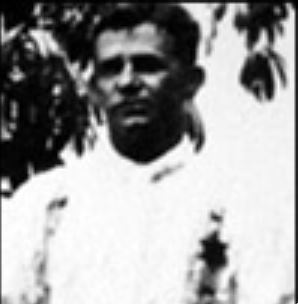
Miami Deputy Sheriff – Wilber Hendrickson

Photo shown below: (L-R) Alvin Hendrickson and Captain U.D. Hendrickson (uncles of Wilbur Sr.), Dorothy Hendrickson, Etta Hendrickson, and Frances Lane Hendrickson Bridgeman (Etta was U.D.’s wife and the mother of Dorothy and Frances), Marion Platt Hendrickson, Wilbur W. Hendrickson Sr. and Wilbur W. Hendrickson Jr. (Jean Ann Thurber Photo)
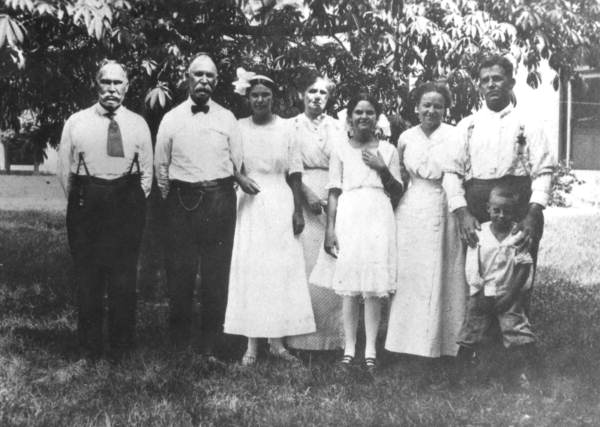
Hendrickson Family, courtesy Jean Ann Thurber

1916

John Ashley sentenced to 17 ½ years for the Stuart Bank heist. Ashley is finally sent to prison. Two years later he escaped from a road gang. John Ashley is once again a fugitive from the law. 

1920

The early Boynton Bank was a repeat victim. “Ashley’s here!” Tellers would fill up their bags; no alarms or dye packs at that time. The notorious outlaws rob banks across Florida including Fort Meade, Avon Park, Pompano Beach, and Stuart.

1921

Horace Bentley Murray, Billy Smith’s brother-in-law, is elected Boynton mayor.
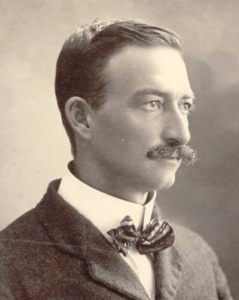
Horace Bentley Murray
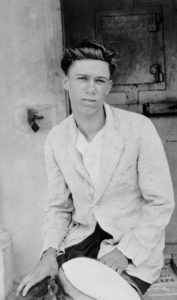
Hanford Mobley, Ashley Gang Leader  (Florida Photographic Collection)


1922 May

The Ashley gang (ordered by John while he was still in jail) made their second robbery of the Stuart Bank. Hanford Mobley, (John Ashley’s nephew and brother of Dorothy Smith Mobley’s husband Lubby) assumed leadership of the gang.  The handsome teenager held up the bank dressed as a woman and fled with $8,000.

A posse of men from the sheriff’s office chased them for 265 miles and deputy Sheriff Morris R. Johns dropped dead from indigestion two days after the unsuccessful hunt.
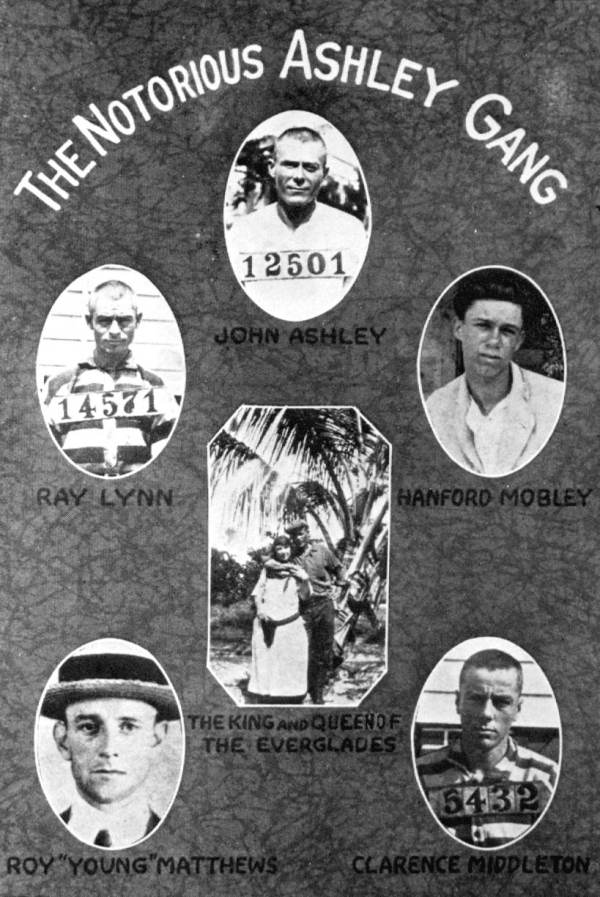
Members of the notorious Ashley Gang

1924 February

 Hanford Mobley robbed the Florida East Coast Railway train.

1924 September

The Mobley-Ashley gang robbed the Pompano Bank of $9,000.

1924 November

DAY OF RECKONING

Deputy Frederick A. Baker led a posse of over 50 men to the Ashley/Mobley camp. Some were equipped with guns borrowed from the old National Guard armory. As the posse entered the camp, the fugitives opened fire. Deputy Baker and Joe Ashley were killed in the shootout. Laura Upthegrove was wounded, but escaped. The remaining fugitives hid in the Everglades as their hideout was burned to the ground. 
Deputy Fred Baker and Joe Ashley Killed (8 Jan 1924 The Lake Worth Herald)


In a carefully orchestrated trap on the Sebastian bridge, four additional members of the Mobley-Ashley gang were shot and killed along with Deputy Sheriff Fred Baker. The four outlaws were John Ashley, nephew Hanford Mobley, Ray Lynn and Clarence Middleton. The Palm Beach Post reported that the slaying of Ashley gang brings end to career of crime.
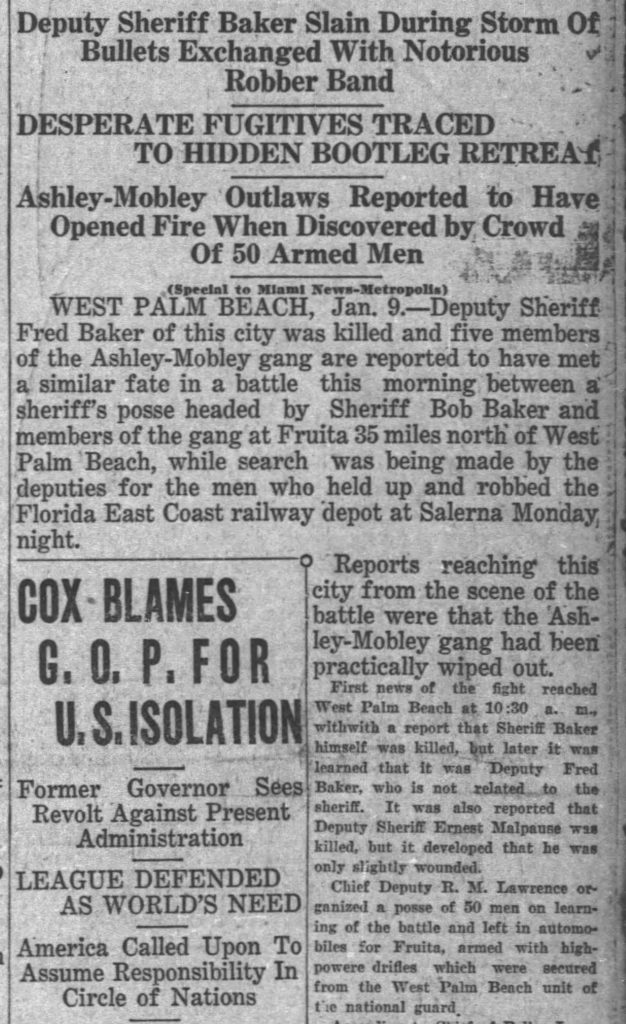
Deputy Fred Baker killed by Ashley-Mobley Gang (9 Jan 1924, The Miami News).

1927

Laura Upthegrove dies after drinking a bottle of disinfectant. The “Queen of the Everglades” is buried in Woodlawn Cemetery in West Palm Beach, in an unmarked grave.

1929 – January
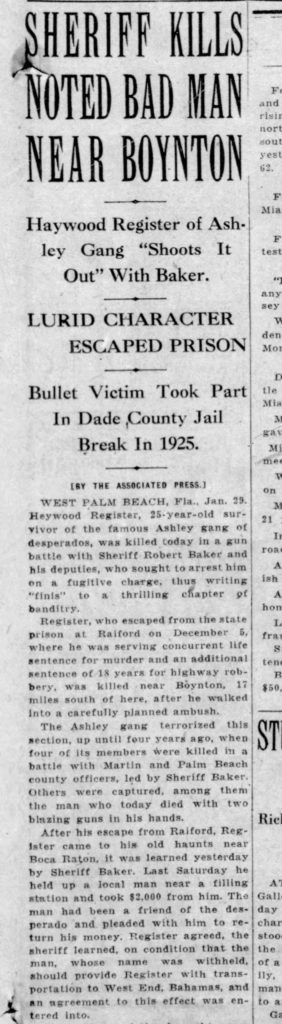
Prison escapee Haywood Register, Ashley Gang leader killed in shootout with Sheriff Baker in Boynton (30 Jan 1929, The Miami Herald)

Haywood Register, the assumed Mobley/Ashley Gang leader who was sentenced to life in the Florida State Prison, escaped and was gunned down along the canal in Boynton by Sheriff Bob Baker. Years later, several Boyntonites described witnessing this event.

1930

Lubby Mosley arrested and jailed on an illegal liquor distribution charge at a moonshine camp.

1933 – February

Sheriff Robert Baker (son of George Baker) died, and the newspaper reported that he died “with his boots on.” William Hiram “Hy” Lawrence, appointed after Baker’s death is another Boynton connection. Lawrence and his brother Red owned Boynton property in the vicinity of today’s Lawrence Road, which is named after them.
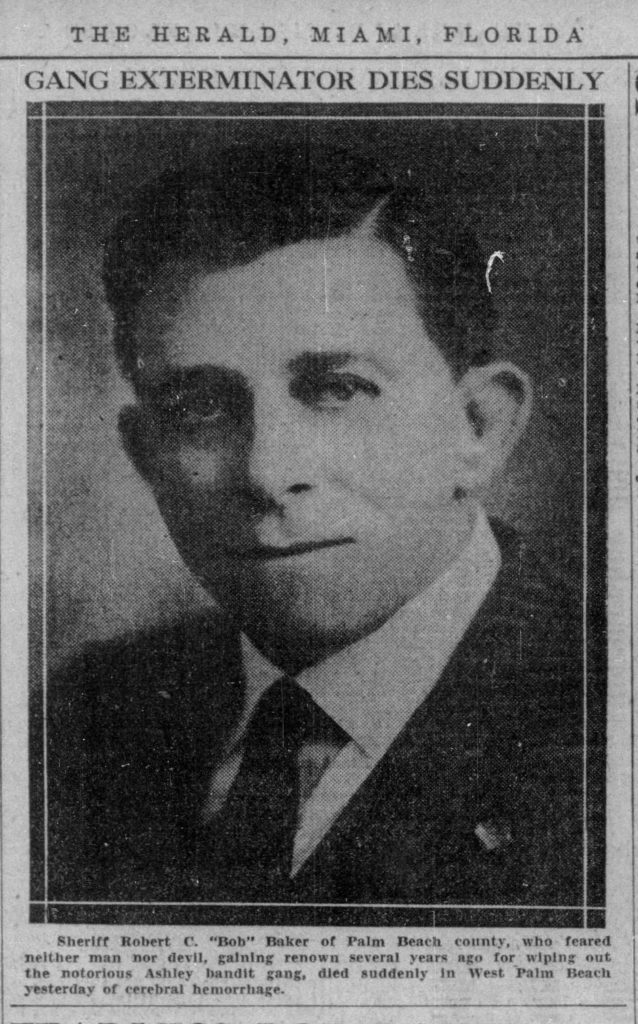
Sheriff Robert C. “Bob” Baker of Palm Beach County (24 Feb 1933, The Miami Herald).

1973

Boynton resident Sam Adams called a local Boynton Beach newspaper,  The Examiner, and told publisher Vernon Lamme that although the Mobley-Ashley gang hid out in Boynton and even robbed the bank that John Ashley was a kindly soul and to remember him as a kind of  “Robin Hood.”

1973
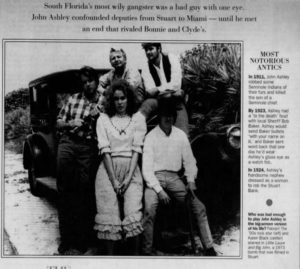
Actors from Little Laura & Big John (1973)


Movie based loosely on the Ashley Gang produced. It is called “Little Laura and Big John.” Reviews are not good.

1980

Glenn Murray, in his 1980 oral history interview, denied claims that he, as a teenager, supplied the Mobley-Ashley gang members with groceries.


1986

Vandals desecrate and loot the Native American Glades people ceremonial mounds north of Boynton Beach Boulevard and west of 441, looking for the legendary treasure stashed by the Ashley gang.

1992

Boynton resident Arris “Ozzie” Lunsford claimed in a 1992 oral history interview that he witnessed the the Palm Beach County sheriff’s office shoot-up  with the getaway car.  Lunsford was  born in 1909, and moved to Boynton at age 14 or 15 (accounts vary). He describes fishing along the Boynton canal and witnessing the sheriff shooting up the Ashley Gang bandit and that he saw him inside the trunk of the car. This account coincides with the January 1929 capture of fugitive Haywood Register.

2021

As we researched this story, we reached out to some Murray family descendants. Ted Murray remembers stories that his great-grandmother Mary Smith Murray was a crack shot, shooting quail and other game. He owns her .38 pistol. He had no recollection of the family’s relationship to the Mobley-Ashley gang, but he wasn’t surprised.

EPILOGUE

What happened to Dorothy Smith Mosley?

Dorothy divorced Lubby Mosley in the 1930s; she married Robert Garner, a mechanic. She is shown on the 1940 Census as living with her parents, husband, and child. The record showed that she had a 4th grade education.

What happened to Lubby Mosley?

Lubby continued his life of crime and was in and out of jail the rest of his life.

What happened to “Uncle Billy” Smith?

Smith, Martin County’s Superintendent of Roads, ironically perished in a head-on automobile collision in 1951 with his daughter Dorothy at the wheel. Newspaper accounts state that the car’s “brakes failed.”

REFERENCES

Lake Worth Herald

Miami Metropolis

Miami News

Palm Beach Post

Sheriff Bob Baker v. the Notorious Ashley Gang

The Ashley Gang – Palm Beach County History Online

The Ashley Gang Landmarks

HISTORICAL VIGNETTES: Guess who took outlaw John Ashley’s glass eye as a key fob memento?

South Florida’s Most Wiley Gangster

The Ashley Gang and Frontier Justice

Florida Outlaws: Move over Bonnie and Clyde
Desperados: The Life and Times of John Ashley

The Notorious Ashley Gang by Sally Ling

Tales of Boynton’s Old Stone Lodge: Death by Electrocution, Rattlesnake, and Double Suicide

A STORIED PAST

Some people might claim the old Boynton restaurant held some type of curse. We know that its proprietors and managers met unnatural deaths. Within eight years, four people perished in three separate incidents on and around the Stone Lodge.

THE STONE LODGE RESTAURANT

The roadside eatery, known as the Stone Lodge, operated from 1924 to 1940 1 1/2 miles south of Boynton’s Ocean Avenue along U.S. 1. The property intersects with the road known today as SE 23rd Avenue. Further west that roadway turns into Golf Road as it continues on to Military Trail past the Village of Golf, Delray Dunes and Country Club Stables.

The lodge occupied the land west of U.S. 1, where the Marathon gas station is today. When the 1920 Federal census enumerators came through Boynton, they counted about 550 people living here, and its residents were primarily laborers, tradesmen and farming and fishing families.

Stone Lodge ad (20 Feb. 1925, The Palm Beach Post)

Stone Lodge ad (20 Feb. 1925, The Palm Beach Post)

Initially, the lodge only operated as a seasonal lunch stand type restaurant, typically open from November through April. Austin Abbot Stone and wife Louisa Jane Turner opened the establishment in 1924. The Stones owned and operated a bakery and rooming house in Massachusetts. They began wintering in Boynton about 1923/24, as did Louisa’s two younger sisters, Grace and Mabel.

MOUTH WATERING HOME COOKING

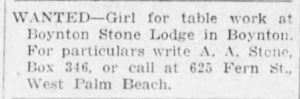
Help Wanted at Boynton Stone Lodge ad (20 Jun 1925, The Palm Beach Post).

Help Wanted at Boynton Stone Lodge ad (20 Jun 1925, The Palm Beach Post).

The Stones served hearty home cooked lunches like ham and alligator pear sandwiches on thick slices of bread that they baked daily. Their chickens supplied plentiful eggs and fresh chicken to be roasted or fried and served to hungry guests. Razor-back hogs, wild turkeys and deer provided other protein. Boynton’s bounty of fish and oysters supplemented the green beans, sweet potatoes, tomatoes and other vegetables from their garden. Freshly squeezed seasonal orange and grapefruit juice and milk from the cows kept on the property washed down delicious desserts like cocoanut cake and huckleberry pie.
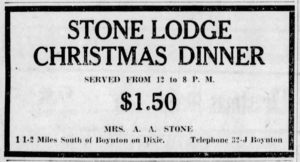
Stone Lodge ad (23 Dec. 1927, The Palm Beach Post)

Stone Lodge ad (23 Dec. 1927, The Palm Beach Post)

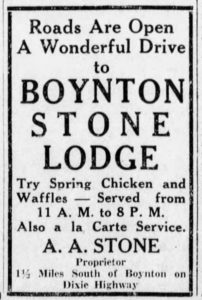
By 1925 the Stones took out Help Wanted ads in the Palm Beach Post seeking kitchen help and tea room attendants. They began advertising their “Chicken and Waffle Dinners” with large ads in The Post, The Lake Worth Herald and Miami News show similar advertisements, and society news columns tell about the lively luncheons, meetings and dinner parties at the Lodge.

HURRICANES

According to news accounts, an unnamed 1926 hurricane shuttered the restaurant for a season Since the Stones only wintered in Boynton, they were not in town during the hurricane season. In 1928, two more hurricanes hit Florida’s east coast, including the devastating “Okeechobee” killer ‘cane.

Ad for Boynton Stone Lodge (16 Apr. 1927, The Palm Beach Post).

Ad for Boynton Stone Lodge (16 Apr. 1927, The Palm Beach Post).

An advertisement for the Stone Lodge Restaurant indicated that the restaurant closed due to road washout and obstruction caused by the hurricanes. Since the rural nature of Boynton at the time considered the isolated place as “in the boonies,” the roadways between Boynton and Delray were likely not a priority for improving.
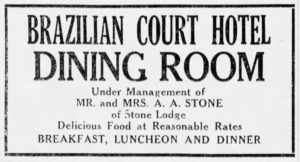
Mr. and Mrs. Stone operating the Brazilian Court Hotel Dining Room (17 Nov. 1928, The Palm Beach Post).

Mr. and Mrs. Stone operating the Brazilian Court Hotel Dining Room (17 Nov. 1928, The Palm Beach Post).

It is unclear if the restaurant itself sustained damage. It’s probably that the enterprising Stones had another couple to manage the Stone Lodge, since in November, 1929 Austin and Louisa Stone were managing The Brazilian Court Dining Room at the swanky boom-time Brazilian Court Apartments in Palm Beach.

The renovated eatery opened in 1929 adding “Fried Chicken and Fish Dinners,” and boasted that it attracted an élite clientele. In other words, it was pricy, and it is likely that more snowbirds and club women dined at the eatery than Boynton locals. There was not much along U.S. 1 in those early years. The 1930 Federal Census shows that Mr. and Mrs. Roland Owens who operated the Lee Manor Inn next to the Boynton Woman’s Club were enumerated as their nearest neighbors to the north.

By the 1930s, one can see that the Depression has set in, and the Stone’s featured “summer specials,” including breakfast, lunch, dinner, homemade cake and pie. The aging, hardworking couple had hired help that probably boarded with them. The establishment’s size is not disclosed in news accounts, however, since the Stones had “boarders” living with them in Massachusetts, the lodge probably served as a temporary home to northern visitors.

DEATH BY ELECTROCUTION

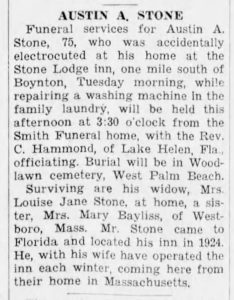
Austin Stone, the Stone Lodge’s namesake, met his demise in the inn’s wash-house in 1932. According to The Post, a family member (probably his wife Louisa) found the unresponsive 74-year-old proprietor on the laundry room floor in a puddle of water, with both hands severely burned.

Death notice for Austin A. Stone, electrocuted at home repairing a washing machine (11 Feb. 1932, The Palm Beach Post).

Death notice for Austin A. Stone, electrocuted at home repairing a washing machine (11 Feb. 1932, The Palm Beach Post).

Mr. Stone had attempted to fix a washing machine while standing in a puddle. Dr. Nat Weems and medics dispatched from Smith Funeral Home in Lake Worth administered mouth-to-mouth resuscitation to the restaurant owner for over an hour with no avail. Dr. Weems listed primary cause of death as electrocution (accidental), and recorded senility as secondary cause.

STOIC MRS. STONE WORKS TO KEEP THE RESTAURANT

During the Great Depression, the widow Stone rented out rooms with board and continued to run the Stone Lodge Restaurant. On the 1935 Florida census, her sister Mabel and brother-in-law Jay Herbert Gould are listed as family members; their occupations are both bakers. Discounted lunches and dinners are once again advertised in The Post. It was what Little Orphan Annie called a “hard-knock life.” Few people had the money to dine out, and those that did, were not spending their time or discretionary income in Boynton.

FOR SALE

After her sister Mabel’s husband died in 1937, Louisa attempted to sell the Lodge, including the house, restaurant and surrounding property. A Palm Beach Post advertisement illustrates that the complex included fully stocked acreage of over three acres, chicken coop and other outbuildings, house, established restaurant with a favorable reputation.

PLEA FOR HELP

As the 1939 season began, Louise again advertised her property, this time with a $5K price tag. On October 30th, the Palm Beach Post ran a wanted ad in which Louise sought a couple to manage the property. It stipulated that the Stone Lodge had an established clientele and had continuously operated for over 14 seasons with the same owner.

PREPARING FOR THANKSGIVING

On November 12, 1939, Louisa Turner Stone awoke early, as usual, and headed out to the Stone Lodge’s chicken coop. Running a restaurant was hard work, and even on a weekend morning, much work had to be done. Thanksgiving and Christmas were approaching, and business at the restaurant was picking up. Earlier in the year, a wild grass fire started at J.J. Williams Fernery had threatened the Stone and Woolbright properties, and severely damaged the Boynton Nurseries. Louisa had recently hired a couple to help her operate the restaurant for the season, and placed prominent advertisements for holiday dinners (this year the fare included roast duck) in The Post. She was probably feeling optimistic, perhaps even excited on that Sunday morning.

TRAGEDY RATTLES BOYNTON

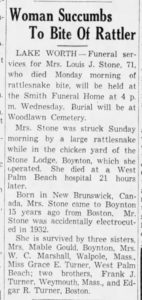
Death notice for Louise J. Turner Stone fatally bit by a rattlesnake (14 Nov. 1939, The Palm Beach Post).

Death notice for Louise J. Turner Stone fatally bit by a rattlesnake (14 Nov. 1939, The Palm Beach Post).

While Louisa was in a chicken yard, a large rattlesnake bit the 71-year-old. Her certificate of death signed by Dr. William Ernest Van Landingham indicates that she died from the rattlesnake bite at 7:00 a.m. the next day at Good Samaritan Hospital in West Palm Beach. Good Samaritan, was the the closest hospital to Boynton in those days. Someone, either the new restaurant manager, or Louisa’s sister Mabel, who served as informant on the death record, drove the victim 17 miles up U.S. 1 to no avail.

BITING BACK

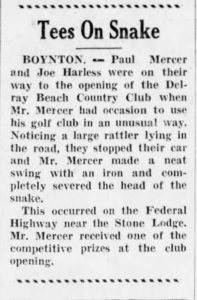
Two days later, Joe Harless and Paul Mercer were motoring down U.S. 1 on their way to the opening of the Delray Beach Country Club. The duo saw a large rattler in the road outside the Stone Lodge. The newspaper article reported that the men stopped the car, and Mercer stepped out and used his golf club to whack the snake and completely sever its head. Whether the rattler was the same one that fatally struck Louisa Stone, we will never know, but on that day one less rattlesnake lived in Boynton.

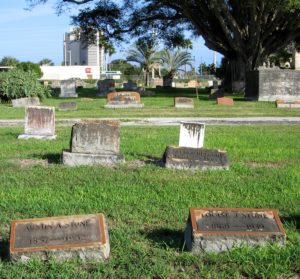
Smith Funeral Home held services for Mrs. Stone. She was laid to rest in Woodlawn Cemetery next to her husband Austin. Their tombstones are in the old section, and one can stay that I have walked amid the Stones many times on our Historic Moonlight Cemetery Tours. Their story, and that of the old Stone Lodge Restaurant will live on through this blog and on the historic tours.

Woodlawn Cemetery, West Palm Beach

Woodlawn Cemetery, West Palm Beach looking east. Pillow headstones for Austin and Louisa Stone are in the forefront.

DOUBLE SUICIDE

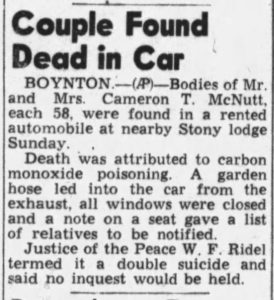
One would think that those two horrendous events at the Stone Lodge proved tragic enough. Unfortunately, there is more to the story. It appears that the restaurant operated through the holidays and the rest of the season, probably under the management of Mabel and the newly hired couple. Then, on April 1st the following year, two bodies were found dead in a car outside the lodge. A garden hose was taped to the car’s exhaust and run inside the window. Justice of the Peace W.F. Ridel determined it a double suicide.

Former Ringling Brothers performers commit double suicide in car outside Boynton eatery (1 April 1940, Tampa Bay Times)

Former Ringling Brothers performers commit double suicide in car outside Boynton eatery (1 April 1940, Tampa Bay Times)


The Palm Beach Post reported former vaudeville and Ringling Brother’s Circus performers Joseph and Laura Cameron McNutt who had managed the Stone Lodge committed a double suicide. The married couple left two notes in the car, one indicating that they should be cremated, and another saying that the car was rented.

In July, 1941 The Post published an ad offering the Stone complex and property for $5K. Augustus Robinson from Hartford, Connecticut purchased the property, Robinson also bought adjacent properties and filed a plat for his subdivision in 1951.

If you have any memories, tales or photos of the old Stone Lodge, we’d love to see/hear more about the establishment.

Palm Beach County’s First Automobiles

1905 – Florida requires automobile registration

Florida Memory - Early Auto Registrations, 1905-1917

Florida Memory – Early Auto Registrations, 1905-1917

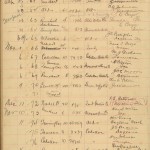
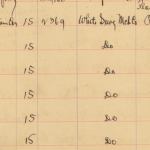
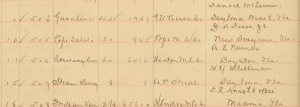
In 2015, the State Archives of Florida digitized the first two volumes of motor vehicle registrations recorded by the Florida Department of State. These ledger pages, found online at Florida Memory, Found Here contain detailed information recorded between 1905 and 1917 about our earliest vehicles, including the registered owner, city, county, make, model and horsepower of each automobile and motorcycle.

George Potter

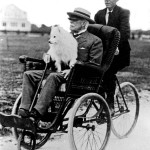
George W. Potter was the first person in this part of the state (Palm Beach County) to legally register his automobile with the state.

George Potter, courtesy Potter Collection, Historical Society of Palm Beach County

George Potter, courtesy Potter Collection, Historical Society of Palm Beach County

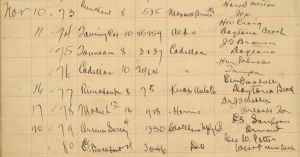
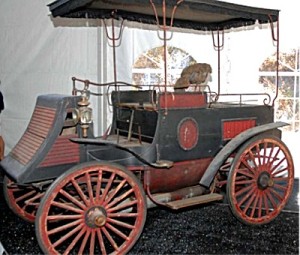
Other horseless carriages were dotting the sandy roads, but Potter’s registration of a lightweight, four-horsepower Orient Buckboard, recorded November 20, 1905, was the 80th registered vehicle in the entire state of Florida. Before moving to Florida, Potter studied art and engineering in Cincinnati. His great grandson, David Willson, cartoonist for the Palm Beach Daily News, recounts how you could tell Potter had a fascination with all things mechanical as his sketches were filled with bridges and steam boats.

Record #80 Geo. W. Potter Nov. 20, 1905 vehicle registration

Record #80
Geo. W. Potter Nov. 20, 1905 vehicle registration

Waltham Manufacturing Company was a manufacturer of automobiles in Waltham, Massachusetts, including the Orient Buckboard, between 1902 and 1908

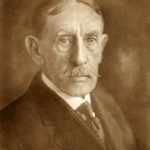
Henry M. Flagler

Henry M. Flagler, courtesy Library of Congress

Henry M. Flagler, courtesy Library of Congress

Henry Morrison Flagler registered his vehicle on December 6, 1905, a few weeks after Potter. Local history sources contend that Flagler did not allow motorized vehicles on his luxury island resort at Palm Beach, instead preferring guests to traverse through the gardens and jungle trials via wicker rickshaw bicycles, powered by Negro guides.
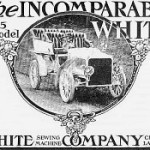
White Auto Co. 1905

White Auto Co. 1905


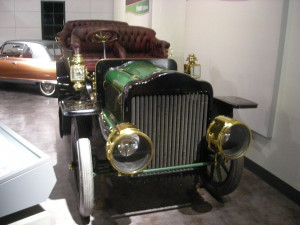
Flagler’s vehicle, listed as a Touring Car manufactured by White Sew’g Mch. Co. (White Sewing Machine Co./White Motor Co.) operated on steam, hence the vehicle was not a noisy as other autos of the time. Presidents William Taft and Theodore Roosevelt also owned White Motor Company automobiles during this time period.

Florida East Coast Hotel Automobile Registrations

Florida East Coast Hotel Automobile Registrations


Florida East Coast Hotel System

The vehicle must have served Flagler well, for in the next few months his Florida East Coast Hotel system purchased and registered five additional identical touring cars.

1907 White Touring Steam Car, courtesy Henry Ford Museum

1907 White Touring Steam Car, courtesy Henry Ford Museum

Boynton Hotel Company President A.E. Parker

A. E. Parker Touring Car Record

A. E. Parker Touring Car Record

In January 1908, Albert Edward Parker, manager of the Boynton oceanfront hotel and son-in-law of hotel owner Maj. Nathan Smith Boynton, registered his 30-horsepower Winton M.C. Co. Touring Car. Parker conducted business in both West Palm Beach and Miami, and likely used the old, bumpy sand trail to traverse the county for business purposes and to take hotel guests on sight-seeing tours.
Winton Motor Carriage Car

Winton Motor Carriage Car


1908 – 500 registered vehicles in Florida

By 1908, 500 vehicles were registered in the state of Florida.


2016 – Over 20,000,000 registered vehicles in Florida

Currently, there are over twenty million vehicles registered in Florida, with 1.2 million in Palm Beach County.

Vehicles registered in the State of Florida as of February 5, 2016

DRIVE SAFE!

Frozen in Time

Last week an envelope of late 1950s/early 1960s photographs arrived in our mailbox. The lovely 8″ by 10″ photographs were taken by popular lens man Stan Sheets. While Mr. Sheets took photographs for the Boynton Star, the Palm Beach Post and other local newspapers, he also captured street scenes of mid twentieth century Boynton Beach. His foresight to photograph everyday street scenes and share his images with friends and neighbors (in this case friend Charles Cassell), allows us to look back and see the charm of our town a half century ago.

Most of the photographs are not labeled, but careful scrutiny of the foreground, background, and other details give clues to the place and the date of the images, now frozen in time.

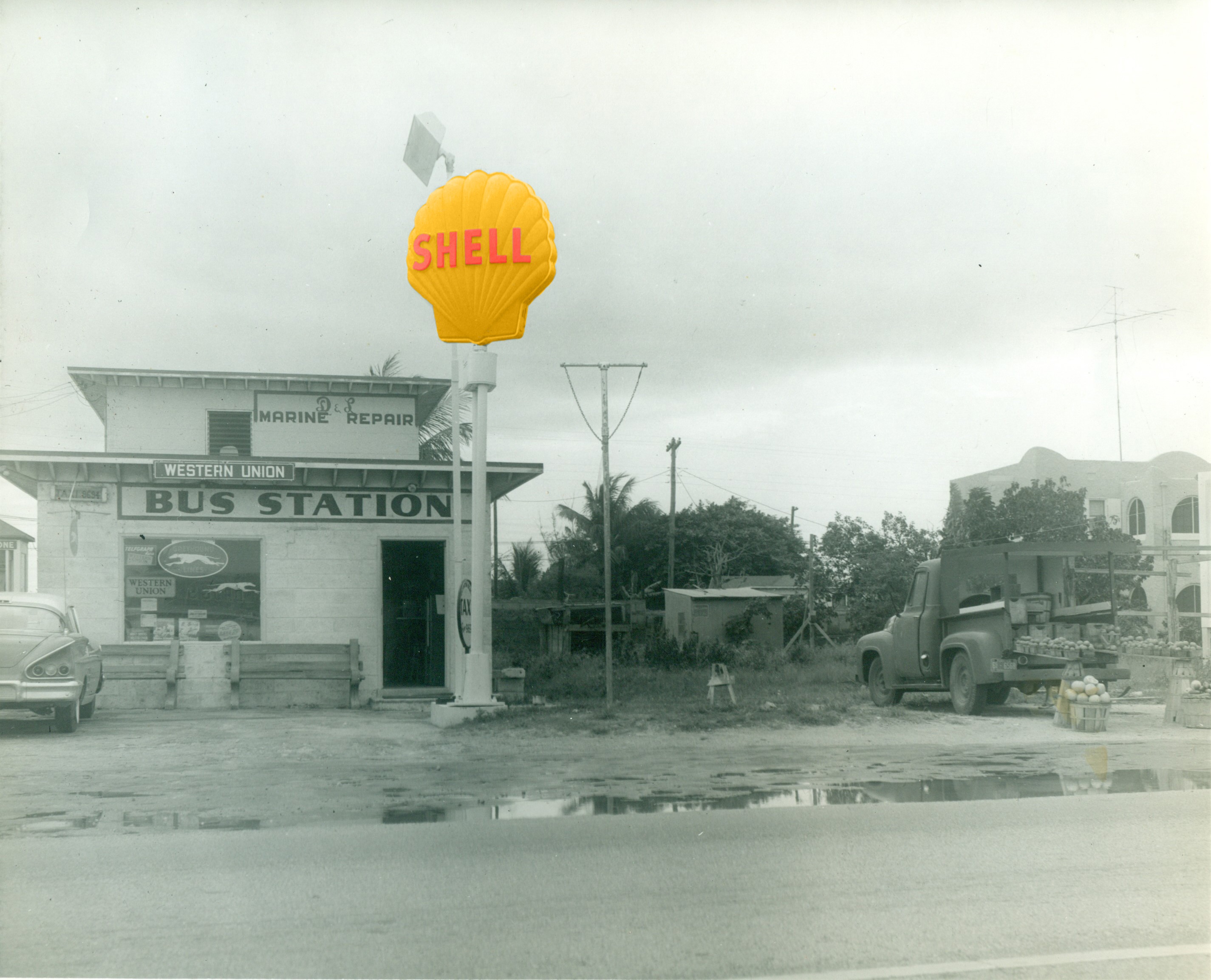
Photograph of Boynton Greyhound Lines Bus Station by Stan Sheets. Donated by Faith Cyr. Colorized by Ginger Pedersen.

Photograph of Boynton Greyhound Lines Bus Station by Stan Sheets. Donated by Faith Cyr. Colorized by Ginger Pedersen.

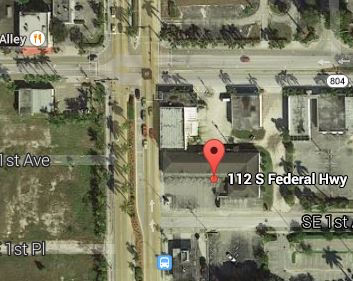
My favorite photograph is of the Greyhound Lines Bus Station. According to the 1959 Polk City Directory the bus station was located at 112 S. Federal Highway on the east side of Federal Highway about a block south of Ocean Avenue. What I find most amazing about this image is the details it captures.

Google Map of 112 S. Federal Highway today

Google Map of 112 S. Federal Highway today

Look closely, and you will see that not only did this structure serve as the bus terminal; it played an important role in communication and transportation, two vital components of our town’s infrastructure.

Note the two benches outside the station, for waiting for the bus. Imagine how many people rested there over the years, perhaps to leave for college in Tallahassee or visit relatives in the north.  Picture the moms and dads tearfully waving white handkerchiefs as the buses pulled away. The station had a Western Union Telegraph Office, where you could send a telegram announcing you had arrived. “ARRIVED IN BOYNTON SAFELY STOP MISS YOU ALREADY STOP LOVE PATSY”

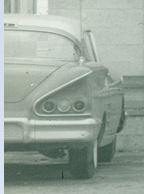
1958 Chevrolet Impala

1958 Chevrolet Impala

The telephone number for the local taxicab (9694) is displayed outside the station, and I spy a telephone booth in the far left of the frame, behind the 1958 Chevy Impala.

Try peering into the open door.  Barely visible inside is an old Coca Cola machine. The 6 oz. bottles of Coke from the vending machine likely cost 10 cents by 1960. The empty bottles fetched a 2-cent return value. The bus station probably sold many of those 10-cent cokes in the summer, as the station had no air conditioning. The structure had jalousie windows and the door is open to let in a breath of air.

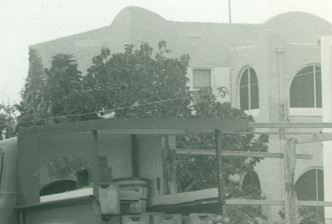
This home once belonged to the Joseph Kolendo family

This home once belonged to the Joseph Kolendo family

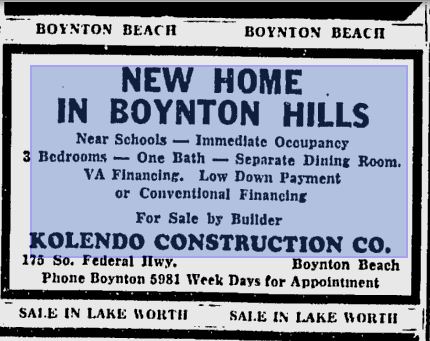
The house to the right of the frame once belonged to the Kolendo family. Joseph Kolendo, a building developer, was responsible for developing many of the single-family homes in Boynton in the 1950s.

Advertisement for Kolendo Construction Company from 1955 Palm Beach Post.

Advertisement for Kolendo Construction Company from 1955 Palm Beach Post.


The house has a huge television antenna. Those were the days before cable TV, satellite dishes, or WiFi. The television was likely a black and white console with only a few TV stations reached by dial, probably WTHS, channel 2,WJNO, channel 5, WEAT, channel 12, WIRK, channel 21.

1950s logo of WPTV News Channel 5 NBC affiliate

1950s logo of WPTV News Channel 5 NBC affiliate

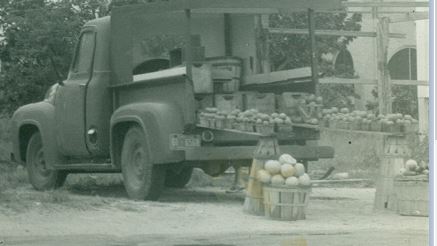
What is curious about the photo is the roadside citrus stand. An old pickup truck with a makeshift stand is peddling grapefruit and oranges.

Roadside citrus stand

Roadside citrus stand

Behind the truck are several lean-to’s or storage sheds with an assortment of old junkyard type objects lying about.

Children's toys and other items piles atop the structures next to the bus station

Children’s toys and other items piles atop the structures next to the bus station

I spy a child’s old rusted tricycle on top of the haphazard pile. I guess the city didn’t have code enforcement in those days.

(Update: Wayne Kolendo tells us the small building with the tricyle, bike wheels and other items housed his bicycle repair/building shop. Kolendo was a mechanical entrepreneur during his high school years.).

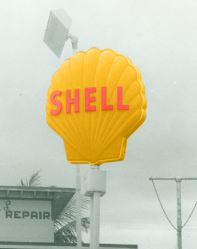
While no gas pumps are visible, one can’t miss the iconic yellow and red Shell Oil Company sign with the 1955 emblem. Using modern day magic, the original photograph by Stan Sheets is again glowing brightly.

1955 Sign for Shell Oil Company

1955 Sign for Shell Oil Company

Next time you come across some old pictures, send them to us. You might see some of them featured here!

*If any readers know Mr. Sheets, please let him know we are interested in talking to him, and thanking him for capturing and preserving our history.

(8/21/14 update) We learned Stan Sheets left us in 2005. We are working with his family to honor him for his community support and for chronicling Boynton history.

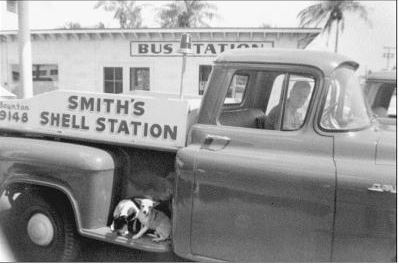
We also found another photo of the bus station/Shell Station.

Jim Smith, owner of Smith's Shell Station in his truck. (Photo courtesy Wendy Smith Franklin)

Jim Smith, owner of Smith’s Shell Station in his truck. (Photo courtesy Wendy Smith Franklin)

Special thanks to:

  • Faith Cyr
  • Wendy Smith Franklin
  • Debra Kolendo
  • Ginger Pedersen
  • Stan Sheets
  • Historic Boynton Beach Facebook Fans

References for this story:

  • Car Gurus. http://www.cargurus.com/Cars/1958-Chevrolet-Impala-Pictures-c4308
  • Florida Television History. http://rogersimmons.com/florida-television-history/
  • GoogleMaps. https://www.google.com/#q=112+S+Federal+Hwy%2C+Boynton+Beach%2C+FL
  • Palm Beach Post
  • Polk City Directory
  • Shell Oil Company. http://www.shell.com/global/aboutshell/who-we-are/our-history/history-of-pecten.html
  • History of Coca Cola. http://www.worldofcoca-cola.com/coca-cola-facts/coca-cola-history/


Jungle Fire: History of Boynton Beach Fire Rescue

For this blog we are pleased to have a another Boynton Beach Fire Department history installment from our resident guest blogger, Michael Landress of the Boynton Beach Fire Department

An interesting early morning structure fire during the late 1940s occurred at a tiny pub called the Jungle Inn Bar located in Briny Breezes. The inn was a popular drinkery owned and op…erated by a man called “Biggin” Baskin — aptly named due to his mountainous size.

The fire began as an unattended barbeque pit that was used inside the tavern collapsed in the wee hours of the morning, sending smoldering coals crashing to the ground. The unabated embers ignited the wooden floorboards and flames quickly rolled up the walls.

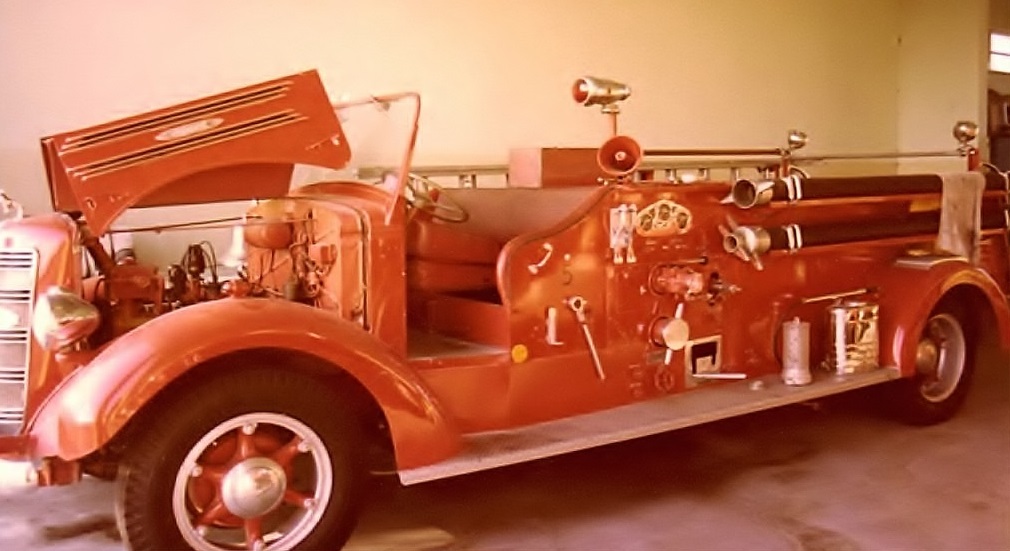
This 1946 Mack 500 GPM Piston Pumper is the truck used during the Jungle Inn Bar fire. The fire engine would prove its worth, as it was still in service in our department during the 1970s

This 1946 Mack 500 GPM Piston Pumper is the truck used during the Jungle Inn Bar fire. The fire engine would prove its worth, as it was still in service in our department during the 1970s

The department had recently purchased a 1946 Mack 500 GPM piston pumper and Boynton firemen responded to the blaze with the new engine. On arrival, they found the inn totally insulted by fire. They staged the fire engine parallel to the tangled mangroves and Intracoastal Waterway (ICW) in hopes of drafting water, as hydrants were few, or non existent.

In the chaos that ensued, the weary operator engineer [driver] stood aghast at the pump panel. Scratching his head in disbelief, he had forgotten the sequence for pumping. Fireman James I. Lacey then stepped up to the panel and quickly engaged the pump. As other firemen began to pull multiple sections of hose and nozzles from the engine, James deployed the hard suction, complete with strainer into the saltwater, thus beginning the drafting process.

They valiantly battled the blaze until dawn.

“It was saltwater, but it was wet. We pumped water until daybreak and finally extinguished the fire. It was a good thing because we noticed that our drafting hose and strainer were dangling in mid air. The water level had dropped considerably. We thought that we had drained the canal until we realized it was an outgoing tide! We all enjoyed a hearty laugh.”

~ Fireman Lacey

Michael Landress

Michael Landress

Michael Landress is a native Floridian and novice historian. He has spent the previous 15 years as a professional firefighter/paramedic for the City of Boynton Beach Fire Rescue Department. He holds a BA from St. Thomas University in Miami, Florida and his hobbies include; spending time with his two teenage sons, writing, photography, supporting the Miami Dolphins and saltwater fishing.